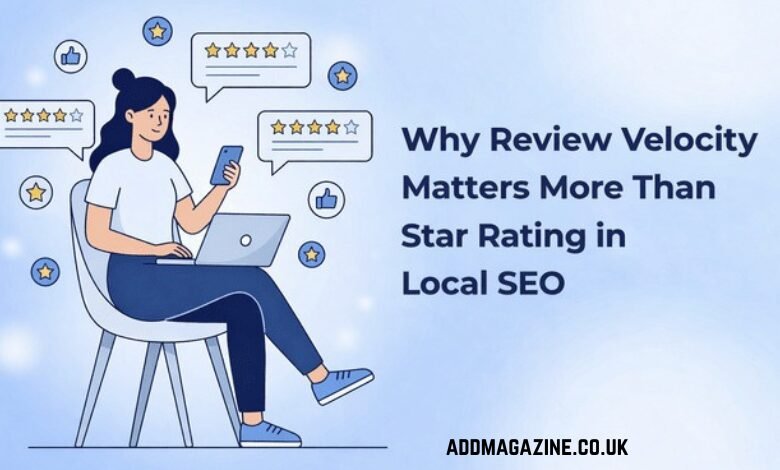
Let’s suppose you’re searching for a dentist in your city. You find two options in the Google Maps local pack. The first has 4.9 stars and 312 reviews, but the last review was posted 14 months ago. The second has 4.6 stars and 89 reviews, with 11 new reviews just from this month. Which one feels more trustworthy? Most people pick the second one. And here’s the thing: Google does too. Why Review Velocity Matters becomes obvious in this exact scenario: because how frequently you earn new reviews signals that your business is active, relevant, and consistently delivering value.
That is exactly why review velocity is important in local SEO, and why obsessing over your star rating while ignoring how consistently you are earning reviews is one of the most costly mistakes local business owners make.
Understanding Review Velocity and Recency
What Is Review Velocity?
Review velocity is the rate at which your business earns new reviews over time. It is the speed and consistency of your review growth. Not a burst. A rhythm.
The specific number matters less than the pattern. A steady flow of customer reviews signals to Google that your business is active and relevant right now, not just two years ago when you ran a one-time campaign.
You can have 800 reviews and terrible velocity if they all came in during a single push years back. Or you can have 60 reviews and excellent velocity if you are consistently getting 4 to 6 new ones every month.
Freshness is baked into how Google evaluates local relevance. A business that was great in 2022 may have changed ownership, declined in quality, or closed.
Fresh reviews tell Google that your business is still operating and still delivering today.
Review freshness is one of the most underrated ranking factors in local SEO. When someone searches for a plumber at 9pm on a Tuesday, Google wants to show them businesses trusted by customers who visited recently.
An old batch of glowing reviews simply cannot compete with consistent, recent social proof.
The Connection Between Review Velocity and Recency
These two concepts are inseparable. Velocity creates recency. If your review acquisition strategy is working, you will always have fresh reviews.
Stop asking for six months, and your recency drops, along with the trust signal your Google Business Profile sends to the algorithm.
Think of it like a heartbeat. Consistent rhythm means the business is alive. A flatline, even after a strong start, is a red flag.
If your review profile has gone cold, a professional review service like ReviewGrow can help you rebuild momentum fast
How Google Uses Review Activity in Local Rankings
How Google’s Local Algorithm Interprets Review Signals
Google’s local algorithm evaluates three core pillars: relevance, distance, and prominence. Review signals sit under prominence.
Google factors in total volume, average rating, recency, keyword presence in review text, and diversity of review sources.
To simplify how Google calculates local prominence, think of it this way:
P (Prominence) = (V + R) x Q
Where V = Velocity, R = Recency, and Q = Quality/Sentiment.
This is not an official Google formula, but it reflects how these signals interact. A high star rating alone (Q) without ongoing velocity (V) and fresh recency (R) produces a much weaker prominence score than a profile that is strong across all three.
The Impact of Review Velocity on Google Business Profile Rankings
Consistent review activity tells Google that your business is generating real, ongoing customer engagement. This is a relevance signal, not just a social proof signal.
Businesses with strong review velocity SEO tend to hold higher Google Maps local pack positions because they are constantly refreshing their prominence. It is a compounding advantage that builds month after month.
Review Velocity and the Google Maps Local Pack
The local pack, those three listings that dominate local search results above organic results, is prime real estate. I have seen businesses with a 4.3 star average outrank competitors at 4.8 stars simply because their review growth rate was stronger and more consistent.
Google is not a Yelp list sorted by stars. It is a relevance engine. Recent activity is a relevance signal.
Why Review Velocity Matters for SEO Performance
Freshness, Trust, and Competitive Benchmarking
Search engines reward freshness across the board. The importance of review frequency is that it keeps your local SEO signals current and hard to overtake.
There is also a trust angle most people overlook. A suspiciously perfect 5.0 score with all reviews bunched in a two-week window raises red flags for Google and for real users. A 4.5 average with reviews trickling in every week feels earned. Spread-out, organic review acquisition is not just better for SEO. It is better for conversion.
Finally, if your top competitor earns 15 reviews per month and you earn 2, you are falling behind regardless of your star rating. Understanding your Google review growth rate relative to local competitors is essential context for your strategy.
Impact on User Behavior and Click-Through Rates
Users scan local search results in seconds. After your star rating, the next thing they notice is how recent your reviews are. A Google Business Profile showing “2 weeks ago” and “1 month ago” communicates that real customers are actively choosing you right now. That is social proof in real time.
Click-through rate is a local SEO signal in itself. Fresh reviews increase CTR because they make your listing look active and trustworthy at a glance. In my experience managing local SEO for clients, a consistent review cadence improves CTR noticeably within two to three months, without changing anything else about the listing.
Healthy vs. Unhealthy Review Velocity
Signs of Unnatural Review Growth
If you get 50 reviews in a single weekend after years of silence, that is a problem. Google’s algorithm is built to detect anomalies. Watch for these warning signs:
- Sudden spikes with no gradual buildup
- Reviews from accounts with no prior activity
- Multiple reviews from the same device or IP
- Templated or suspiciously similar review language
Risks of Penalties and Filtering
Google actively filters reviews it considers inauthentic. Filtered reviews disappear from your count and your rating calculation.
Repeated violations can get your Google Business Profile flagged or suspended. Increasing online reviews consistently through legitimate means is not just ethical.
Industry Benchmarks for Review Velocity
Here is a practical reference point for how often to get customer reviews by industry:
| Industry | Target Monthly Reviews | SEO Impact |
| Restaurants / Retail | 10 to 20+ | High (Volume-Based) |
| Medical / Dental | 4 to 8 | Very High (Trust-Based) |
| Home Services | 3 to 6 | High (Recency-Based) |
| B2B / Professional | 1 to 3 | Moderate |
The goal is consistent review activity, not chasing a magic number.
Strategies to Build and Maintain Consistent Review Velocity
Creating a Systematic Review Request Process
The number one reason businesses have poor review velocity is that they rely on spontaneous reviews. Some customers will leave them without prompting. Most will not, even after a great experience. You need a system.
Identify the right moment to ask (immediately after a positive experience), train staff to mention it verbally, and follow up with an automated text or email within 24 hours.
Timing, Frequency, and Leveraging Existing Customers
Ask at the peak of satisfaction, not a week later. Ask every eligible customer, every time, not just the ones you think are happy.
Your existing customer database is also an untapped goldmine. A simple honest re-engagement email asking for feedback can give your velocity an immediate lift. Do not offer incentives. Google prohibits it, and it creates authenticity problems that can backfire.
Best Review Management Services for Local SEO
Some tools send review requests automatically after a transaction. This removes the human inconsistency from the equation and makes your velocity a function of your customer volume.
Google Business Profile itself also lets you generate a direct review link you can share anywhere, from your email signature to a QR code on your receipts, which is completely free and surprisingly effective.
Leveraging Reviews for Ongoing SEO and Engagement
Responding to Reviews and Using Them as Relevance Signals
Responding to every review, positive and negative, signals active profile management to Google. When you respond, use natural language and occasionally include your service type and city. This adds semantic relevance without being spammy.
The text inside your reviews is also indexed by Google. When customers mention your services, your location, and specific outcomes, it reinforces your profile’s relevance for related searches in a way you simply cannot manufacture yourself.
Analyzing and Monitoring Review Performance
Tools to Track Review Velocity and Turn Data Into Improvements
At minimum, track your monthly review volume, average rating trend, response rate, and how your velocity compares to your top three local competitors.
Google Business Profile Insights gives you baseline data for free. Whatever tool you use, the goal is to spot drops early before they affect your rankings.
If velocity drops, go back to your request process first. Did you stop asking? Did your automation break? The data should guide the fix.
Future Trends in Review Velocity and Local SEO
Google is moving in a few clear directions that every local business should know about:
- Multimedia Reviews: Photo and video reviews are weighted more heavily because they are harder to fake. Encourage customers to add photos.
- Smarter Spam Detection: Google’s ability to catch fake and incentivized reviews is improving every year. Organic, consistent review acquisition is the only strategy that holds up long term.
- Predictive Local SEO: As AI-powered search matures, review patterns may influence rankings before a user even finishes typing. Businesses with strong velocity will be better positioned in this environment.
Final Take
A high star rating is nice to have. But it is not enough to dominate local search in a competitive market. What drives sustained local SEO performance is review velocity: a consistent, ongoing flow of genuine customer feedback that tells Google your business is active, relevant, and trusted right now.
If you have been coasting on an old batch of good reviews, it is time to build a real review acquisition strategy. Ask systematically. Respond consistently. Track your velocity monthly.
This is not complicated. It is just consistent. And in local SEO, consistency beats intensity every single time.
FAQs
How many reviews per month do I need to improve my local SEO?
For most local businesses, 4 to 10 new reviews per month consistently will outperform competitors with stagnant profiles. The key is regularity, not volume.
Does Google care more about review quantity or quality?
Both matter, but recency and consistency often have a stronger impact than a perfect score. A business with recent 4.4-star reviews can outrank one with a 4.9 rating that hasn’t been updated in months.
Can I ask customers for reviews without violating Google’s policies?
However, you must not offer incentives, filter only positive reviewers, or use fake review services. A genuine and consistent approach is fully compliant.
What is the best way to increase review velocity quickly?
Start with your existing customers. Send a simple, honest email asking for feedback, implement automation tools like Podium or Birdeye, and train staff to ask in person. These steps alone can significantly increase review velocity within a month.
How does review velocity affect my position in the Google Maps local pack?
Review velocity influences the prominence factor in Google Business Profile rankings. Businesses with a steady flow of new reviews tend to maintain stronger positions in the local pack over time.
What happens if I get a sudden spike of negative reviews?
First, flag any fake or policy-violating reviews through Google. Then respond professionally to legitimate ones. Finally, focus on generating new positive reviews consistently to rebalance your profile and restore trust over time.
How long does it take for new reviews to impact local SEO rankings?
New reviews can start influencing visibility within a few days to a few weeks, depending on your competition and overall activity. Consistent review velocity over time has a stronger and more lasting impact than short-term spikes.
Should I focus on getting reviews on Google or other platforms too?
Google Business Profile should be your top priority for local SEO, as it directly affects map rankings. However, building reviews on platforms like Yelp or Trustpilot helps strengthen your overall online reputation and trust.
Can removing negative reviews improve my ranking?
Not necessarily. While removing fake or policy-violating reviews can help, having a natural mix of positive and negative feedback actually builds credibility. Google values authenticity, so a steady flow of recent, genuine reviews is more beneficial than trying to maintain a perfect rating.