Brief Overview
This paper throws light on the evolution of the financial environment in the UK capital city, exploring how principal financial representatives, Tax Accountants London (TAL), are implementing innovative technology solutions to streamline and vitalise the Personal Tax Account (PTA) system operated by HMRC. Instead of being reluctant (and consequently mistaken in tax filing and changes), those professionals are proactive in their approach to data (consequently precise, secure, and helpful in today’s complicated tax world).
Introduction
The latest advice and guidance from the UK government is to turn digital, so having the expertise to know how and the technologically advanced capabilities are crucial to achieving financial success. For the average tax filer, the HMRC Personal Tax Account is more than a simple log-in from time to time, but rather a living, breathing account of data that requires careful handling.
By understanding that their role is to focus more than just “keeping the accounts,” tax accountants who have been the most successful in the city realise that they are relevant in other ways. It’s not just about suitability and ease; all of the available tax breaks that can be claimed using technology, and compatibility can be managed long before the issue arises.
Filling the gaps with cloud accounting.
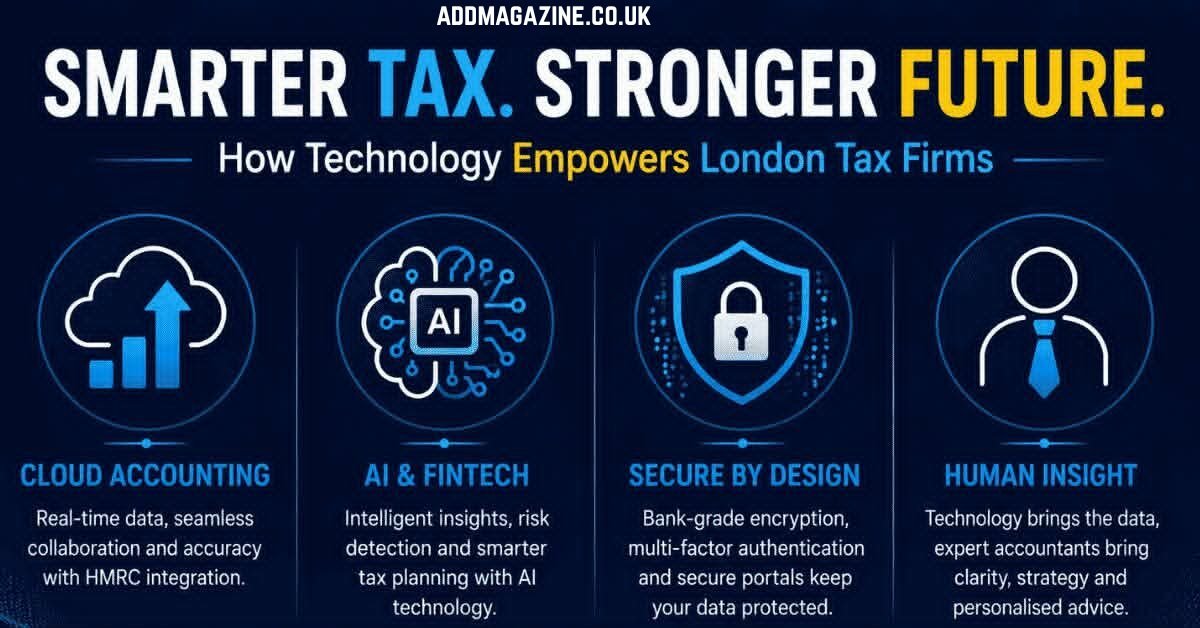
Manual accounting does not offer enough flexibility for today’s London atmosphere. With the advent of cloud platforms in accounting, there has been a change in the way a client and an advisor cooperate. No more waiting weeks for a client to be able to reconcile their account without the need to log on to their cloud accounting software: they can use the software to reconcile in real-time, comparing account data with the HMRC Personal Tax Account of their client.
By connecting this digitally, the taxpayer can be certain that the estimated income tax that he/she sees will also be validated while he/she is seeing the National Insurance. This is a digital bridge where the lack of administrative “noise” makes the portal look as if it were a personal financial health dashboard for someone who is working very hard and never idle in the City.
Artificial Intelligence in Fintech
London would be among the biggest in the world in comparison to Fintech. When it comes to tax advising, London Tax Accountants leverage AI as part of their audit process to identify anything questionable, which could attract HMRC’s attention. The software will be used to compare many transactions made by a customer to the current laws in the UK in relation to taxes.
With the help of AI algorithms, tax planners will be able to forecast tax liabilities according to spending. It is beneficial to individuals who make cash from more than one source, such as those who have a tax account, which can offer them insight into a number of numbers which may be confusing.
The Software Behind the Fortress: Security, the Software.
Tax data is susceptible to phishing and identity fraud attacks. Many of London’s most trusted businesses have undertaken steps to dissuade reliance on old mail and move to client portals that offer the same encryption features that banks provide.
This results in a Digital fortress as data will be sent and stored. These firms typically have to perform multi-factor authentication and make secure connections with APIs to gain access to the HMRC Personal Tax Account and protect the financial ID of the individual from cybercrime assaults.
The Person with Human Insight in the Automation Age.
No “tech tools.” The program will instruct you on how to do something, and the accountant will spell out the why. Relationships with residence, capital gains or a High Income Child Benefit Charge can only be resolved with human insight, which isn’t possible with technology.
London Tax Accountants make use of technology to save them from data entry and help them to become consultants. They derive meaning from the data in the government’s databases to form a personal plan for the future. The purpose today isn’t to complete the tax return; the purpose is towards maximizing the finances.
Staff members are breaking through the portal: New Questions for a New Era
My accountant sees my data in my HMRC data portal. How does this work?
Your advisor has access to your record via “Agent Dedicated Lines” and digital authorisation. They don’t see your logon page to the HMRC site, but by using the right software, they can access the same data that has been given to the government.
Is it possible to use AI with multiple income streams?
AI is adept at “pattern matching.” If you have rental income, dividends and a salary, it will automatically categorise each of those income streams in the right place on your tax return form.
Is it my fault or the technology’s fault if it screws up on my tax return filing?
Finally, it’s your responsibility, as the taxpayer, to return the computer – “human in the loop” is important. My accountant effectively utilizes this software while also manually reviewing calculations to ensure no errors stem from specific transactions
Does HMRC need to know that persons are on a Personal Tax Account?
It doesn’t have to be a requirement, but it certainly helps in dealing with HMRC. One only foregoes either the adequate time for a refund or a notice if one refuses. Unlike the space program, this isn’t rocket science; it’s a trusted accountant who can help get there.
How do Real Time Data influence the decisions (plans) I make?
With real-time data, one won’t know about their tax until the post-tax year. Your bank account information has been provided to update your finances, so the accountant will let you know how much money you have to save per month for taxation.