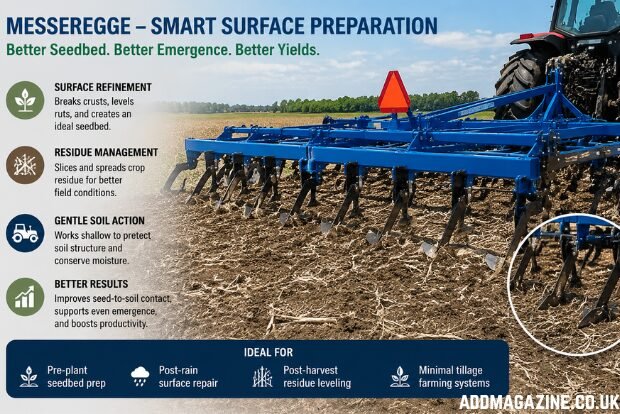
In agricultural practice, even minor surface imperfections can influence crop development. After rainfall, soil may develop a firm top crust, leftover plant residues may remain uneven, and faint wheel tracks can create small depressions. While these issues may seem minor, they can hinder proper seed placement during planting. Seeds that lack good soil contact germinate unevenly, affecting crop uniformity and yield.
The Messeregge addresses these challenges. Its design emphasizes shallow, precise work, targeting only the surface without disturbing the soil beneath. Unlike traditional deep tillage equipment, the Messeregge focuses on refining the seedbed rather than overturning the soil.
Etymology and Function
The term “Messeregge” originates from German, combining Messer (knife) and Egge (harrow), which literally translates to “knife harrow.” This name reflects the tool’s primary mechanism: a series of knife-like blades arranged to interact with the soil surface. Its objective is simple: improve surface conditions while preserving the soil structure below.
Messeregge implements are generally shallow tillage tools. They target the upper few centimeters of the soil profile to resolve problems such as hardened crust, uneven residues, and small surface ruts. By focusing on the top layer, the Messeregge prepares a seedbed efficiently without the downsides associated with deep soil mixing, such as moisture loss or erosion.
Relevance in Modern Farming
Modern agricultural methods emphasize minimal soil disturbance. Techniques like conservation farming, reduced tillage, and residue retention prioritize soil health while maintaining productivity. Messeregge tools align well with these strategies. Farmers can prepare clean seedbeds without disrupting soil structure, conserving moisture, and maintaining surface residue that protects the soil.
Its role in modern systems is to create a more uniform and workable surface. A smooth top layer facilitates even seeding, promotes consistent emergence, and supports the early growth of crops. This makes the Messeregge particularly valuable for precision agriculture, where minor variations in seed placement can have large cumulative effects on yield.
Core Tasks
The Messeregge primarily improves the soil’s surface condition. Its main tasks include:
- Crust Breaking: Hard, dry layers on the soil surface can inhibit water infiltration and seedling emergence. The Messeregge slices through these layers without disturbing deeper soil, improving aeration and water absorption.
- Residue Management: Leftover plant material from harvest or cover crops often remains on the field surface and requires proper handling. The tool cuts and distributes this material evenly, preventing clumping while preserving the protective benefits of surface residue.
- Surface Leveling: Minor depressions, wheel tracks, and rough patches hinder planter efficiency. By leveling these irregularities, the Messeregge creates a consistent seedbed depth.
Design and Mechanism
Messeregge tools rely on rows of steel blades set in staggered arrangements across a robust frame. These blades are flat or slightly curved, with some models offering serrations. Unlike deep tillage implements, the working depth remains shallow, typically ranging from 1 to 5 centimeters.
Adjustable blade angles enhance versatility. Steeper angles increase cutting and crust-breaking action, whereas shallower angles provide gentle surface grooming. Operators also consider forward speed, typically 8 to 15 kilometers per hour, to optimize residue cutting and crust management without soil smearing.
Key Components
A Messeregge consists of several important parts:
- Frame: The backbone of the implement, supporting blade arrangement and maintaining stability. Some frames fold for transport.
- Blades/Knives: The working parts that engage the soil directly, cutting through residues, loosening crusts, and refining the top layer. Blade type affects performance and residue handling.
- Mounting System: Can be attached at the front, via a three-point hitch, or integrated with rollers or drill combinations for versatile operation. This choice affects tractor compatibility and operational flexibility.
- Rollers: Optional components that finish and firm the soil surface post-blade action, enhancing smoothness and seed-to-soil contact.
- Adjustable Controls: Manual or hydraulic systems allow customization of blade angle, pressure, and depth to match field conditions.
Optimal Usage
The Messeregge excels in specific scenarios:
- Pre-planting surface finishing: After primary tillage, the top layer may still require leveling or residue management. Messeregge offers a gentle pass to create uniform conditions.
- Post-rain crust management: Rainfall often hardens the soil surface, creating a compact layer that can hinder seedling emergence. Shallow passes with the Messeregge reopen the surface without excessive disturbance.
- Residue-friendly systems: In conservation or cover crop systems, it slices residue while leaving protective material on the soil surface.
- Stale seedbed preparation: The implement refreshes the soil surface lightly, maintaining structure while supporting reduced tillage practices.
Advantages Over Other Tools
Farmers often compare the Messeregge to disc harrows, chain harrows, or spike-tooth harrows:
- Disc Harrows: Heavy-duty implements that mix soil deeply, often moving more earth than needed for light surface issues.
- Chain/Spike-tooth Harrows: Provide a brushing effect but lack the slicing precision of the Messeregge.
The Messeregge occupies a middle ground: gentle enough to protect soil, yet effective in addressing surface issues.
Field Practices and Maintenance
Effective use begins with inspection. Operators check blade condition, frame integrity, and mounting security. Soil moisture affects performance; excessively wet conditions may smear the soil, while overly dry conditions can reduce cutting effectiveness.
Operators typically start shallow, adjusting based on initial results. Regularly checking the field allows the operator to confirm that crusts are opened, residues are evenly spread, and the soil surface remains uniform. Moderate forward speeds optimize action without displacing soil unnecessarily.
Maintenance practices include regular greasing, blade inspection, bolt tightening, and cleaning after use. Storing the implement in dry conditions prolongs service life and prevents corrosion. Safety is critical: sharp blades require caution during adjustment, transport, or storage.
Impact on Seedbed Quality
A uniform seedbed provides consistent depth and soil contact for each seed, directly influencing germination and early growth. By addressing crusts, light residues, and uneven surfaces, the Messeregge enhances seed placement precision, promoting even emergence and crop development.
Its shallow, precise action ensures minimal disruption of soil structure, preserving porosity, microbial habitats, and residue cover.
Selection Considerations
Choosing a Messeregge requires evaluation of farm and field conditions:
- Tractor Compatibility: Matching implement size and lifting requirements to available horsepower.
- Working Width: Smaller units suit compact farms; larger widths increase coverage for expansive fields.
- Blade Type and Configuration: Tailored to residue load, crust severity, and soil type.
- Field Conditions: Clay soils, sandy soils, and high-residue systems may require different blade spacing or roller options.
Selecting the right implement ensures efficiency, minimizes fuel usage, and maximizes seedbed quality.
Conclusion
The Messeregge is a practical, specialized tool that addresses shallow soil surface challenges. By slicing residue, breaking crusts, and leveling minor imperfections, it creates a more uniform seedbed without disturbing deeper soil layers. Its design, simplicity, and precision make it an essential implement in conservation agriculture, reduced tillage, and residue-friendly farming systems. Proper selection, timing, and maintenance enhance its performance, supporting consistent germination, early crop growth, and long-term soil health.
For farmers seeking a balance between efficiency, soil preservation, and high-quality seedbed preparation, the Messeregge offers a reliable and effective solution.