According to the Health and Safety Executive (HSE) report, airborne hazards cause approximately 12,000 deaths annually due to exposure to harmful substances in the workplace, especially chemicals and dust. That’s why many companies today invest in proper respiratory protection to ensure their employees remain protected from different types of harmful air particles while working.
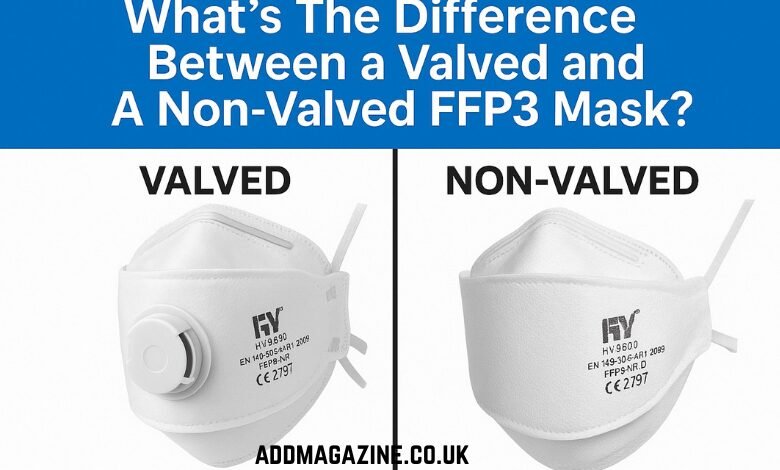
An FFP3 mask is one such popular protective equipment that offers the highest level of filtration protection available. The masks are known to capture at least 99% of airborne particles, including fine dusts, mists, and harmful aerosols. These masks come in two variants: a valved and a non-valved one.
But what’s the difference between these two variants, and how to pick the right one for your specific workplace hazards? Keep on scrolling to find out!
An Overview of Non-Valved FFP3 Mask
Non-Valved FFP3 masks are designed to filter out airborne particles, including bacteria, viruses, dust, and pollution. They have a close-fitting design that creates a seal around your nose and mouth to make sure air is being filtered through the mask material. Apart from surgical masks, non-valve versions are commonly used in healthcare settings.
Here are the benefits of choosing Non-valved masks,
- Protection for Everyone: Non-valved version protects both the wearer and those present nearby by filtering both incoming and outgoing air. It is quite a non-negotiable option when source control is important.
- No Risk of Contamination: As the exhaled air is filtered through the mask material, the non-valved FFP3 mask shows high filtration efficiency while dealing with harmful particles.
- Disposable: Most non-valved FFP3 dust masks are disposable. It means there are fewer chances for cross-contamination to occur as you will be using a fresh one each time.
An Overview of Valved FFP3 Mask
Valved FFP3 masks, on the other hand, are similar to non-valved ones, but they have one-way exhalation valves. The valves allow you to exhale more easily, making breathing more comfortable. These versions are often favored for their ease of use for a prolonged period since most people consider non-valved ones to be stuffy and uncomfortable. They are commonly used in construction and industrial settings.
Here’s why you should choose Valved Reusable masks,
- Comfortable Breathing: The exhalation valve in the FFP3 face maskreduces resistance, making it easier for you to breathe, especially for long shift periods.
- Reduce Moisture Build-up: Valved masks are less prone to accumulating moisture inside the mask. It means you will feel comfortable for long-term wear.
- Less Claustrophobic: The valve in the FFP3 mask allows for a cooler and less restrictive experience. As a result, most employees prefer FFP3 masks with valves over the non-valved ones, which could be a bit uncomfortable.
Here’s a Quick Comparison between Valved vs non-valved FFP3 Masks
| Feature | Valved FFP3 | Non-Valved FFP3 |
| Wearer Protection | 99% filtration efficiency | 99% filtration efficiency |
| Protection for Others | No filtration of exhaled air | Filters exhaled air |
| Breathing Resistance | Significantly lower | Higher during exhalation |
| Comfort Level | High (reduced heat/moisture) | Moderate (heat buildup) |
| Extended Wear | More comfortable (3-9 hours) | Less comfortable for long periods |
| Glasses Fogging | Minimal | Common issue |
| Best For | Industrial, construction, manufacturing | Healthcare, sterile environments |
How to Make the Right Choice Between Valved and Non-Valved FFP3 Masks?
Now that you know the difference between valved and non-valved masks, you must know how to choose the right variant according to the different situations. Let’s take a look at some tips,
Choose Valved Masks When:
- If you plan to wear a respirator for an extended period in a dusty work environment, a valved respirator provides more comfort and breathability.
- If you are in industrial settings where all workers wear proper PPE. Valved masks offer better compliance through improved comfort.
- If you are engaging in physical activities. The reduced breathing resistance makes demanding tasks more manageable.
- If your primary goal is protecting yourself and you’re not around vulnerable populations.
Choose Non-Valved Masks When:
- If you’re wearing a respirator primarily to protect others. A non-valved respirator is best for two-way protection because it filters both incoming and outgoing air.
- If you are in healthcare settings, and need to prevent contamination in both directions.
- If you are in sterile spaces like clean rooms, laboratories, and surgical suites that need complete filtration.
- If there’s any chance, you’re contagious and carrying infectious particles, non-valved masks protect others.
What are the Other Factors to Consider While Choosing an FFP3 Mask?
While you know the difference between valved and non-valved masks, here are some additional factors to consider to choosing the FFP3 Mask:
- Mask Material: The choice of material for the FFP3 mask will have an impact on its breathability, comfort, and effectiveness. Both valved and unvalved versions are made from various materials, including cotton, polyester, or even synthetic blends. So, choose the mask according to your fabric preference.
- Fit and Adjustability: A well-fitted mask is important for complete protection. Make sure the mask you choose fits snug around your nose and mouth without any gaps. You can choose masks that have adjustable ear loops or straps to get the right fit.
- Reusability and care: Pick between reusable or disposable masks. Reusable masks can be cost-effective and eco-friendly. But it requires the proper care to maintain its effectiveness. While disposable can be convenient, it can lead to waste of resources and investment.
Wrapping Up!
An unvalved FFP3 mask provides two-way protection, protecting both the wearer and the patient. On the flip side, a valved model only protects the wearer. Both valved and non-valved masks have their merits and limitations. Always make the choice based on your specific requirements and follow the guidance provided by the authorities of your industry, so that you remain protected in any situation. Still, opt for unvalved masks if you are in sterile or healthcare environments to prevent any cross-contamination.
At Protective Masks Direct, we provide premium FFP3 respiratory protection to protect your health in even the most challenging work environments. Browse our wide range of FFP3 masks, both valved and non-valved, and choose the one that fits your workplace requirements, without compromising on your comfort.