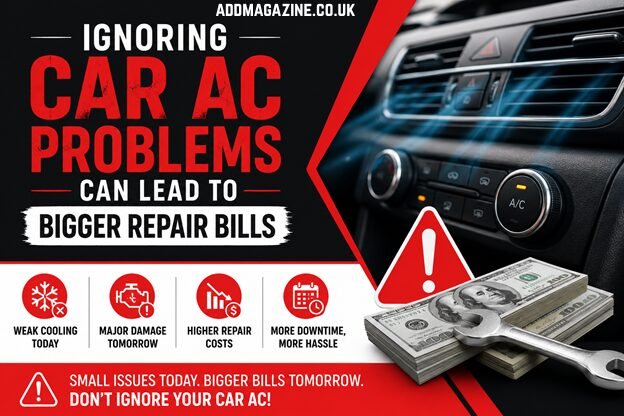
Summer hits, and suddenly everyone notices their car AC isn’t blowing as cold as it used to. Most people shrug it off. It’s just a little warm air, right? You crack the window, tell yourself you’ll deal with it later, and move on with your day. That’s pretty much how every expensive AC repair starts.
Here’s the thing about car AC systems — they rarely fail all at once. It’s almost always a slow decline. A little less cold air this month, a weird smell next month, maybe a faint hissing sound a few weeks after that. By the time it actually stops working completely, you’re usually not looking at a small fix anymore. You’re looking at auto air conditioning repair that costs a lot more than it would’ve if you’d caught it early.
I’ve seen this play out the same way more times than I can count. Someone ignores the early signs for months, sometimes a whole season, and what could’ve been a quick recharge turns into a compressor replacement. The AC system in a car is interconnected in a way most people don’t realize — one small leak doesn’t just mean less cold air, it means the whole system is slowly working harder than it should, and that strain adds up.
Why People Ignore It in the First Place
Honestly, it makes sense why people put it off. The AC not working doesn’t stop you from driving anywhere. The car still starts, still gets you to work, still does everything it’s supposed to do except keep you cool. So it feels optional in a way that, say, a brake issue never would.
But that’s exactly what makes it sneaky. There’s no dashboard light screaming at you. No grinding noise that makes you pull over immediately. Just a slow, easy-to-ignore decline that somehow always seems to get worse at the worst possible time — usually mid-July, on a long drive, with the kids in the back seat.
The Small Signs That Actually Matter
A few things are worth paying attention to before the system fully gives up:
Air that’s cool but not cold anymore. This is usually the first sign, and it’s the one people brush off the most. It typically points to low refrigerant, which often means there’s a leak somewhere in the system.
A musty or moldy smell when you first turn the AC on. This usually means moisture’s built up somewhere it shouldn’t have, often in the evaporator core, and mold’s started growing. Not dangerous immediately, but not something you want sitting there either.
Weird noises right when you switch the AC on. Clicking, rattling, a faint hum that wasn’t there before. Often, it’s the compressor clutch or a belt starting to wear out.
Air is only coming from certain vents, or barely coming out at all. That’s usually a blend door or blower motor issue, and it tends to get worse gradually rather than fixing itself.
None of these means instant disaster. But every one of them tends to get more expensive the longer they’re left alone.
What Happens If You Just Keep Ignoring It
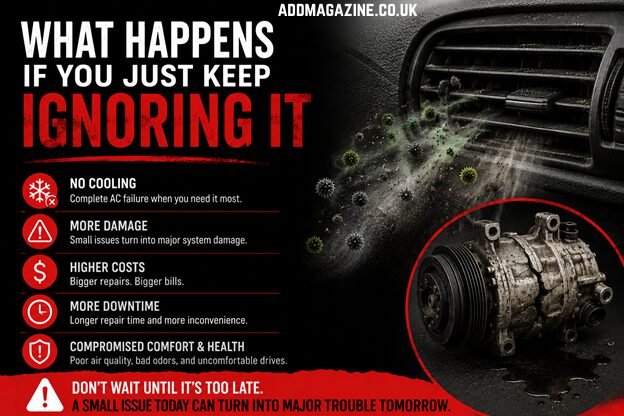
This is where it gets costly, and where I think most people genuinely don’t realize what’s coming.
A small refrigerant leak, left alone, doesn’t stay small. The system keeps running low, the compressor keeps working harder than it should to compensate, and eventually that compressor burns out. Replacing a compressor is a completely different price range than just topping off refrigerant and sealing a small leak.
Moisture sitting in the evaporator core for months can lead to mold that’s genuinely tough to clean out properly, sometimes requiring the whole core to be replaced rather than just cleaned. And a blower motor that’s struggling will eventually just stop, leaving you with zero airflow instead of weak airflow.
The pattern is always the same. A small, cheap problem ignored becomes a bigger, expensive one. It’s not really any different from a small oil leak being ignored until the engine starts running low on oil entirely.
What an Honest Shop Actually Checks
A good shop doesn’t just glance at your AC and say, “needs a recharge, that’ll be X dollars.” There’s usually a proper process behind it.
They’ll check the refrigerant level first, but they should also be checking for leaks using a UV dye or an electronic leak detector, not just topping it off and sending you on your way. If they just add refrigerant without checking why it was low, you’re going to be back in a few months with the same problem.
They’ll also check the compressor itself, the condenser for any blockage or damage, and the cabin air filter, which gets overlooked constantly but plays a real role in how well the system performs overall. A clogged cabin filter can make a perfectly fine AC system feel weak just because air isn’t moving through it properly.
If you’ve been searching for auto air conditioning repair near me and landed on a shop that skips straight to “let’s just recharge it,” that’s usually a sign they’re not actually diagnosing anything. They’re just treating the symptom.
Why Timing Actually Matters Here
People assume AC issues can wait because, well, it’s just the AC. But waiting genuinely changes the cost involved, sometimes by a significant margin.
Catching a small leak early might mean a seal replacement and a recharge. Catching it after the compressor’s already strained from running low for months means a compressor replacement, which involves more labour and a part that costs considerably more than a seal kit ever would. It’s the same logic as catching a cavity early versus waiting until you need a root canal. The problem doesn’t stay still while you ignore it.
What This Means for You as a Driver
If your AC’s been acting slightly off — not ice cold like before, a weird smell, some noise you’ve been telling yourself you’ll look into eventually — that’s actually the best time to get it looked at. Not when it’s completely stopped working in the middle of August.
Finding a reliable auto repair shop Toronto drivers can count on for this kind of work matters more than people think, mainly because AC diagnosis isn’t always straightforward. Two cars with the same symptom can have completely different causes, and a shop that actually takes the time to test properly will save you money in the long run compared to one that just guesses and replaces parts, hoping something sticks.
A Quick Gut-Check Before You Decide to Wait
Ask yourself honestly — has the air gotten weaker over the past few weeks, not just today? Is there any smell when it first kicks on? Any noise that wasn’t there a month ago? If you’re answering yes to even one of these, it’s worth getting checked sooner rather than later, even if the car’s still technically cooling fine most days.
Waiting rarely saves money with AC systems. It just delays the bill and usually makes it bigger by the time it actually arrives.
Final Thoughts
Car AC problems are easy to brush off because the car still runs, still gets you where you’re going, and the only thing missing is comfort. But that’s exactly what makes them costly if left alone too long. A small leak becomes a compressor issue. A clogged filter makes a healthy system feel broken. And what could’ve been a quick, affordable fix turns into something far more involved. Fine Tuned Autos has seen this pattern enough times to know it’s almost always cheaper to deal with the small warning signs early than to wait for the system to fail. If something feels even slightly off with your AC, that feeling is usually worth li