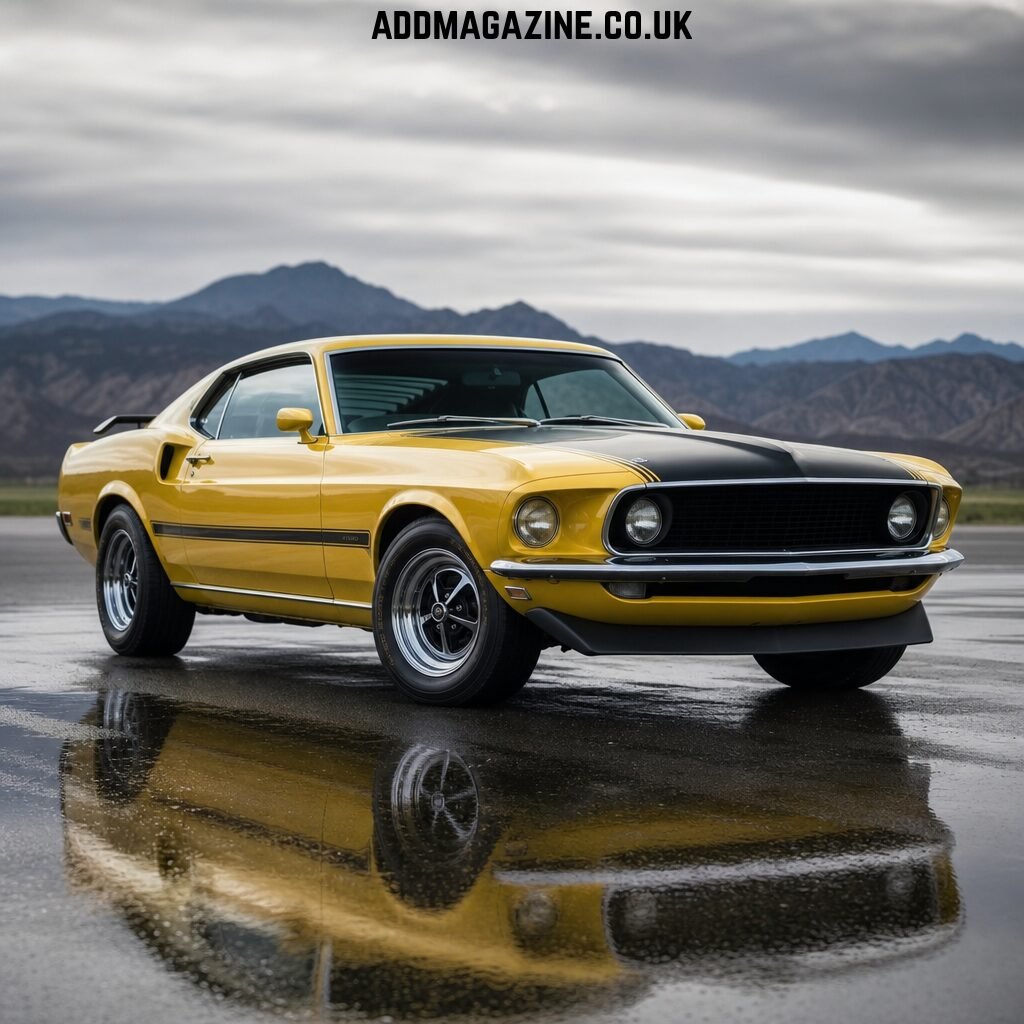
Few American muscle cars have captured the imagination of enthusiasts quite like the Boss Mustang series. Born from Ford’s desire to dominate the Trans-Am racing circuit, the Boss 302 represented a rare convergence of street credibility and genuine motorsport engineering. Its sharp lines, high-revving small-block engine, and no-compromise attitude made it an instant icon — one that continues to command respect and serious collector interest more than five decades after its debut.
The Origins of the Boss 302 Program
Ford was locked in a fierce battle with Chevrolet on the Trans-Am circuit, where regulations mandated that competing vehicles be based on production cars available to the public. This rule forced manufacturers to build genuinely capable road cars if they wanted to race — and Ford took that challenge seriously.
The 302 cubic inch engine at the heart of the car was not a standard small-block. Its engine architecture used angled valve positioning inspired by the 429 big-block, improving cylinder breathing and maintaining strong performance at higher engine speeds. This was a racing engine wearing street clothes, and it showed in every aspect of the car’s character.
What Made the 1970 Model Year Special
The 1970 Boss 302 refined everything that made the 1969 model great. The updated model features a reshaped nose, refreshed visual details, and carefully adjusted bodywork designed to improve airflow. The interior received updates as well, with better ergonomics and a sportier presentation that matched the car’s performance intentions. Mechanically, the suspension tuning was sharpened, and the overall package felt more cohesive — as if Ford had taken the lessons learned from the first year of production and applied them with precision.
The engine itself remained the centerpiece. Rated conservatively at 290 horsepower by Ford — a figure widely regarded as understated — the 302 delivered a driving experience defined by its willingness to rev. Unlike torque-heavy big-block alternatives, the Boss 302 rewarded drivers who understood how to work through the rev range, making it a more engaging and technically demanding car to drive quickly.
Suspension and Handling: A Different Kind of Muscle Car
While many muscle cars of the era prioritized straight-line acceleration above all else, the Boss was designed to corner. Ford fitted the car with a competition suspension package that included stiffer springs, staggered rear shocks to combat wheel hop, and a front spoiler that genuinely contributed to aerodynamic stability at speed. Its carefully engineered handling allowed drivers to attack bends confidently while maintaining stability and predictable control.
Revology Cars: Preserving the Boss Legacy for Modern Collectors
The company builds continuation Mustangs that honor the original designs while incorporating modern engineering for reliability and drivability. If you are searching for a meticulously crafted example of this legendary nameplate, the 1970 Boss Mustang 302 available through Revology represents one of the most authentic and thoughtfully executed interpretations of the original car available today. These vehicles are not restorations — they are new builds that capture the spirit and visual identity of the original while delivering a driving experience suited to contemporary roads and expectations.
The Collector Market and Investment Perspective
Original Boss 302 Mustangs have appreciated significantly over the past two decades. Well-documented examples in excellent condition routinely command six-figure prices at auction, and the trajectory shows no signs of reversing. As authentic classic vehicles become harder to repair and replacement components increasingly difficult to obtain, some collectors are choosing carefully recreated models that deliver a similar driving character with fewer ownership concerns.
For those approaching this from a business or investment angle, understanding the financial implications of acquiring and maintaining a classic vehicle is important. Exploring vehicle acquisition strategies — whether for personal collections or business purposes — can help enthusiasts make informed decisions about how to structure ownership in a way that makes financial sense over the long term.
The Engine That Defined a Generation
The Boss 302 engine’s design philosophy was ahead of its time. By prioritizing high-RPM power over low-end torque, Ford created a small-block that behaved more like a purpose-built racing unit than a street engine. The free-breathing cylinder heads, solid lifter camshaft, and four-barrel carburetor all contributed to an engine that came alive above 5,000 RPM and pulled hard all the way to its 7,500 RPM redline. This was not a car for casual Sunday driving — it demanded engagement and rewarded skill.
For enthusiasts interested in exploring the broader context of high-performance Ford V8 development during this era, this detailed examination of a 1969 Ford Mustang Mach 1 with a Kaase V8 offers fascinating insight into how Ford’s engineering philosophy evolved and influenced subsequent performance builds across multiple decades.
Cultural Impact and Enduring Relevance
The Boss 302 arrived at a pivotal moment in American automotive history. The muscle car era was approaching its peak, and the Boss represented the most technically sophisticated expression of that movement. Rather than depending solely on oversized horsepower in a lightweight frame, the Boss combined balanced engineering and capable handling to deliver strong performance on both racing circuits and straight-line tracks.
That balance of capability is what has kept the Boss 302 relevant in enthusiast culture long after the muscle car era faded. It was never just about raw power — it was about the quality of the performance experience. That distinction matters to collectors, to drivers, and to anyone who appreciates the craft that goes into building a genuinely great automobile.
Conclusion
The 1970 Boss Mustang 302 stands as one of the most complete performance cars ever produced by an American manufacturer. Its combination of a purpose-built engine, race-tuned suspension, and aggressive styling created a vehicle that transcended the limitations of its era. Whether you encounter one in original form at a concours event or experience a modern continuation build on an open road, the Boss 302 communicates something essential about what American performance cars can be when engineering ambition and design intent are perfectly aligned. Its legacy is not merely historical — it is a living standard against which performance vehicles continue to be measured.