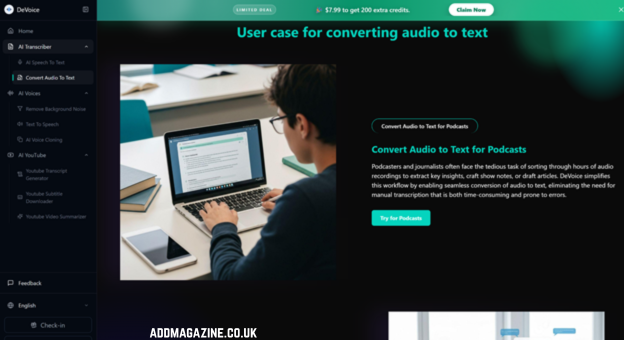
In an era defined by speed and content, audio has become one of the most widely used formats for communication. From podcasts and interviews to voice notes and online meetings, spoken content is everywhere. Yet, audio alone has limitations: it’s harder to search, reference, and repurpose. This is where audio-to-text technology steps in, transforming spoken words into structured, usable text.
With tools like Devoice Ai, transcription is no longer a slow, manual process. It has become fast, accurate, and accessible, enabling creators, professionals, and businesses to unlock the full value of their audio content.
Why Audio Content Needs Text Conversion
Audio is convenient to create but not always practical to manage. Unlike text, you can’t quickly scan an audio file for key points or copy specific sections without replaying it.
Converting audio to text solves several challenges:
- It makes content searchable and easy to navigate
- It allows quick editing and repurposing
- It improves accessibility for wider audiences
- It enhances productivity across workflows
For anyone dealing with large volumes of spoken content, transcription is no longer optional—it’s essential.
The Evolution of Audio-to-Text Technology
Traditional transcription used to be time-consuming and expensive. It often required human transcribers who would listen to recordings and type them out manually. While accurate, this process was slow and not scalable.
Modern AI has completely changed this landscape. Today’s audio-to-text tools use advanced speech recognition algorithms that can process hours of audio in minutes. They are capable of understanding different accents, filtering background noise, and identifying speech patterns with impressive accuracy.
Devoice Ai represents this new generation of tools, combining speed with precision to deliver reliable transcription results.
How Audio-to-Text Works Behind the Scenes
At its core, audio-to-text technology relies on machine learning models trained on vast amounts of speech data. These systems analyze sound waves, break them into smaller components, and match them with linguistic patterns.
The process typically involves:
- Converting audio signals into digital data
- Identifying phonemes (basic sound units)
- Matching sounds to words using language models
- Structuring sentences based on context
The result is a readable transcript that closely mirrors the original speech.
With Devoice Ai, this process is optimized for clarity, even when dealing with complex recordings.
Key Benefits of Using Audio-to-Text Tools
One of the biggest advantages of AI-powered transcription is efficiency.
Speed and Time-Saving
Instead of manually transcribing, users can generate text instantly, freeing up time for more important work.
Improved Accuracy
Modern tools can handle different accents, speaking speeds, and audio qualities with high precision.
Easy Content Repurposing
A single audio file can be turned into blog posts, social media content, reports, or summaries.
Better Organization
Written content is easier to store, search, and manage compared to raw audio files.
These benefits make tools like Devoice Ai valuable across multiple industries.
Real-World Applications of Audio-to-Text
Audio-to-text technology is not limited to one field—it’s used across a wide range of industries.
Content Creation
Podcasters and YouTubers can convert their audio into articles, captions, and subtitles, expanding their reach.
Business and Meetings
Professionals can transcribe meetings, interviews, and discussions, making it easier to review and share information.
Education
Students and educators can convert lectures into notes, improving learning and retention.
Journalism
Reporters can quickly transcribe interviews, saving time and ensuring accuracy.
Customer Support
Call recordings can be converted into text for analysis and training purposes.
In each of these cases, Devoice Ai simplifies the process, turning audio into actionable content.
Overcoming Common Audio Challenges
Not all audio recordings are perfect. Background noise, multiple speakers, and unclear speech can make transcription difficult.
Modern AI tools address these challenges by:
- Filtering out background noise
- Distinguishing between different speakers
- Adjusting to various accents and tones
- Improving clarity through context recognition
Devoice Ai is designed to handle these real-world conditions, ensuring that transcripts remain accurate even in less-than-ideal environments.
Audio-to-Text and SEO Advantages
For digital creators and businesses, transcription offers significant SEO benefits. Search engines cannot “listen” to audio, but they can index text.
By converting audio into written content, you can:
- Improve website visibility
- Add keyword-rich content
- Increase engagement through readable formats
- Reach a broader audience
This makes audio-to-text an important tool for online growth strategies.
The Role of Automation in Modern Workflows
Automation is reshaping how work gets done, and transcription is a perfect example. Instead of dedicating hours to repetitive tasks, users can rely on AI to handle them efficiently.
This shift allows professionals to focus on:
- Creativity and strategy
- Content development
- Decision-making
With Devoice Ai, transcription becomes a seamless part of the workflow rather than a separate, time-consuming task.
Future Trends in Audio-to-Text Technology
The future of audio-to-text is focused on even greater accuracy and integration. Emerging developments include:
- Real-time transcription for live events
- Multilingual support for global communication
- Integration with other AI tools for content generation
- Improved speaker recognition and context understanding
As these technologies evolve, tools like Devoice Ai will continue to play a central role in how we process and use audio content.
Choosing the Right Audio-to-Text Solution
- Accuracy and reliability
- Speed of processing
- Ease of use
- Compatibility with different audio formats
- Additional features like editing and exporting
A well-rounded tool should not only convert audio to text but also make the output easy to work with.
Conclusion: Turning Voice into Value
Audio-to-text technology has transformed the way we handle spoken content. What was once a slow and manual process is now fast, automated, and highly efficient. By converting audio into text, users can unlock new opportunities for content creation, productivity, and accessibility.
With Devoice Ai, this transformation becomes simple and practical. It empowers users to turn voice into value making information easier to use, share, and grow.