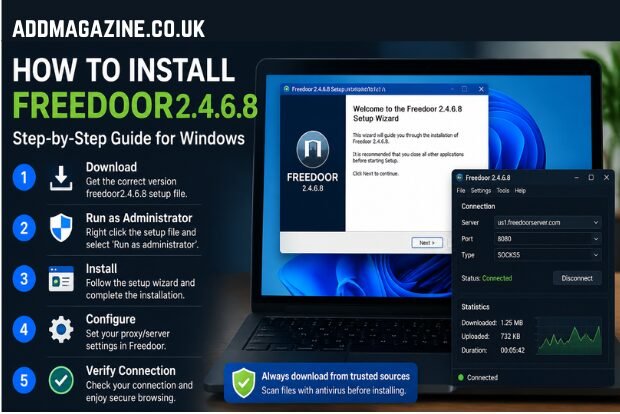
Installing software like Freedoor2.4.6.8 requires a basic understanding of setup files, system compatibility, and configuration steps after installation. Many users look for this version because it is lightweight, runs on standard Windows systems, and is used for routing network traffic through proxy-based connections. In practice, the installation process is straightforward, but errors often happen when system requirements are ignored or incorrect files are used.
This guide explains how to install freedoor2.4.6.8 in a structured way, along with system preparation, troubleshooting, updates, and usage considerations across Windows and Mac environments.
What is Freedoor2.4.6.8
Freedoor 2.4.6.8 is a network utility designed to route internet traffic through configured servers. It is commonly used for proxy connections and tunneling setups, helping users manage how their system communicates with external networks.
Unlike large networking suites, this version is designed to remain lightweight. It does not require high system resources and can run on older Windows machines. Its simplicity is one of the main reasons users search for how to install freedoor2.4.6.8 on PC systems.
The software generally includes:
- Core application files for execution
- Configuration tools for proxy setup
- Log system for monitoring connections
- Service components for background routing
System requirements before installation
Before starting the installation process, it is important to ensure that the system meets minimum requirements. Most installation errors happen due to incompatible environments.
Minimum requirements
| Component | Requirement |
|---|---|
| Operating System | Windows 7, 8, 10, or 11 |
| Processor | 1 GHz or higher |
| RAM | 2 GB minimum |
| Storage | At least 500 MB free space |
| Permissions | Administrator access required |
For stable performance, systems with higher RAM and updated Windows builds are recommended.
Preparing your system for installation
Proper preparation reduces errors such as freedoor2.4.6.8 data error or installation failure. Before running the installer, complete the following steps:
1. Remove older versions
If an older version of Freedoor is already on your system, remove it fully to prevent any installation conflicts.
2. Close background applications
VPN tools, proxy managers, or network utilities may interfere with installation.
3. Update Windows
Keeping Windows updated helps prevent compatibility issues.
4. Create a restore point
This allows recovery if installation affects system stability.
5. Scan antivirus settings
Some antivirus programs may block setup files, so ensure the installer is scanned and allowed.
Downloading freedoor2.4.6.8 safely
A major cause of installation problems is using incorrect or modified files. When searching for how to install freedoor2.4.6.8, file authenticity is important.
Follow these steps:
- Download only the exact version 2.4.6.8
- Prefer .exe or .zip formats from reliable sources
- Verify file size and version details
- Scan the file using antivirus software
- Check checksum if available
Incorrect downloads often lead to errors such as installation crash or data mismatch issues.
Step-by-step installation on Windows PC
This part describes the process of installing freedoor2.4.6.8 on a Windows-based system.
Step 1: Locate the setup file
Go to your Downloads folder and find:
- freedoor2.4.6.8.exe or similar file name
Step 2: Run as administrator
Right-click the file and select:
Run as administrator
This ensures the installer has permission to modify system directories.
Step 3: Start setup wizard
The installation wizard will open. Click Next to proceed.
Step 4: Accept terms
Read the license agreement and select:
I Agree
Step 5: Choose installation directory
Default location:
C:\Program Files\FreedoorAvoid long or nested paths to prevent errors.
Step 6: Select installation type
You may see two options:
- Standard installation (recommended)
- Custom installation (advanced users)
Standard mode installs all necessary components automatically.
Step 7: Begin installation
Click Install and wait for the process to complete.
This usually takes a few minutes depending on system performance.
Step 8: Allow permissions
If Windows prompts for firewall or network access, allow it so the software can function properly.
Step 9: Finish setup
Select Finish to complete setup, then reboot your computer if the system prompts you to do so.
Portable version installation
Some distributions of freedoor2.4.6.8 come as portable files.
Steps:
- Extract ZIP file using WinRAR or 7-Zip
- Open extracted folder
- Run freedoor.exe directly
- No installation required
This version does not modify system directories and is easier for testing.
How to use freedoor2.4.6.8 on Mac
Users often ask how to use freedoor2.4.6.8 on Mac systems. However, the software is primarily designed for Windows. On macOS, users typically rely on:
- Virtual machines
- Windows emulators
- Compatibility layers
Once Windows environment is set up, installation steps remain the same.
Configuring freedoor2.4.6.8 after installation
After installation, proper configuration is necessary for correct operation.
Steps to configure:
- Open Freedoor application
- Go to settings panel
- Select server or connection mode
- Choose proxy type (HTTP or SOCKS)
- Enable automatic connection (if available)
- Set port values if required
- Save configuration
Correct configuration ensures proper traffic routing.
How to verify installation is working
After setup, confirm the software is functioning:
- Check version shows 2.4.6.8
- Open a browser and test internet access
- Review log files for connection activity
- Confirm proxy routing is active
If traffic is not routed correctly, configuration may need adjustment.
Common errors and fixes
1. Missing administrator rights
Fix: Run installer as administrator
2. System conflict or low resources
Fix: Close background apps and retry
3. Firewall blocking access
Fix: Allow Freedoor in firewall settings
4. Incorrect file downloaded
Fix: Reinstall correct version
5. Data error during installation
Fix: Re-download file and verify integrity
Such issues are frequently encountered when users look for solutions related to freedoor2.4.6.8 data errors.
Is freedoor2.4.6.8 safe for Windows?
Safety depends on the source of the file and system configuration. The software itself is lightweight, but risks arise when:
- Downloading from unknown websites
- Using modified versions
- Disabling antivirus protection
For safe use:
- Keep antivirus active
- Scan files before installation
- Avoid cracked versions
- Monitor system behavior after setup
Updating and upgrading freedoor2.4.6.8
Users often look for upgrade freedoor2.4.6.8 or update freedoor2.4.6.8 options.
Update process generally includes:
- Download newer version package
- Uninstall old version (recommended)
- Install updated version
- Import previous configuration if supported
Keeping software updated improves stability and reduces compatibility issues.
Understanding system files
During installation, several file types are created:
| File Type | Purpose |
|---|---|
| Application files | Main software execution |
| Configuration files | User settings |
| Log files | Connection tracking |
| Service files | Background processes |
These components work together to ensure stable performance.
Best practices after installation
To maintain stability:
- Use latest Windows updates
- Avoid restricted system folders
- Keep antivirus active
- Restart system after installation
- Check logs periodically
These steps help prevent long-term issues and improve performance.
Troubleshooting performance issues
If the software becomes slow or unstable:
- Reduce number of active connections
- Restart application
- Clear log files
- Check system RAM usage
- Reinstall if necessary
Performance issues often relate to system overload rather than software failure.
Conclusion
Installing Freedoor 2.4.6.8 is a structured process that depends on correct preparation, safe file handling, and proper configuration after setup. While the installation itself is simple, most problems occur due to missing permissions, incorrect downloads, or system conflicts.
By following the steps outlined—checking system requirements, preparing Windows, installing with administrator access, and configuring proxy settings—users can avoid common errors like freedoor2.4.6.8 data error or installation failure.
Whether used on Windows PCs or through a virtual setup on Mac systems, the key to stable performance is keeping the environment clean, updated, and properly configured.