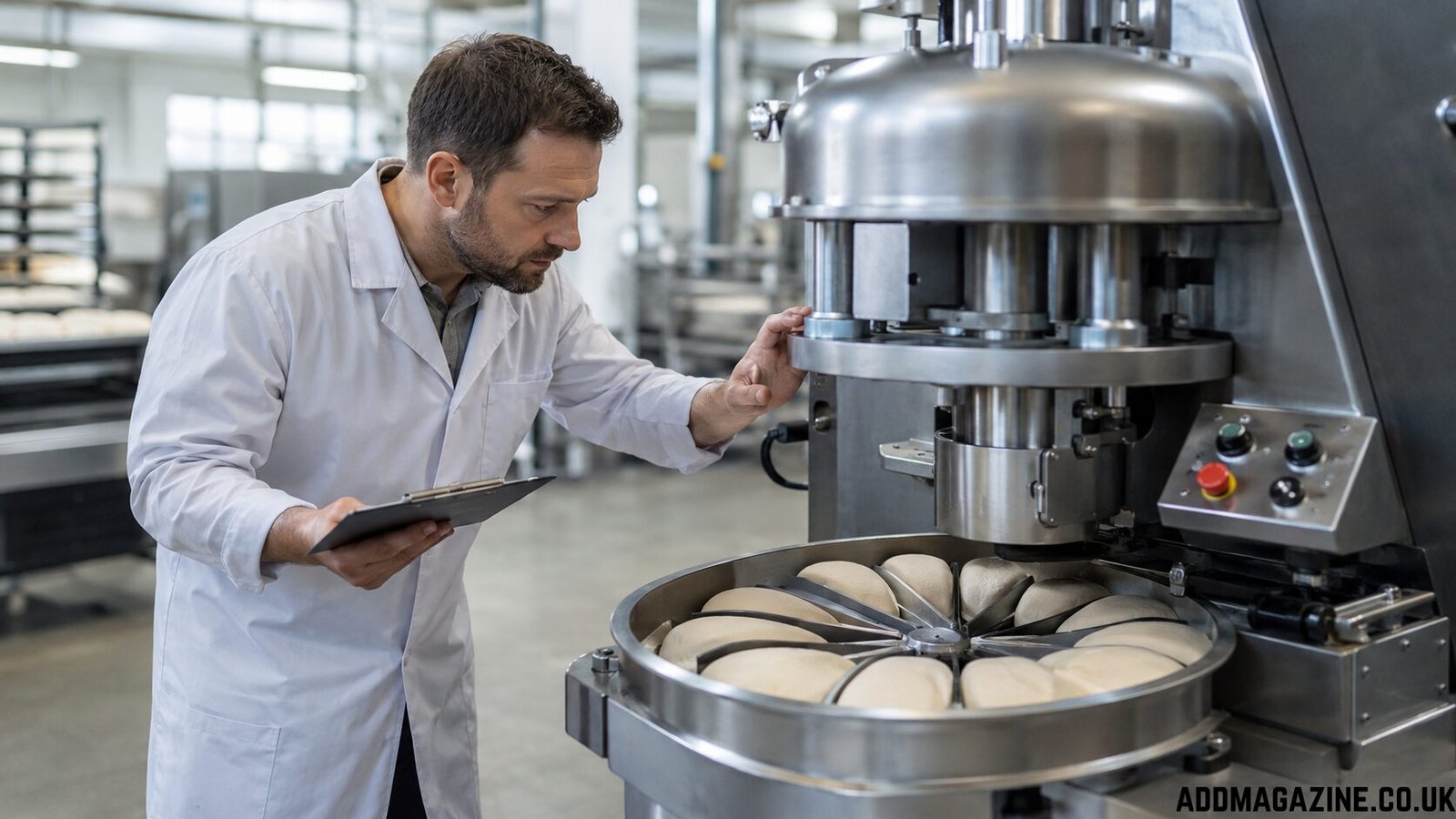
Expanding a bakery from one outlet to several locations creates new opportunities, but it also introduces new production challenges. Customers expect the same bread, buns, rolls, and pizza products at every branch.
A professional Dough Divider can help central production facilities prepare more consistent dough portions before products are shaped, proofed, baked, or distributed. Controlled portioning gives each branch a more reliable starting point and reduces differences caused by manual cutting and weighing. When combined with standardized recipes and clear operating procedures, it can support consistent quality across a growing bakery network.
Growth Demands a New Approach to Production Management
A single bakery can often rely on a small team that understands every recipe and production method. Staff members work closely together, and an experienced baker may personally check most batches.
This becomes more difficult when the business opens additional outlets. Each location may have different employees, equipment, demand levels, and working conditions. Without clearly defined processes, product quality can become inconsistent across different locations.
One outlet may prepare larger rolls, while another may bake them for longer. These small differences can weaken the bakery’s identity and confuse regular customers.
Expansion therefore requires a more controlled production system.
Central Production Can Improve Consistency
Many growing bakeries use a central kitchen or production facility. Dough and other products are prepared in one location and then supplied to different branches.
A centralized baking operation gives businesses complete oversight of recipes, ingredient consistency, serving sizes, and quality standards from a single production hub. This approach also minimizes the requirement for fully equipped baking facilities at each individual store, helping streamline operations and maintain uniform products.
The central kitchen can prepare dough portions, partially processed products, or finished baked goods depending on the business model.
However, centralized production only works well when the facility can process enough volume and maintain accurate standards. A mistake made at the central location may affect every branch receiving that batch.
Standard Recipes Are Essential
Every branch should work from the same approved recipe. Ingredients must be measured by weight rather than estimated by volume or appearance.
A standardized recipe should include ingredient quantities, mixing order, mixing time, target dough temperature, resting period, portion weight, proofing conditions, and baking instructions.
Recipes must specify approved flour varieties, suitable leavening agents, permissible fats, and any other ingredients required to meet established standards. Changing an ingredient brand or type may affect water absorption, fermentation, and finished texture.
Portion Weight Defines the Product
If one branch receives larger dough portions, its products may look more generous but cost more to produce. Another branch may receive smaller portions and face customer complaints.
Consistent portioning helps ensure that every location receives products that follow the same specification. It also protects ingredient costs because the bakery can calculate how many pieces should come from each batch.
Even a small weight difference becomes important when thousands of products are prepared for several branches every week.
Uniform Portions Simplify Branch Operations
Branches often have limited production space and fewer skilled bakers than the central facility. Their employees may focus on proofing, baking, finishing, displaying, and serving products.
This can make production easier for outlets operating in small commercial spaces.
A more streamlined workflow minimizes errors while enabling new team members to understand their duties with greater ease.
Product Appearance Should Match the Brand
Customers often recognize a bakery product by its appearance. The shape, size, crust colour, topping, and packaging all contribute to brand identity.
When products look different at every branch, the business may appear poorly managed. Customers may also begin preferring one location because they believe its products are better.
Consistent dough weight gives shaping teams a similar starting point. Staff can follow the same shaping method and use the same trays or molds.
The bakery should also create visual quality standards. Reference photographs, measurement guides, and finished product samples can help employees understand the expected result.
Accurate Dividing Supports Production Forecasting
A central bakery must prepare enough products for every outlet without creating unnecessary surplus.
Managers must accurately calculate the required dough volume, estimate the yield from each batch, and plan how every portion will be allocated. These calculations depend on accurate portion weights.
A suitable Dough Divider can make batch output more predictable by preparing portions closer to the required standard.
Better forecasting reduces the risk of one location receiving too little stock while another receives more than it can sell.
Distribution Requires Careful Planning
Dough and bakery products must be protected during transport. Temperature, delivery time, packaging, and handling can all affect quality.
If raw or fermented dough is delivered to branches, the bakery must control how long it remains in transport and at what temperature. Unexpected delays may cause fermentation to continue beyond the planned level.
Frozen or chilled dough may offer more scheduling flexibility, but it requires suitable storage and controlled thawing procedures.
Finished items require reliable protection against impact damage, moisture exposure, and contamination during storage and transport. Packaging should be appropriately sized for each product and sanitized on a routine basis to maintain quality and safety.
Consistent portions make transport packaging easier because products fit into standardized trays and containers.
Every Branch Needs the Same Proofing Standards
Even equal dough portions can produce different results if proofing conditions vary.
One outlet may have a controlled proofer, while another relies on room temperature. Differences in heat and humidity can change how quickly dough rises.
The bakery should establish target proofing conditions and provide suitable equipment where possible. Employees should learn how to identify correctly proofed dough rather than depending only on time.
Branch managers should also record unusual conditions, such as very hot weather or equipment problems. These records can help explain changes in product volume or texture.
Baking Procedures Must Be Standardized
Different ovens may produce different results, even when they are set to the same temperature. Airflow, heat recovery, tray position, and oven load can affect crust colour and baking time.
Each branch should test and document the correct settings for its equipment. The goal is to achieve the same finished standard, even if exact oven settings differ slightly between locations.
Employees should follow agreed tray arrangements and avoid overcrowding the oven. Products should also be checked for internal doneness, crust colour, and finished weight.
Regular comparisons between branches can reveal whether one location needs equipment adjustment or additional staff training.
Quality Checks Should Happen at More Than One Stage
Quality control should begin at the central production facility and continue at each branch.
The central team can check dough temperature, portion weight, batch yield, and product condition before distribution. Branch employees can check proofing, baking, appearance, packaging, and display quality.
Random samples should be weighed and measured regularly. Products from different branches can also be compared during management visits.
When a quality issue appears, the bakery should determine whether it began during mixing, dividing, transport, proofing, baking, or storage.
Clear records make this investigation much easier.
Communication Between Locations Matters
Branches should have a simple way to report shortages, damaged products, unusual dough behaviour, or customer feedback.
Without regular communication, the central facility may continue producing a product that is creating problems at one or more outlets.
A daily or weekly reporting system can include sales quantities, waste, product quality, delivery timing, and equipment issues.
Managers should look for patterns rather than reacting to one isolated comment. If several branches report the same problem, the recipe or central production method may need review.
Good communication helps the entire network improve together.
Staff Training Protects Consistency
Every employee who handles dough or finished products should understand the bakery’s standards.
Training should cover receiving deliveries, storing dough, proofing, shaping, baking, cooling, packaging, and cleaning. Employees should also know how to identify products that do not meet the required standard.
Written instructions, photographs, demonstrations, and short refresher sessions can support training.
When procedures change, every branch should receive the updated information at the same time. Allowing locations to develop their own unofficial methods can lead to growing differences in quality.
Cleaning Standards Must Be Shared
Food safety requirements should remain consistent across all production and retail locations.
Mixers, dividing equipment, trays, proofers, worktables, ovens, and storage areas must be included in cleaning schedules. Employees should know which products to use and how often each area requires cleaning.
At the central facility, dough residue should be removed from equipment before it dries. The machine should always be switched off safely before cleaning or inspection.
Branch managers should confirm that cleaning records are completed and that employees understand cross-contact risks when handling different recipes.
Waste Data Can Reveal Branch Problems
Comparing waste between locations can provide useful information.
A branch with unusually high waste may be receiving too much stock, over-proofing dough, burning products, or failing to follow storage procedures. Another location may be selling out too early and missing potential sales.
Managers should track unsold products, rejected items, delivery damage, and production losses separately.
This information can improve future delivery quantities and identify where additional training is needed. It also prevents the business from treating every branch as though it has identical demand.
Equipment Capacity Should Grow With the Network
As more outlets open, the central facility must process larger dough volumes. Equipment that worked for two branches may become a bottleneck when the network grows to five or ten locations.
Bakery owners should review mixing, dividing, proofing, baking, cooling, packaging, and delivery capacity before opening another branch.
Adding sales locations without strengthening production can create delays and reduce quality. Growth should be planned around what the central facility can reliably produce, not only around expected customer demand.
Suitable equipment allows the bakery to increase output while keeping important standards under control.
Final Thoughts
Maintaining consistent quality across several bakery locations requires more than sharing the same recipe. The business must control ingredient measurements, dough portions, proofing, baking, transport, training, cleaning, and quality checks.
Centralized production can make these standards easier to manage, but it also increases the importance of accurate processes. A single batch may supply several branches, so mistakes can affect a large number of products.
Controlled dough dividing supports predictable output, uniform product size, easier branch operations, and more accurate distribution planning. When it is combined with clear procedures and regular communication, it can help a growing bakery protect its brand identity.
For bakery businesses building centralized or multi-location production systems, mirabake.com offers professional equipment designed to support consistent commercial operations.