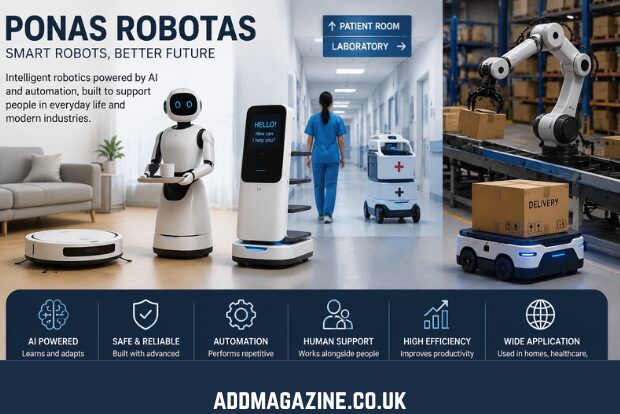
Ponas Robotas can be understood as a modern idea built around intelligent robots and their growing place in human life. The term does not refer to one single machine or one fixed product. Instead, it represents a wider shift in robotics, where machines are no longer limited to repeating simple programmed actions. They are becoming more responsive, more aware of their surroundings, and more useful in homes, workplaces, hospitals, schools, and public spaces.
The main idea behind Ponas Robotas is simple: robots are moving from controlled industrial areas into ordinary environments. In earlier decades, most robots were found inside factories. They welded car parts, lifted heavy materials, or handled production lines. Their work was important, but their abilities were narrow. They needed fixed instructions and carefully arranged surroundings. If something changed, the robot often stopped or made a mistake.
Smart robotics has changed that picture. Modern robots can use sensors, cameras, artificial intelligence, mapping systems, and data processing to understand what is happening around them. They can move through rooms, recognize objects, follow spoken instructions, and perform tasks with less direct human control. Ponas Robotas captures this change from basic automation to practical machine assistance.
What Ponas Robotas Means
Ponas Robotas is best described as a concept connected with advanced robotics and machine intelligence. It points to robots that are built to support people in real situations, not just in factory settings. These robots may clean floors, move goods, assist doctors, support elderly people, teach students, monitor buildings, or help businesses manage repeated tasks.
The word itself sounds creative, but the idea behind it is serious. It reflects the growing importance of machines that can work with people rather than only work behind walls. These robots are designed to understand tasks, collect information, respond to changes, and complete work with accuracy. They do not replace every human role, but they can reduce pressure in areas where work is tiring, risky, repetitive, or time-sensitive.
A Ponas Robotas-style system may include hardware such as wheels, arms, cameras, microphones, screens, batteries, and sensors. It may also include software that helps the robot process commands, identify surroundings, and make decisions. The value comes from the connection between the physical machine and the intelligent system behind it.
How Robotics Has Changed Over Time
Robotics started mainly as an industrial tool. Early robots were strong and reliable, but they were not flexible. They followed strict instructions and worked best in spaces where everything stayed the same. This made them useful for manufacturing because factories often depend on repeated movements and measured steps.
Over time, engineers began adding better control systems, improved sensors, and safer designs. Robots became more accurate and easier to manage. Later, artificial intelligence and machine learning gave robots another layer of ability. Instead of only following a fixed path, they could begin to recognize patterns, adjust movement, and improve performance through data.
This change is important because real life is not as predictable as a factory floor. A home has people, pets, furniture, doors, carpets, and unexpected obstacles. A hospital has patients, visitors, staff, equipment, and urgent situations. A warehouse has constant movement and changing stock. Ponas Robotas fits into this new stage because it focuses on robots that can operate in active environments.
The Technology Behind Ponas Robotas
Several technologies make smart robots possible. Artificial intelligence is one of the main parts. It helps robots process information and respond in a more useful way. Without AI, a robot is mostly a machine that follows a script. With AI, it can analyze input and choose an action based on the situation.
Sensors are another major part. A robot needs to know what is around it before it can move safely. Sensors may detect distance, movement, light, heat, pressure, or sound. Cameras help robots see objects and spaces. Microphones allow them to receive voice commands. Mapping tools help them remember layouts and plan routes.
Machine learning helps robots improve by studying data. For example, a delivery robot inside a building may learn which route is usually faster. A cleaning robot may learn which areas collect more dust. A customer service robot may improve how it responds to common questions. These changes are not always dramatic, but they make robots more useful over time.
Ponas Robotas in Homes
One of the most familiar areas for smart robots is the home. Many people already use simple robotic cleaners, smart speakers, security systems, and automated devices. These machines are not perfect, but they show how robotics can become part of daily routines.
A home robot can help with cleaning, reminders, basic monitoring, and safety alerts. For older people or people living alone, smart machines may provide useful support by reminding them about medicine, detecting unusual movement, or helping them connect with family members. In busy households, robots may reduce small tasks that take time every day.
The challenge in homes is trust. People want robots that are safe, quiet, easy to control, and respectful of privacy. A useful home robot should not feel complicated. It should solve real problems without creating new ones. Ponas Robotas, as a concept, is strongest when it focuses on practical help rather than unnecessary features.
Ponas Robotas in Healthcare
Healthcare is one of the most important areas for robotics. Hospitals and clinics often deal with pressure, staff shortages, hygiene needs, and time-sensitive work. Robots can support healthcare workers by handling routine tasks, moving supplies, cleaning specific areas, delivering medicine, or assisting in rehabilitation.
Some robots are used in surgery, where precision matters. Others help patients walk again after injury or illness. Some machines support nurses by carrying materials across hospital floors. In laboratories, automated systems can help process samples and reduce manual workload.
Ponas Robotas in healthcare should be seen as support for professionals, not a replacement for care. Patients still need human attention, judgment, and compassion. Robots can help by taking over tasks that slow staff down or increase fatigue. When used responsibly, they can improve workflow and reduce avoidable errors.
Ponas Robotas in Business and Warehouses
Businesses are using robots to manage work that requires speed, tracking, and repeated movement. Warehouses are a clear example. Products must be received, stored, scanned, moved, packed, and shipped. When demand is high, human workers can face pressure and physical strain.
Robots can move items from one location to another, scan shelves, support inventory checks, and help prepare orders. These systems can make warehouse work more organized and reduce delays. They can also lower the number of mistakes caused by tiredness or rushed handling.
In shops, hotels, and service spaces, robots may help with guidance, cleaning, delivery, or simple customer support. A robot should improve service, not make customers feel ignored. The best use of Ponas Robotas in business is where automation handles routine work while people focus on problem-solving and customer relationships.
Ponas Robotas in Manufacturing
Manufacturing remains one of the strongest areas for robotics. Factories use machines for assembly, inspection, packaging, welding, painting, and material handling. The difference now is that robots are becoming more flexible and safer to use near people.
Collaborative robots, often called cobots, are designed to work beside human workers. They may hold parts, assist with assembly, or handle tasks that require steady movement. This reduces strain and allows workers to focus on supervision, quality checks, and technical decisions.
For manufacturers, Ponas Robotas represents better consistency and improved production control. Robots can repeat tasks with the same level of accuracy for long periods. They can also collect data during production, helping managers find faults, reduce waste, and improve planning.
Ponas Robotas in Education
Robots are also becoming useful in education. Schools and training centers use robotics to teach coding, science, engineering, problem-solving, and teamwork. Students learn better when they can see how a machine responds to their instructions.
Educational robots do not need to be highly advanced. Even simple machines can help students understand logic, design, movement, and programming. More advanced robots can introduce learners to artificial intelligence, automation, sensors, and real-world technology.
Ponas Robotas in education can also prepare students for future careers. As robotics spreads across industries, young people need to understand how machines work and how humans can manage them. This does not mean every student must become an engineer. It means digital and technical understanding will become more useful in many jobs.
Benefits of Ponas Robotas
The first clear benefit is efficiency. Robots can complete repeated tasks without losing focus. They do not become tired in the same way people do, and they can continue working for long hours when properly maintained. This is useful in warehouses, factories, hospitals, and cleaning services.
Another benefit is safety. Robots can be sent into places that may be dangerous for people. They can inspect risky sites, handle heavy loads, work in extreme temperatures, or clean contaminated areas. This reduces human exposure to harm.
Accuracy is also important. In fields such as medicine, manufacturing, and laboratory work, small mistakes can create serious problems. Robots can help maintain consistent results when tasks are clearly defined. They can also record data, making it easier to track performance and identify issues.
Challenges Linked With Ponas Robotas
The growth of robotics also brings concerns. One of the biggest is employment change. Some jobs based mainly on repeated manual tasks may shrink as automation expands. This does not mean humans will no longer be needed, but it does mean workers may need new skills.
Training is a major part of the solution. People will be needed to install, repair, operate, supervise, and improve robotic systems. New jobs may appear in robot maintenance, AI support, data handling, safety testing, and automation planning. The challenge is helping workers move into these roles.
Cost is another issue. Advanced robots can be expensive. Large companies may adopt them quickly, while small businesses may struggle. If only wealthy organizations can access better automation, the gap between large and small businesses may increase.
Privacy and Safety Concerns
Smart robots often collect information through cameras, microphones, sensors, and connected apps. This creates privacy questions. A robot in a home may observe daily habits. A robot in a hospital may handle sensitive patient information. A robot in a workplace may collect data about employee movement or performance.
This information must be protected. Clear rules are needed for what data is collected, how it is stored, who can access it, and when it is deleted. Users should also understand what the robot is doing. Transparency builds trust.
Safety is equally important. Robots working near people must be designed to avoid collisions, sudden movements, and system failures. They should have emergency stop features, strong testing, and clear limits. A smart robot is only useful if people feel safe around it.
Human and Robot Collaboration
The strongest future for Ponas Robotas is not a world where robots do everything. It is a world where people and machines work together in practical ways. Humans bring judgment, empathy, creativity, ethics, and complex decision-making. Robots bring consistency, strength, speed, and data processing.
In a hospital, a robot may deliver supplies, but a nurse decides how to comfort a patient. In a school, a robot may help demonstrate coding, but a teacher guides learning. In a warehouse, a robot may move products, but a supervisor manages priorities and solves problems.
This partnership is more realistic than full replacement. Robots are tools with growing intelligence, but they still need human direction, maintenance, and purpose. Ponas Robotas works best when technology is designed around human needs.
The Future of Ponas Robotas
The future of Ponas Robotas will depend on how responsibly robotics develops. Better batteries, smaller sensors, stronger AI systems, and lower production costs may make robots more common. More businesses may use them for logistics, cleaning, inspection, security, and customer support. More homes may adopt basic support robots.
At the same time, regulations and public trust will matter. People will not accept robots simply because they are new. They will accept them when they are useful, safe, affordable, and understandable. Companies that build robots must focus on real value instead of adding features that people do not need.
The future may also include more personalized robots. Machines may adjust to user routines, language preferences, home layouts, and work patterns. This can be helpful, but it also increases the need for privacy protection and user control.
Conclusion
Ponas Robotas represents the wider movement toward smart, useful, and adaptive robots. It is not only about machines doing work faster. It is about how robotics can support homes, hospitals, businesses, schools, factories, and public services in a practical way.
The idea is important because robots are no longer limited to industrial spaces. They are becoming part of ordinary life and professional systems. Their role will continue to grow as artificial intelligence, automation, sensors, and data systems improve.
Still, the growth of robotics must be managed carefully. Job changes, privacy concerns, high costs, and safety risks cannot be ignored. When used responsibly, smart robots can reduce pressure, improve accuracy, support workers, and help people manage tasks that are difficult, repetitive, or unsafe.
The real value of Ponas Robotas is not in the machine alone. It is in how well the machine serves human needs.