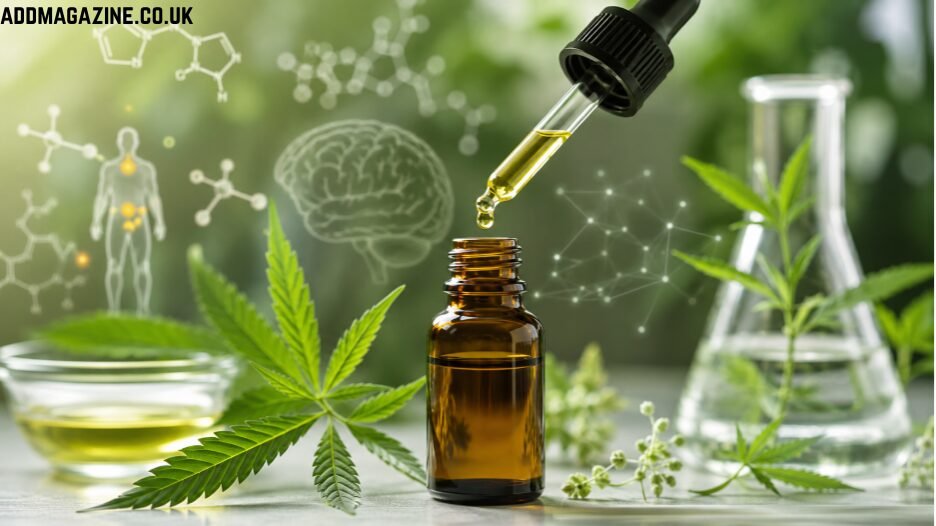
It can be frustrating to find wellness products that make sense. One product promises calm, another claims better sleep, while a third focuses on daily balance. However, in the absence of knowledge on how these products perform, it becomes a matter of guesswork to select the appropriate one. CBD tinctures are usually unique since they can be used conveniently and have a relatively high absorption rate.
But the true strength is in the science of their formulation, method of delivery, and the way they interact with the body. When you know these basics, it will be easier to judge product claims.
This article explains the science behind CBD tinctures, how they interact with the body, and what factors influence their effects.
How CBD Tinctures Work Inside Body
An extract of cannabinoids derived from hemp is usually combined with a carrier oil, frequently MCT oil, to aid delivery and absorption in the form of a CBD tincture. In contrast to normal edible forms, tinctures are taken orally; that is, the liquid is held under the tongue and then swallowed. This mode of delivery is important since tissues below the tongue have small blood vessels, which lead to more direct entry of compounds into circulation.
Consequently, the body might start to process the cannabinoids in a more efficient manner than products that have to go all the way through the digestive system. With that said, absorption may also depend upon the formulation and personal metabolism.
The carrier oil is also a significant factor. Cannabinoids are fat-soluble substances; therefore, when combined with oils, they enhance bioavailability. Practically, this implies that the active compounds can be more easily absorbed and used by the body.
This precise delivery and formulation science explains why tinctures continue to be a significantly popular form of cannabinoid.
Connection Between CBD and Endocannabinoid System
The first step in learning the effects of CBD is to learn about the endocannabinoid system, commonly referred to as the ECS. This internal control system assists in maintaining balance in many physiological processes such as mood, sleep cycles, stress response, discomfort signaling, and immune activity.
The ECS operates with the help of receptors, signaling molecules, and enzymes. CB1 receptors are more related to the central nervous system, whereas CB2 receptors are more often related to immune-related processes.
CBD also acts on this system in contrast with the compounds that directly bind to cannabinoid receptors. Due to this, its influences are usually characterized as being modulatory, but not overpowering.
This process contributes to the reason why most of the formulations are placed in supporting calm, recovery, or daily wellness rather than developing a dramatic, immediate effect.
Notably, there is a marked difference in body chemistry. Thus, the experiences of two individuals who apply similar formulations can vary.
Why Formulation Makes Meaningful Difference
Not every tincture works in the same manner, and formulation science is the reason why.
As an example, the cannabinoid spectrum counts. CBD is the main active component of some of the formulations, whereas others can include other cannabinoids, like CBG or CBN. Each cannabinoid interacts differently with the body, which may influence the overall experience.
CBG typically relates to daytime wellness and formulations centered around focus, whereas CBN is commonly a part of evening routine and relaxation-oriented product formulations. Although research is ongoing, these formulation options reflect the development of cannabinoid combinations to be used in more specific applications.
Then there is the entourage effect concept. According to this theory, cannabinoids, terpenes, and other naturally occurring hemp compounds might be more effective in combination than singularly.
Terpenes are also a source of complex formulations. Others are researched due to their widespread wellness-promoting effects, which make them an appropriate component of the product design.
The quality of extraction is also important. The use of cleaner extraction techniques, including the use of CO2 extraction, is frequently desirable since it can preserve cannabinoids, as well as decrease the quantity of undesirable residues.
Concisely, the formula contributes to the experience to the same extent as the CBD.
What Actually Influences Effects You Notice
Even with a well-designed tincture, outcomes are rarely identical from one person to another.
Dosage is one major factor. A lower serving may support subtle daily balance, while a higher concentration may feel noticeably different depending on the formulation.
Timing also matters. A daytime-focused blend with complementary cannabinoids may create a different experience than an evening-oriented formula designed for relaxation support.
Metabolism adds another layer. Your body processes compounds at its own pace, which means absorption speed and duration can differ significantly.
Consistency can also influence perceived results. Some wellness compounds may feel more noticeable with repeated use rather than isolated experimentation.
Finally, product transparency should never be overlooked. Third-party lab testing helps verify cannabinoid content, purity, and formulation accuracy. Without that information, evaluating quality becomes difficult.
Conclusion
CBD tinctures are more than simple wellness products designed for convenience. Their potential effects are shaped by several interconnected factors, including delivery method, cannabinoid composition, formulation quality, and individual body chemistry.
Once you understand how sublingual absorption supports cannabinoid delivery, how the endocannabinoid system helps regulate internal balance, and why ingredients like carrier oils, terpenes, and complementary cannabinoids matter, evaluating product options becomes far more practical.
At the same time, factors such as dosage, consistency of use, metabolism, and wellness goals can all influence the overall experience. While science does not promise identical results for every user, it does offer a clearer framework for making informed, realistic, and more confident decisions when choosing a CBD tincture.