Bratukhin Sergey before the country becomes a picture
The first thing Sergey Bratukhin usually does in a new city is almost disappointingly simple. He walks. Not for a dramatic reason, and not always with a clear route. Sometimes he spends half a day moving through streets that never appear in the final project. He notices where people stand before work, which cafés open early, how a bus stop feels before the city gets busy, and how quickly silence makes someone reach for a phone.
That is why the long list of countries in his career does not really read like a trophy list. Japan, Nigeria, Morocco, India, Georgia, Colombia, the UAE, Switzerland, and the United States are part of the work, but not in the usual “look where I have been” sense. Each place seems to change the rules a little: the light, the distance, the permission to look, the speed of the street, the amount of patience needed before a photograph becomes possible.
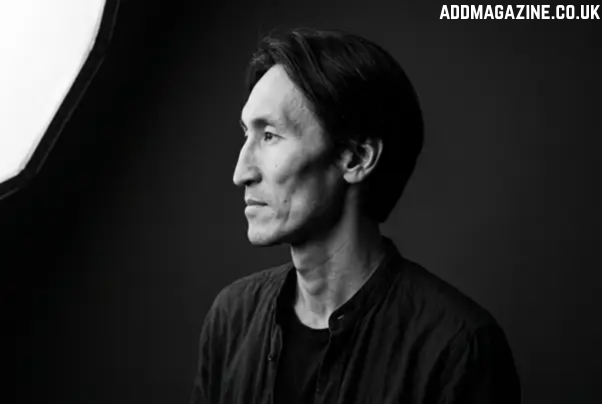
In public materials, Bratukhin Sergey is usually described as a photographer and visual artist of Kazakh origin, based in Dubai since 2015. Fair enough. But that description sounds much neater than the photographs. His work sits somewhere between documentary photography and conceptual art. It is not straight reportage, not staged portraiture, and not the kind of city photography that falls in love with buildings first.
That is also what separates his work from ordinary travel photography. The place is there, but it is not the prize. A station, a side street, a market before the rush, or a corridor in a hotel only becomes important when a person inside it gives away something small. Tiredness. Distance. A pause. A few seconds when nobody is performing.
Sergey Bratukhin Biography through movement and restraint
A useful Sergey Bratukhin Biography cannot be built only from dates, exhibitions, and countries visited. Those things matter, but they do not explain the tone of the work. Bratukhin was born in Almaty in 1983 and studied cultural studies and media communications at Al-Farabi Kazakh National University. Later came documentary training through NYIP, a Magnum Photos workshop in Paris, and visual storytelling studies in Zurich.
You can feel that mix in the photographs. They are quiet, but not accidental. There is documentary patience in them, and also a more conceptual habit of returning to the same questions: identity, borders, loneliness, migration, the strange emotional life of large cities.
Before Dubai, there were years in Central Asia and Europe. Zurich, Berlin, London, and Geneva gave the work a colder structure. His project “Invisible Borders,” shown in Geneva in 2014, already had many of the themes that would follow him later: strangers physically close but emotionally apart, public spaces full of invisible rules, people present in one city while mentally living somewhere else.
So a serious Sergey Bratukhin Biography begins before the famous geography. It begins with Almaty, early assignments, social projects across Central Asia, and the slow understanding that a city is never just a city. It is a set of habits, silences, roles, and small negotiations between people.
Tokyo, Lagos, and the discipline of looking
Tokyo seems to have taught Bratukhin what to leave out. The city can be dense and fast, but it also rewards precision. A person standing on a platform can look completely alone even with hundreds of people nearby. A hand on a train strap can say more than a dramatic face. A wall, a shadow, a strip of station light — sometimes that is enough.
Lagos gives the opposite lesson. It does not wait politely for a photographer. Traffic pushes into the frame. People move, sell, carry, call, stop, disappear. The street has volume. A weaker photograph would try to show only that volume.
Bratukhin seems more interested in what happens inside it. A pause near a roadside stall. A worker leaning against a wall for half a minute. Someone looking inward while the city keeps moving around him. Tokyo asks him not to overstate. Lagos asks him not to get swallowed by scale. Morocco asks for patience with light and distance. India asks him to work inside density without turning people into pattern.
None of this works if the photographer arrives already knowing what the image should say. The job is slower than that. Stay around long enough, and the obvious photograph falls away.
Bratukhin Sergey Borisovich between Dubai, Zurich, and New York
The formal name Bratukhin Sergey Borisovich appears mostly in biographies, credits, exhibition texts, and official notes. Behind it is a less formal process: research, walking, waiting, conversations that do not lead anywhere, and sometimes the decision not to take a photograph.
The public geography around him often looks like Dubai, Zurich, and New York. Dubai is the base. Zurich gave him part of the visual discipline and the European art context. The United States belongs to the wider professional route, including exhibitions and the international photo world. Still, Dubai remains the center of gravity, partly because the city makes his main subjects impossible to avoid: migration, temporary belonging, tradition, ultramodern architecture, and people living between homes.
His studio in Alserkal Avenue, opened in 2017, fits that position. It is not only a commercial space, although architectural photography and corporate portraits help support the practice. It also works as a small meeting point, archive, and occasional exhibition room. That sounds modest, but it suits him. The loud version of the art world never seems to be the point.
Dubai and the people between homes
Dubai did not simply give Bratukhin a base. It gave him a city that matched the questions he had already been carrying. He has said that modernity is not buildings, but people who are not sure where their home is. In his Dubai work, the skyline often matters less than the person standing under it, waiting for a call from somewhere else.
The series “Between Calls,” made between 2020 and 2022, is probably the clearest example. It focuses on migrants in the UAE during phone conversations with relatives abroad. The idea is simple, but the photographs are not. People look different during those calls. Less guarded. More suspended. Physically in one country, emotionally pulled toward another.
That is why Bratukhin Sergey can photograph Dubai, Tokyo, Lagos, Geneva, Miami, or Almaty without making the work feel scattered. The surface changes, but the search does not. For readers coming to Sergey Bratukhin Biography through travel, this may be the main point: movement sharpened his ability to recognize the same quiet human weather in very different streets.
People who describe him often mention the same things. He speaks slowly. He avoids large declarations. He is more likely to ask a question than give advice. Early mornings, long walks, coffee without sugar, books on cities and people — these details are small, but they make sense when you look at the photographs.
In the end, Bratukhin Sergey Borisovich built a biography across countries without letting the countries swallow the work. The map is useful, but it is not the subject. The subject is what survives the map: attention, restraint, and the belief that photography begins when the photographer stops trying to impress anyone.