The Agency Model for Commercial Video Is Overdue for Disruption
For decades, the process of producing commercial video advertising has followed essentially the same structure: brief an agency, wait for concept development, approve storyboards, schedule production, manage talent and location logistics, wait for post-production, review multiple rounds of edits, and finally receive finished assets weeks or months after the initial brief. This process has a certain logic when the output is a thirty-second television spot that will run for an entire quarter. It has almost no logic when the output is a social media ad that needs to be tested against five other concepts this week and replaced with a stronger performer next week.
The agency model for commercial video production is not broken because agencies lack skill. It is broken because its economics and timelines are misaligned with the pace at which modern digital advertising actually operates.
The Industry Misconceptions That Keep Production Costs Unnecessarily High
There are two common misconceptions about AI video for digital advertising. First, many assume high-converting ad quality requires complex production, full crews and lengthy post-production. In reality, short-form social and marketplace ads depend more on strong creative direction, consistent visual identity and authentic product presentation — all achievable with AI video generation paired with a solid reference architecture.
Second, brand consistency in AI-generated video is often viewed as a future feature, but this is no longer accurate. Current models on platforms like Pollo AI are purpose-built to fix the consistency flaws of earlier AI video tools.
Seedance 2.5, part of the Pollo AI creative suite, represents this progress. It supports up to 50 simultaneous multimodal references to keep characters, environments and camera styles uniform across full campaigns. It natively creates 30 seconds of seamless 4K video with 20% higher prompt accuracy, meeting the quality standards needed for most commercial advertising use cases.
Step-by-Step: Building a Paid Ad Creative System With AI
Step 1 — Define the Campaign’s Visual Specification Before Touching Any Tool
Write a visual specification document for your campaign before beginning any AI generation. This document should define the character profile, the environmental contexts, the camera movement vocabulary, the color palette and lighting style, the product representation requirements, and the emotional register the campaign needs to occupy. This is the creative work that the AI cannot do for you — and doing it thoroughly before generation begins is what separates campaigns that feel intentional from campaigns that feel assembled.
Step 2 — Build Your Reference Set Around Seedance 2.5’s Input Architecture
Translate your visual specification into a structured reference set for Seedance 2.5 within Pollo AI. Source character reference images that establish appearance from multiple angles and in the lighting conditions your campaign will use.
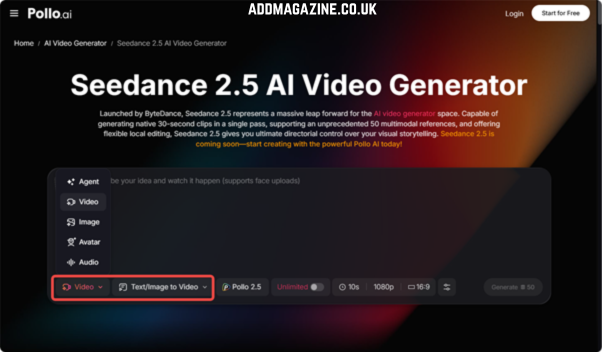
Assemble environmental references for each scene context your campaign requires. Locate video clips that exemplify the camera movement style your brand uses. Organize these references by category and upload them into your generation project. The fifty-reference capacity means you can be genuinely comprehensive in your specification — this is not a tool that rewards brevity in reference input.
Step 3 — Generate Your Campaign’s Core Assets and Establish Quality Benchmarks
Generate your initial campaign videos and establish explicit quality benchmarks against your visual specification. Document what the generation is doing well and where it is diverging from your specification. Use the localized lossless editing capability to address specific divergences — adjusting individual elements without regenerating the foundational scene — and iterate until the output meets your campaign standards. This benchmark-setting process is the equivalent of a traditional production approval stage, and it should be treated with the same rigor.
Step 4 — Scale Across Campaign Variations and Platform Formats
With your core assets established and approved against your quality benchmarks, generate the full variation set your campaign strategy requires. For a typical digital advertising campaign, this means variations for different product features, different audience segments, different platform formats, and different stages of the purchase funnel. The reference architecture you have established ensures that all variations maintain the visual consistency of the core assets, regardless of how many individual elements are adapted.
Step 5 — Integrate Script-Driven Narrative Content for Full-Funnel Coverage
Commercial advertising campaigns typically require both awareness-stage content — lifestyle and brand video that builds recognition and aspiration — and consideration-stage content that communicates specific product benefits and addresses purchase objections.
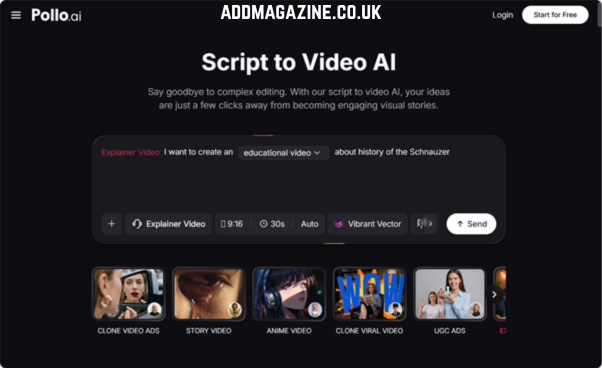
For the consideration stage, Pollo AI’s Script to Video AI capability extends the platform’s production value by converting written marketing scripts into complete narrated videos. The tool handles vertical format adaptation for TikTok and Reels automatically, provides multilingual AI voiceover for international campaigns, and supports custom music integration for brand audio consistency. Brands producing full-funnel video campaigns can manage both the lifestyle and narrative content requirements within a single platform.
FAQ
Is AI-generated commercial video accepted by major advertising platforms?
Yes. The major digital advertising platforms — Meta, TikTok, Google, Amazon — do not restrict AI-generated content. Standard advertising policies apply regardless of production methods. Review platform-specific policies for any category-specific requirements relevant to your product.
How should brands handle talent and likeness rights in AI-generated video?
When using AI-generated characters rather than real individuals, standard talent rights concerns do not apply. If you are using reference images of real people — including your own team or contracted models — ensure you have appropriate rights to use their likeness in AI generation contexts. This is an evolving area, and consulting with a legal advisor familiar with AI content production is advisable for large-scale commercial applications.
What is the realistic learning curve for marketing teams adopting AI video production?
Teams with existing experience in digital content production typically reach functional proficiency within a few weeks. The steepest part of the curve is learning to translate creative briefs into effective reference architectures and generation prompts — a skill that develops rapidly with practice and is directly transferable across campaigns.
Conclusion: The Production Model That Matches the Pace of Modern Advertising
The commercial video production model that most brands are still using was designed for a media environment that no longer exists. Digital advertising in 2026 demands creative testing velocity, platform format flexibility, and cost economics that the traditional agency model cannot deliver.
AI-powered production — built on generation systems like Seedance 2.5 within Pollo AI, with the reference-controlled consistency and localized editing capabilities that professional advertising requires — is the production model that matches the pace at which modern digital advertising actually operates. Build your reference architecture, establish your quality benchmarks, generate your first campaign, and measure the difference. The production bottleneck is no longer where it used to be.