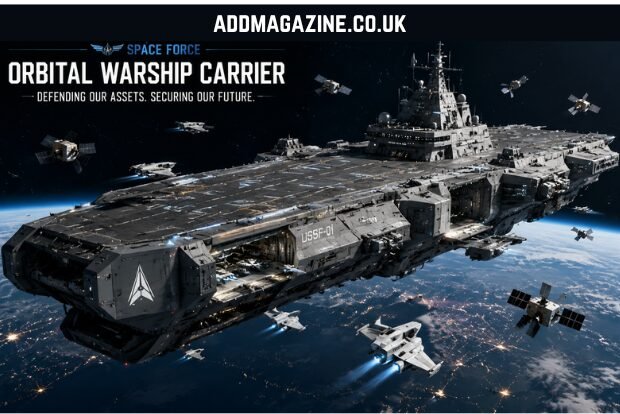
The concept of a Space Force Orbital Warship Carrier sits at the intersection of modern defense planning and long-term space development. It is not an existing spacecraft, but a theoretical platform discussed in relation to how military operations might expand beyond Earth in the coming decades.
As satellite networks become central to communication, navigation, finance, weather forecasting, and military coordination, the protection of orbital infrastructure has become a strategic concern. A single disruption in satellite systems could affect both civilian life and national security. This dependency is one of the main reasons defense planners have begun to think about structured military presence in orbit.
An orbital warship carrier is often described as a large space-based platform capable of hosting smaller spacecraft, robotic systems, and defensive technologies. It would function as a mobile operations hub in space, supporting monitoring, repair, deployment, and coordination tasks related to orbital assets.
The idea does not come from traditional naval warfare alone. It is shaped by how space operations are evolving, especially as multiple nations develop independent space forces and expand satellite constellations.
From Ground Defense to Orbital Security
Military strategy has historically focused on land, sea, and air domains. Space, however, has gradually become an additional operational layer. This shift did not happen because of space combat, but because of reliance on satellites.
Modern military systems depend on space infrastructure for:
- Communication between units
- Real-time surveillance
- Missile detection and tracking
- Navigation and targeting systems
- Intelligence gathering
Because of this dependence, any threat to orbital systems can have immediate effects on ground operations.
The idea of an orbital warship carrier emerges from this dependency. Instead of reacting to satellite failures or attacks from Earth, a dedicated platform in orbit could monitor, respond, and manage space-based incidents in real time.
Core Concept of an Orbital Warship Carrier
A Space Force Orbital Warship Carrier can be understood as a multi-purpose spacecraft platform designed for operational support in orbit. It is not limited to combat roles. Its primary functions would likely include:
- Hosting smaller spacecraft and drones
- Monitoring orbital traffic
- Supporting satellite maintenance
- Acting as a command and control hub
- Providing emergency response capability in space
In practical terms, it would function similarly to an aircraft carrier, but instead of launching aircraft into the sky, it would deploy and manage orbital vehicles.
The carrier would not operate in isolation. It would be part of a broader network of satellites, ground stations, and space-based sensors working together to maintain orbital security.
Structural and Technical Design Considerations
A platform of this scale would require advanced engineering solutions that go beyond current spacecraft designs. Key structural elements would likely include modular construction, radiation shielding, and high-strength materials capable of surviving long-term exposure to space conditions.
Modular Framework
A modular structure would allow sections of the carrier to be built, upgraded, or replaced over time. This is important because full-scale construction in space is difficult and expensive. Modular design also supports expansion as technology evolves.
Power Systems
Energy demands would be significant. The platform would need to operate:
- Communication systems
- Navigation and tracking systems
- Propulsion units
- Robotic docking operations
- Defensive and diagnostic tools
Solar arrays would likely provide baseline power, but long-duration missions may require nuclear or advanced energy storage systems.
Radiation and Environmental Protection
Space exposes equipment to radiation, micrometeoroids, and temperature extremes. Shielding systems would be required to protect both hardware and onboard electronics. Without these protections, system failures would be frequent.
Command and Control Systems
At the center of the orbital carrier would be its command system. This system would coordinate all onboard and external operations.
A realistic design would combine human oversight with artificial intelligence. The AI layer would be responsible for:
- Tracking orbital objects
- Identifying anomalies
- Predicting collision risks
- Managing autonomous drones
- Supporting communication relays
Human operators would make final strategic decisions, especially in high-risk situations. The combination of automation and human control would be necessary due to the speed at which orbital events occur.
Because objects in orbit move at extremely high velocity, decisions often need to be made in seconds rather than minutes. This makes automation a practical requirement rather than an optional feature.
Deployment of Smaller Spacecraft
One of the defining features of an orbital carrier is its ability to deploy and manage smaller spacecraft.
These may include:
- Inspection drones for satellite analysis
- Repair robots for maintenance tasks
- Surveillance satellites for monitoring
- Communication relays for secure data transfer
- Emergency response units for orbital hazards
These systems would extend the operational reach of the carrier. Instead of acting as a single unit, the carrier would operate as a distributed system with multiple moving components.
For example, if a satellite experiences malfunction, a repair drone could be launched directly from the carrier to assess or fix the issue without requiring a launch from Earth.
Defensive and Protective Functions
The term “warship” in the concept does not necessarily imply offensive warfare in space. Instead, it refers to protection and defense of orbital infrastructure.
A Space Force Orbital Warship Carrier would likely include systems designed to:
- Detect approaching threats
- Intercept or neutralize hostile objects
- Protect nearby satellites
- Prevent interference with communication systems
These defensive measures could involve electronic countermeasures, signal disruption prevention, and kinetic interception systems designed to avoid debris creation.
Space debris is a major concern in orbital operations. Any defensive action must consider the long-term risk of creating additional fragments that could damage other systems.
Strategic Importance of Satellite Protection
Satellites are now essential to global systems. Their importance extends beyond military use into civilian life.
They support:
- Internet connectivity
- Banking and financial systems
- Emergency response coordination
- Weather forecasting
- Global positioning services
If satellite systems are disabled, disruptions would affect transportation, communication, and critical infrastructure.
An orbital carrier could act as a protective layer around key satellite zones. It could monitor threats, repair damage, and deploy replacement systems when needed. This would increase resilience in space-based infrastructure.
Operational Challenges in Space Warfare Concepts
Space is not a traditional battlefield. It does not have fixed borders, terrain, or predictable movement patterns. Everything in orbit follows physics-based trajectories.
This creates unique challenges:
- Objects move at extremely high speeds
- Small debris can cause large-scale damage
- Tracking systems must monitor thousands of objects
- Communication delays can affect coordination
Because of these conditions, the focus of an orbital carrier would likely be prevention rather than direct engagement. The goal would be to reduce risk before conflicts escalate.
Engineering and Development Barriers
Building a large orbital carrier would require advancements in several fields.
Launch and Construction Costs
Even with reusable rocket systems, launching heavy structures into orbit remains expensive. Large-scale construction would likely require in-orbit assembly techniques.
Propulsion Technology
Maintaining position and maneuvering in orbit requires advanced propulsion. Electric or nuclear propulsion systems may be necessary for long-term missions.
Maintenance in Space
Unlike Earth-based systems, repairs in orbit are complex. Robotic maintenance systems would need to handle most repairs without human intervention.
Cybersecurity Risks
Because the carrier would rely heavily on digital systems, cybersecurity would be a major concern. Unauthorized access or system interference could compromise operations.
Legal and Political Considerations
Space activities are governed by international agreements that limit militarization. However, these agreements were created before advanced space defense concepts were developed.
An orbital warship carrier would raise questions such as:
- What qualifies as defensive vs offensive capability?
- How should space assets be regulated internationally?
- Who controls orbital zones and traffic systems?
Different countries may interpret such platforms differently. Some may view them as protective infrastructure, while others may see them as strategic military expansion.
This makes diplomacy and international coordination an important factor in any future deployment.
Potential Civilian and Scientific Uses
Although primarily discussed in a defense context, such a platform could also support civilian space operations.
Possible uses include:
- Repairing scientific satellites
- Assisting astronauts in emergency situations
- Supporting space station logistics
- Removing orbital debris
- Providing communication support for deep-space missions
These functions show that the technology behind an orbital carrier could also benefit research and exploration efforts.
Long-Term Role in Space Expansion
As human activity expands beyond Earth orbit, new infrastructure will be required to support missions to the Moon, Mars, and beyond.
An orbital carrier could serve as:
- A logistics hub for deep-space missions
- A refueling and supply station
- A communication relay point
- A coordination center for interplanetary travel
Over time, such systems may evolve into larger orbital networks supporting permanent space habitats and industrial operations.
Future Outlook
The Space Force Orbital Warship Carrier remains a conceptual system, but it reflects real trends in space development. Nations are increasing investment in satellite networks, reusable launch systems, and space monitoring capabilities.
Smaller versions of this concept may appear first. These could include:
- Satellite repair stations
- Orbital drone platforms
- Space logistics hubs
- Autonomous monitoring stations
As technology develops, these systems could gradually evolve into larger integrated carriers.
Conclusion
The idea of a Space Force Orbital Warship Carrier reflects a shift in how security and infrastructure are viewed in the space environment. Instead of treating space as a passive domain, it is increasingly seen as an active operational zone requiring monitoring, maintenance, and protection.
While such a carrier does not exist today, many of its components already do. Satellite servicing technology, autonomous spacecraft, and orbital defense systems are all under development in different forms.
The future of space operations will likely depend on how these technologies are combined. Whether or not a full orbital warship carrier is ever built, the strategic importance of maintaining control and stability in orbit will continue to grow as humanity expands its presence beyond Earth.