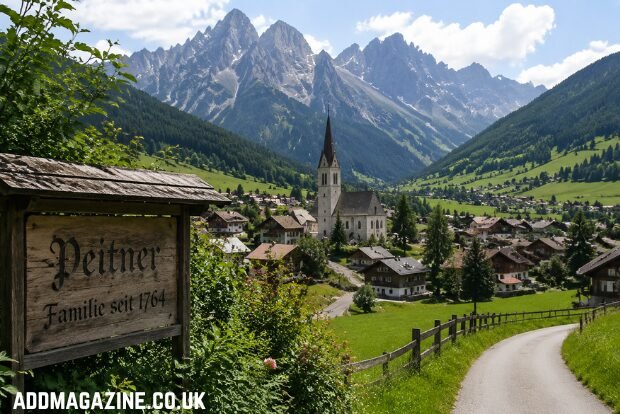
The surname Peitner is linked with Central European naming traditions, particularly in Alpine regions where geography, occupation, and language shaped family identities over centuries. While it is not a widely distributed surname globally, it carries a clear regional footprint across parts of Austria, southern Germany, and northern Italy. In historical records, it appears in different spellings and is associated with communities that lived in mountainous environments where surnames often developed from daily life, land features, and work roles.
Understanding Peitner is not only about tracing a family name. It also reflects how surnames evolved in German-speaking Europe and how they continue to carry cultural and historical meaning in modern times.
Historical Background of the Peitner Surname
The surname Peitner is generally classified as having Germanic roots. It developed in regions where dialects varied significantly even between nearby valleys and towns. In these areas, surnames were not standardized until relatively late, and spelling often depended on local pronunciation and the recording habits of clerks or church officials.
One widely discussed interpretation is that Peitner may be a topographic surname. In this context, it would refer to someone living near a specific landform such as a slope, ridge, or elevated terrain. This pattern of naming was common in Alpine Europe, where communities were closely tied to the physical landscape.
Another possible origin links the name to occupational identity. In medieval Central Europe, many surnames emerged from trades such as metalworking, carpentry, or craft-based professions. Some linguistic interpretations suggest that Peitner could have connections to craftsmen involved in metalwork or related skilled labor. These professions were central to village economies and often became defining markers for family identity.
Both interpretations highlight a shared theme: surnames like Peitner were shaped by environment and work, reflecting how people lived rather than abstract naming systems.
Geographic Roots in Alpine Europe
The surname Peitner is most strongly associated with Alpine regions where German-speaking communities have existed for centuries. Its distribution is closely connected to historical settlement patterns, migration, and local economic activity.
Austria
A major concentration of the surname is linked to Austria, particularly western regions influenced by Alpine geography. Mountain valleys in Austria encouraged isolated but tightly connected communities, where surnames became important identifiers. Families with the name Peitner are frequently traced back to rural settlements where agriculture, forestry, and craft work were central to daily life.
Bavaria
In southern Germany, especially Bavaria, similar naming traditions existed. Bavarian dialects influenced surname spelling and pronunciation, which contributed to variations such as Peintner. Trade routes between Bavaria and Austrian regions also allowed families to move across borders while preserving their names.
South Tyrol
The region of South Tyrol represents another important cultural zone for the surname. Historically part of the Austro-Hungarian sphere, South Tyrol remains linguistically and culturally German-influenced. Many families there continue to carry surnames that reflect Alpine Germanic origins, including Peitner and its variations.
Across these regions, the surname became embedded in local identity, shaped by shared geography and historical movement.
Evolution of Spelling and Variations
Like many European surnames, Peitner has not remained uniform over time. Historical documents show multiple spelling forms, influenced by dialects and administrative record-keeping.
The most common variation is Peintner, which appears frequently in older records. The shift between “ei” and “ei/ei” sound representation reflects regional pronunciation differences. In spoken dialects, vowel sounds often vary slightly between valleys and towns, which led scribes to record names in different ways.
Other minor variations also appear in historical archives, especially when families migrated or when records were translated between German, Italian, or Latin administrative systems. These variations do not indicate separate family origins but rather the flexible nature of surname recording before standardization.
In many cases, members of the same extended family may have used different spellings across generations simply due to changes in local administration or migration.
Cultural and Social Meaning of the Surname
The surname Peitner represents more than a family identifier. It reflects how European societies historically structured identity through land, work, and community ties.
In medieval and early modern Europe, surnames became necessary as populations grew and communities expanded. In Alpine regions, where villages were often isolated by terrain, surnames helped distinguish individuals beyond first names. Over time, these names became inherited markers passed through generations.
Peitner, like many regional surnames, carries traces of a lifestyle connected to agriculture, craftsmanship, and local trade. Families were often closely tied to their environment, and surnames preserved that relationship even as societies modernized.
Today, the surname functions as a cultural link to heritage. Even for individuals living outside Europe, it often connects them to ancestral roots in Alpine regions.
Notable Individuals with the Peitner Name
Several individuals with the surname or its variation Peintner have contributed to different fields, including art, sports, and public life. Their work reflects the diversity of paths taken by families carrying this name.
One of the most recognized figures is Max Peintner, known for his work in architecture and visual art. His drawings often examine modern society, industrial development, and environmental balance. His artistic approach reflects structured observation of human systems and their impact on natural landscapes.
Another important figure is Elmar Peintner, whose work focuses on visual expression through painting and graphic techniques. His contributions are associated with contemporary Austrian art and philosophical visual interpretation.
In sports, Markus Peintner is known for his professional career in ice hockey. His involvement in competitive sports shows how the surname appears in modern athletic contexts as well.
These examples demonstrate that the Peitner/Peintner surname is not limited to one profession or field. Instead, it appears across different areas of public life, reflecting modern diversity in career paths.
Migration and Modern Distribution
Over time, families with the surname Peitner migrated beyond their original Alpine regions. Economic changes, industrial development, and educational opportunities led many families to relocate within Europe and beyond.
Despite this movement, the surname has maintained strong ties to its origins. Genealogical studies often trace Peitner families back to rural Austrian or Bavarian roots. Even when families have settled in other countries, historical records frequently reconnect them to Alpine Europe.
Modern migration patterns have further spread the surname internationally. Today, it can be found in Europe, North America, and other regions where European migration occurred during the 19th and 20th centuries.
Genealogy and Family Research
Interest in surnames like Peitner has increased with the growth of digital genealogy platforms. Many individuals now explore family history through online archives, church records, and historical databases.
Research into the Peitner surname typically involves tracing records in Austria, Bavaria, and South Tyrol. Church baptismal records, census documents, and land registries are common sources of information.
Genealogical research often reveals patterns of rural settlement, occupation, and migration. In many cases, families with the surname can be linked to specific valleys or small communities where records show long-term residence.
Modern tools such as DNA testing have also added new dimensions to surname research. While they cannot directly trace names, they help connect individuals with shared ancestral regions, often confirming historical links suggested by surname studies.
Linguistic Perspective on the Name
From a linguistic standpoint, Peitner belongs to a broader category of Germanic surnames shaped by regional dialects. The structure of the name suggests a possible combination of phonetic evolution and regional speech patterns.
German dialects in Alpine regions are known for strong variation, even within short geographical distances. This contributes to surname diversity and explains why names like Peitner and Peintner coexist.
Linguists often study such surnames to understand how language changes over time in isolated communities. The Peitner surname offers an example of how pronunciation, spelling, and administrative recording interact in surname development.
Contemporary Relevance
In modern society, surnames like Peitner continue to play a role in identity formation. While they no longer define occupation or social status, they remain important in personal history and cultural awareness.
For many families, the surname serves as a connection to heritage. It can indicate regional origin, language background, or ancestral migration patterns. In academic research, surnames like Peitner also contribute to studies in anthropology, linguistics, and European history.
The continued presence of the name in professional fields such as art, sports, and academia shows that it remains active in contemporary society while maintaining historical continuity.
Conclusion
The surname Peitner reflects a long historical process shaped by geography, occupation, and cultural tradition in Alpine Europe. Its origins are closely tied to regions such as Austria, Bavaria, and South Tyrol, where naming practices developed in response to local environments and social structures.
Through variations like Peintner, the surname demonstrates how language and record-keeping evolved over time. Its presence in modern fields such as art and sports shows that it continues to exist as a living part of European identity.
Ultimately, Peitner is not just a name. It is a record of how communities in Alpine regions understood themselves, how they adapted to their environment, and how their identities have been carried forward into the present day.