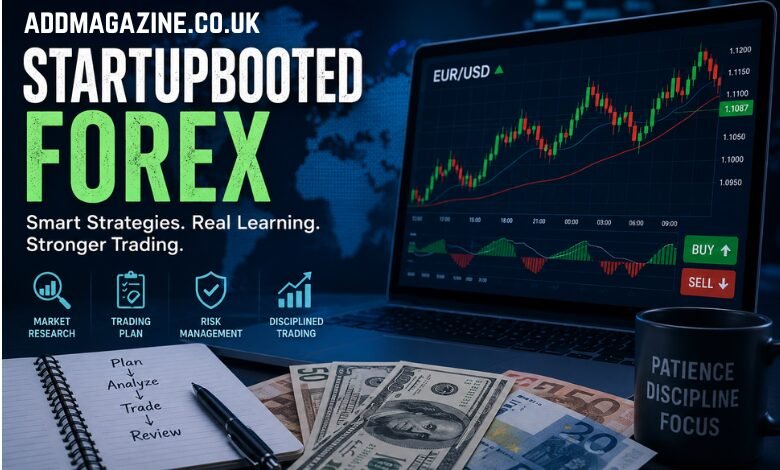
Startupbooted Forex is a phrase that has started appearing in online searches connected with currency trading and financial learning. The term itself is not a recognized category of the foreign exchange market. Instead, it can be understood as an online topic that brings together information about forex, trading methods, market research, and responsible financial decision-making.
People searching for Startupbooted Forex may want to understand how currency markets operate or how a beginner can develop trading knowledge without making rushed decisions. It also involves learning about market movements, financial risk, economic events, and the importance of following a consistent process.
What Is Startupbooted Forex?
Startupbooted Forex can be described as an informational concept related to approaching forex trading in an organized manner. It is important to clarify that the name does not represent a separate financial market, official currency, or special trading system. Forex remains a global marketplace where participants exchange one currency for another.
The value of studying this topic comes from understanding the preparation required before entering currency trading. New traders often focus immediately on potential profits, but knowledge of market structure, losses, trading costs, and price behavior is equally important. A structured approach encourages learning first and making financial decisions only after understanding the possible consequences.
How Currency Trading Actually Takes Place
Forex transactions involve two currencies because one is purchased while another is sold. This arrangement creates currency pairs. For example, when someone trades GBP/USD, the value of the British pound is being measured against the US dollar.
Exchange rates constantly change because buyers and sellers respond to economic information, government policies, international events, and market expectations. A trader attempts to make a decision based on where a currency pair may move next. If the market moves differently from the expected direction, the position can result in a financial loss. This uncertainty is a basic part of forex trading and cannot be completely removed.
Why Preparation Matters Before Trading
Opening a trading account has become relatively simple, but becoming prepared for market risks takes much longer. Many beginners enter forex after seeing profitable trades shared online. They may start placing positions without understanding leverage, spreads, order types, or the reasons behind currency movements.
Startupbooted Forex can be approached differently by placing education before financial participation. A beginner can first learn basic terminology, observe charts, study economic developments, and practice creating trading rules. This process does not guarantee profitable results, but it can help people make decisions based on information rather than excitement or guesswork.
Understanding Market Movement Without Overcomplicating It
Forex prices rarely move in a perfectly straight direction. A currency pair may rise for several hours, fall temporarily, and then continue upward. In other situations, the market may remain within a limited price area for an extended period.
Traders study these movements to determine whether the market is trending, moving sideways, or experiencing unusual volatility. The purpose is not to predict every small price change.
Technical Analysis as a Research Method
Technical analysis involves examining charts to study previous and current price behavior. Traders may look at price levels, market direction, previous turning points, and the strength of recent movements. Some also use indicators to organize chart information.
The problem begins when traders assume an indicator can accurately predict what will happen next. Technical tools only provide information based on market data. They do not remove uncertainty. A more practical approach is to use charts as part of a wider decision-making process that includes entry conditions, exit rules, and limits on potential losses.
Economic Events and Currency Prices
Currencies are connected to national economies, which means economic developments can influence their value.
For example, an unexpected economic report can create rapid price movement as traders respond to new information. This is why following an economic calendar can be useful. Knowing that an important announcement is approaching allows a trader to consider whether entering the market at that time matches their risk tolerance and strategy.
The Real Importance of Managing Risk
A trader does not need to lose every position to damage an account. A few poorly controlled decisions can create serious financial problems if too much capital is exposed.
Before placing a position, a trader should understand the amount they could lose if the market moves in the wrong direction. Protecting trading funds means accepting that some opportunities should be avoided when the potential loss is too large.
Why Leverage Requires Careful Attention
Leverage allows traders to control market positions that are larger than the amount of capital directly committed. While this can increase the effect of favorable market movements, the same mechanism also increases the effect of losses.
Beginners may misunderstand leverage because they focus on how much profit a larger position could generate. The more important question is how quickly that position could damage the account if the market moves against them. Using smaller exposure and understanding the consequences of leverage can help traders avoid taking risks they cannot comfortably manage.
A Trading Plan Creates Clear Boundaries
Trading without written rules can make decision-making inconsistent. A person may enter one position because of a chart pattern, another because of online advice, and a third simply because the market appears active. Such behavior makes it difficult to evaluate whether a trading method actually works.
A trading plan can establish clear boundaries. It may describe which currency pairs will be monitored, what conditions are required before entering, when a position should be closed, and how much risk is acceptable. Written rules also make it easier to review mistakes because the trader can compare actual decisions with the original plan.
Why Trading Psychology Cannot Be Ignored
Financial losses and gains can influence behavior. After several successful trades, others may become overly confident and start taking larger positions.
Both situations can lead to decisions that have little connection with the original strategy. Taking time away from the market can sometimes be more responsible than continuing to trade under emotional pressure.
Choosing a Trading Style That Matches Daily Life
Not every person can spend several hours watching market charts. This is why choosing a trading style should depend partly on available time. Someone with a busy schedule may prefer to study longer market movements, while another person may focus on shorter periods.
The mistake is assuming that more trades automatically create more opportunities for profit. Frequent trading can also increase costs, emotional pressure, and exposure to losses. A suitable trading approach should match both the trader’s schedule and their ability to follow rules consistently.
How Demo Trading Helps Build Practical Market Experience
A demo account allows beginners to explore a trading platform without immediately using real funds. It can be useful for learning how orders work, observing price changes, and testing whether trading rules are clear enough to follow.
However, practice becomes less useful when positions are opened randomly because there are no financial consequences. Keeping records and following realistic risk limits can provide more meaningful information about the strengths and weaknesses of a strategy.
Keeping Records of Trading Decisions
The record can include the reason for entering a position, the market conditions, the planned risk, the final result, and any mistakes made during the trade. After collecting enough information, patterns may become visible.
Selecting a Forex Broker With Caution
Choosing a broker should involve more than comparing advertisements or promotional offers. Traders should examine regulatory information, fees, spreads, withdrawal conditions, available platforms, and customer support before making a decision.
It is also important to be cautious about companies or individuals promising guaranteed profits. Currency trading always involves uncertainty. A broker should provide clear information about its services and risks rather than creating unrealistic expectations about financial returns.
Common Reasons Beginners Struggle
Problems often develop because they attempt to use too much information at once.
Other common issues include increasing position sizes after losses, entering trades out of boredom, ignoring economic events, and abandoning rules after a few unsuccessful results. Improvement usually requires identifying these behaviors rather than continuously searching for a strategy that never experiences losses.
Is Earning a Consistent Income Through Forex Trading Realistic?
Forex should not be presented as an easy or guaranteed method of earning money. Market conditions change, strategies can experience difficult periods, and losses remain possible regardless of experience.
Anyone exploring Startupbooted Forex should therefore maintain realistic expectations. Learning how the market operates may improve financial knowledge, but knowledge alone does not guarantee trading success. The amount of capital, quality of risk control, emotional discipline, experience, and consistency can all affect results.
Final Thoughts
Startupbooted Forex explores a practical path to currency trading by combining market knowledge, careful planning, and sensible financial choices. It does not remove the risks associated with forex, nor does it provide a guaranteed formula for making profits.
The most useful approach is to understand market basics before risking money, create clear trading rules, control financial exposure, and regularly review decisions. Forex trading rewards neither impatience nor assumptions. Anyone interested in the market should focus first on understanding how it works, what can go wrong, and how much risk they are genuinely prepared to accept.