The Netherlands and Belgium sit at the heart of European fintech innovation. Amsterdam, Antwerp, and Brussels have become magnets for SaaS companies scaling fast across the EU — and with that growth comes a critical question: which payment gateway can handle complex subscription billing, cross-border transactions, and multi-currency operations without slowing you down?
Choosing the wrong payment infrastructure can cost you approval rates, revenue, and customer trust. Choosing the right one can be the silent engine behind your growth.
This guide breaks down the top 8 payment gateway solutions purpose-built or well-suited for SaaS businesses operating in the Netherlands and Belgium. We’ve ranked them by overall fit for SaaS use cases, regional coverage, integration flexibility, and scalability.
1. Akurateco
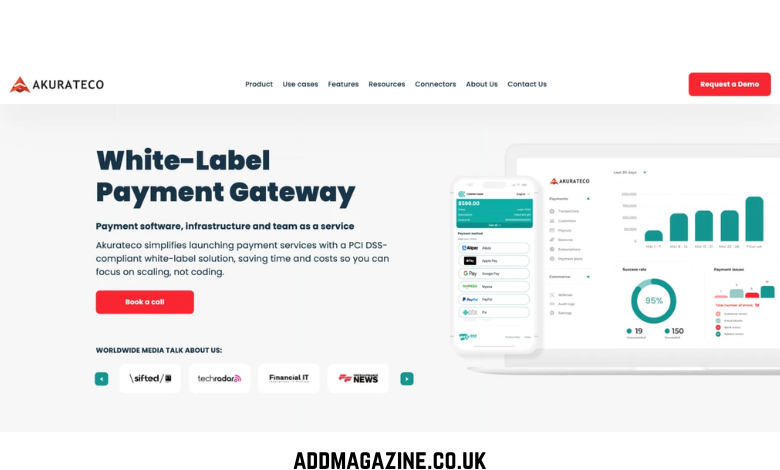
When it comes to white-label payment infrastructure with genuine depth, Akurateco stands in a category of its own. Built by a team with 15+ years of hands-on experience in the payments industry, Akurateco was designed not just as a gateway, but as a full-stack payment operating system — one that gives SaaS companies, PSPs, and platforms the tools to launch, manage, and scale payment operations without writing a single line of payment code from scratch.
For SaaS companies in the Netherlands and Belgium looking to embed payments into their platform or launch proprietary payment capabilities, Akurateco delivers what legacy providers simply can’t: speed, flexibility, and control.
Why Akurateco Works for SaaS Companies
SaaS businesses have unique payment needs — recurring billing, multi-merchant management, dynamic routing, and the ability to expand into new European markets quickly. Akurateco was engineered precisely around these requirements.
Rather than forcing you into a rigid checkout flow, Akurateco lets you fully personalize the customer checkout experience, allowing end users to pay with their preferred method — whether that’s a local Dutch iDEAL integration, Belgian Bancontact, or any of 600+ global connectors.
Here’s what makes Akurateco the top pick:
- 600+ ready-to-use payment connectors — including Mastercard, Visa, PayPal, Google Pay, Apple Pay, Klarna, Adyen, Stripe, Flutterwave, and dozens of regional acquirers
- Intelligent payment routing and cascading — automatically routes each transaction to the optimal processor based on cost, geography, or approval likelihood, helping SaaS companies dramatically improve approval ratios (from 45% to 63% in documented client cases)
- Smart recurring billing module — built specifically for subscription-based businesses, with token-based recurring payments and full billing lifecycle management
- White-label merchant management system — onboard and manage your merchants under your own brand, with customizable dashboards and reporting
- Comprehensive analytics and reporting — real-time transaction monitoring, conversion data, and revenue insights to help you make the right decisions at every stage
- Advanced fraud prevention — intelligent internal antifraud module plus third-party provider integrations, so your platform is protected from day one
- PCI DSS compliance built-in — no need to spend months on certification; Akurateco’s infrastructure is already compliant
- Payment Team as a Service — rather than hiring a full internal payments team, Akurateco provides dedicated account managers with deep expertise in routing, compliance, and optimization.
Launch in Two Weeks, Not Two Years
One of the most compelling differentiators for SaaS companies under growth pressure is time to market. Building payment infrastructure from scratch costs anywhere from $250,000 to over $1 million and typically takes 12–18 months. With Akurateco, you can go live in as little as two weeks, with a fully tested, PCI-compliant platform operating under your brand.
Their white label payment solutions model means you retain full brand ownership over the payment experience — your logo, your colors, your domain — while Akurateco handles the infrastructure, maintenance, compliance, and upgrades in the background.
Proven Results Across Europe and Beyond
Akurateco’s case studies demonstrate real-world impact. They’ve helped PSPs across Europe unlock proprietary payment infrastructure, enabled mobile payment transformation in the Middle East, and implemented Apple Pay and Google Pay integrations for leading processing centers in Central Asia. For SaaS businesses in the Benelux region looking for a partner with both EU market expertise and global reach, the track record speaks clearly.
Processing revenue improvements, higher approval ratios, and accelerated time-to-market aren’t marketing claims — they’re measured outcomes across Akurateco’s active client base.
To explore how this compares to other providers, check out this independent breakdown of the best white label payment gateway options available today.
Ideal For:
- SaaS platforms embedding payments as a feature
- Payment service providers launching or migrating platforms
- Marketplaces needing multi-merchant payment facilitation
- Banks and acquirers seeking modern merchant management software
2. Rapyd
Rapyd is a fintech-as-a-service platform with strong global coverage and a robust API ecosystem. For SaaS companies in the Netherlands and Belgium, Rapyd offers a convenient way to accept local payment methods like iDEAL and Bancontact alongside a broad international network.
Key features:
- Unified API for payments, payouts, and wallets
- Local payment method support across 100+ countries
- Built-in KYC and compliance tools
- Virtual accounts and FX capabilities
Rapyd is well-suited for SaaS platforms that need a quick, developer-friendly integration and operate across multiple markets. However, for companies looking for deep white-label customization or high-volume routing optimization, it may feel limited compared to more specialized infrastructure providers.
3. Spell
Spell is a subscription billing and revenue management platform with a focus on SaaS-specific workflows. It handles complex pricing models, dunning management, and revenue recognition — making it a natural fit for B2B SaaS businesses in Belgium and the Netherlands.
Key features:
- Flexible subscription and usage-based billing
- Automated dunning and retry logic
- Revenue recognition and reporting
- Integrations with major payment gateways
Spell excels at billing logic but relies on third-party gateways for actual payment processing, meaning you’ll need to layer it with an underlying processor.
4. Paydock
Paydock is a payment orchestration platform that lets SaaS companies connect multiple payment providers through a single integration layer. It’s particularly valuable for businesses that already have gateway relationships and want to unify them under one management interface.
Key features:
- Multi-gateway orchestration from a single API
- Tokenization vault for secure card storage
- Workflow automation and routing rules
- Strong support for subscription and recurring billing
Paydock is an excellent choice for companies that want to avoid vendor lock-in while maintaining flexibility across their existing payment stack.
5. CellPoint Digital
CellPoint Digital focuses heavily on payment orchestration with strong roots in the travel and enterprise SaaS verticals. Their platform is built around intelligent routing and offer management, making it interesting for SaaS companies with complex transaction flows.
Key features:
- Payment orchestration with real-time routing
- Offer and order management capabilities
- Multi-acquirer support
- Strong reporting and reconciliation tools
CellPoint is particularly strong for enterprise SaaS businesses dealing with high transaction volumes and complex checkout journeys, though it may be over-engineered for early-stage companies.
6. BridgerPay
BridgerPay is a payment operations platform designed to help businesses connect to any payment provider through a no-code integration environment. It emphasizes ease of use and fast onboarding, making it accessible for SaaS companies that lack dedicated payments engineering resources.
Key features:
- 500+ payment provider connections
- No-code routing and cascading rules
- Real-time analytics and decline recovery
- PCI DSS compliant infrastructure
BridgerPay’s strength is in its breadth of integrations and its user-friendly interface for non-technical teams. It’s a solid mid-market option for SaaS businesses looking to consolidate multiple payment relationships.
7. Spreedly
Spreedly is a payment orchestration and vaulting platform trusted by SaaS companies worldwide. Its core value proposition is the ability to route transactions across a network of 100+ gateways while keeping card data in a single, secure vault.
Key features:
- Universal card vault for PCI-compliant tokenization
- Gateway routing and failover logic
- Advanced transaction management
- Developer-first API design
Spreedly is particularly strong for SaaS platforms that process cards and want full control over how and where those transactions are routed — without rebuilding their entire checkout each time they add a new processor.
8. Gr4vy
Gr4vy is a cloud-native payment orchestration platform built with modern SaaS infrastructure in mind. It deploys in a company’s own cloud environment, giving teams full data sovereignty — a meaningful advantage for businesses operating under EU data regulations.
Key features:
- Cloud-native, deployable in your own infrastructure
- No-code payment service management
- Built-in routing, vaulting, and tokenization
- Strong GDPR alignment for EU-based operations
For SaaS companies in the Netherlands and Belgium with strong compliance requirements around data residency, Gr4vy’s architecture is a genuine differentiator.
Quick Comparison Table
| Provider | Best For | White-Label | Routing & Cascading | Recurring Billing | PCI DSS Built-In |
|---|---|---|---|---|---|
| Akurateco | PSPs, SaaS Platforms, Acquirers | ✅ Full | ✅ Intelligent | ✅ Advanced | ✅ |
| Rapyd | Global SaaS, Marketplaces | ❌ | ⚠️ Basic | ✅ | ✅ |
| Spell | B2B SaaS Billing | ❌ | ❌ | ✅ Advanced | Via gateway |
| Paydock | Multi-gateway orchestration | ❌ | ✅ | ✅ | ✅ |
| CellPoint Digital | Enterprise SaaS, Travel | ❌ | ✅ | ⚠️ Limited | ✅ |
| BridgerPay | Mid-market SaaS | ❌ | ✅ | ⚠️ Limited | ✅ |
| Spreedly | Card-centric SaaS platforms | ❌ | ✅ | ✅ | ✅ |
| Gr4vy | EU-compliant SaaS | ❌ | ✅ | ✅ | ✅ |
What SaaS Companies in the Netherlands and Belgium Should Look For
Before committing to any payment gateway, SaaS businesses in the Benelux region should evaluate providers against a few non-negotiable criteria:
- Local payment method support — iDEAL dominates in the Netherlands; Bancontact is essential in Belgium. Any serious gateway must support both natively.
- Subscription and recurring billing — SaaS revenue models live and die by recurring payments. Dunning logic, retry rules, and token-based billing aren’t optional features.
- EU compliance readiness — GDPR, PSD2, and Strong Customer Authentication (SCA) requirements mean your payment provider must be built for the European regulatory environment.
- Routing intelligence — For growing platforms processing meaningful volume, intelligent routing can directly improve approval rates and reduce processing costs.
- Scalability — Your payment infrastructure should grow with you, not become a bottleneck when you expand to Germany, France, or beyond.
Conclusion
The Dutch and Belgian SaaS markets are thriving, and the companies that scale fastest are those that treat payment infrastructure as a strategic asset — not just a technical checkbox.
While every provider on this list offers genuine value for specific use cases, Akurateco stands apart for SaaS companies that want true ownership of their payment experience. With its white-label architecture, intelligent routing engine, 600+ connectors, and dedicated payments team, it delivers enterprise-grade infrastructure without the enterprise-grade build timeline or cost. Whether you’re launching a new payment capability, migrating off an old platform, or embedding financial services into your SaaS product, Akurateco gives you the foundation to move fast and scale confidently across the Netherlands, Belgium, and the broader European market.