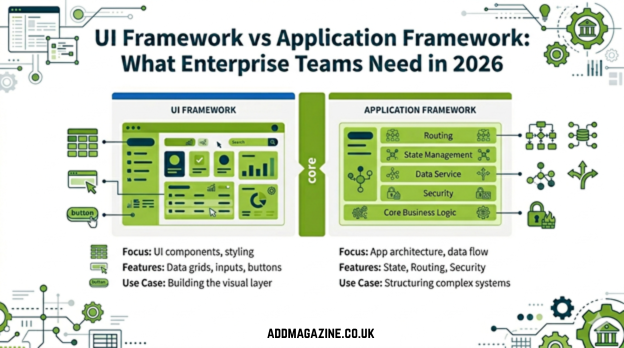
Enterprise teams face a key decision: assemble a UI framework with multiple supporting libraries, or choose a complete application framework. UI frameworks such as React provide component libraries but require additional tools for routing, state management, and data handling in production applications. Application frameworks such as Ext JS deliver a complete solution with built-in architecture, enterprise components, and integrated tooling. For data-intensive enterprise applications, application frameworks can significantly reduce development time while providing long-term stability and single-vendor support.
Key Takeaways
- UI frameworks provide component libraries but require assembly of routing, state management, and build tools.
- In real-world deployments, organizations frequently extend UI frameworks with specialized packages to meet complex application requirements.
- Ext JS 8.0 includes 140+ enterprise components, built-in MVC and MVVM patterns, and performance optimizations.
- UI frameworks excel for simple applications and teams with existing React, Vue, or Angular expertise.
Application frameworks often provide a better total cost of ownership for complex, data-intensive enterprise projects.
What Is a UI Framework?
A UI framework provides the building blocks for user interfaces: components, styling systems, and basic interaction patterns. React, Vue, and Angular are the best-known examples. These frameworks excel at creating interactive web applications but focus primarily on the view layer.
UI frameworks provide buttons, forms, navigation components, and a way to manage component state. Teams build complete applications by combining these pieces with additional libraries for routing, data fetching, testing, and deployment.
Core Characteristics of UI Frameworks
UI frameworks share a few defining traits. They use a component-based architecture, organizing code into reusable components that each encapsulate their own logic, styling, and behavior. They optimize rendering through a virtual DOM, as React does, or through reactive data binding, as Vue and Angular do. They depend on a wider ecosystem: a typical production React project also includes a routing library, a state management library, an HTTP client, and a testing library, among others. As a result, teams need expertise not only in the core framework but also in several additional libraries required to build a production application.
Popular UI Frameworks in 2026
The leading UI frameworks in 2026 are React 19.2.1, a component library with hooks and concurrent features; Vue 3.5, a progressive framework with the Composition API; Angular 21, a full-featured framework with deep TypeScript integration; and Svelte 5, which compiles components to optimized vanilla JavaScript. Angular is worth noting because, although it is often described as a UI framework, it includes enough built-in capability to function as an application framework as well.
What Is an Application Framework?
An application framework provides everything needed to build complete applications. Beyond UI components, it includes architecture patterns, data management, routing, build tools, and enterprise features integrated into a single platform.
We built Ext JS as an application framework because enterprise teams need more than component libraries.
Core Characteristics of Application Frameworks
Application frameworks share several traits. They provide a complete development platform, including UI components, application architecture, data management, routing, and build tools in one integrated package. They tend to be opinionated, enforcing specific patterns such as MVC or MVVM to maintain consistency across large codebases. They ship enterprise-grade components, including built-in data grids, charts, forms, and layouts designed for complex business applications rather than simple websites. And they provide integrated tooling, so the development tools, build system, and deployment utilities work together as one.
Leading Application Frameworks
Examples of application frameworks include Ext JS 8.0, an enterprise JavaScript framework with 140+ components; Angular 21, which functions as a full application platform even though it is often used
Key Differences: UI Framework vs Application Framework
The two approaches differ across several dimensions, summarized below.
| Aspect | UI Framework | Application Framework |
| Scope | View layer and basic interactions | Complete application development |
| Components | Basic UI elements | Enterprise-grade business components |
| Architecture | Flexible, requires decisions | Opinionated, built-in patterns |
| Dependencies | Many additional libraries typical | Most capabilities included |
| Learning curve | Framework plus its ecosystem | Single comprehensive platform |
| Time to production | Longer due to integration needs | Faster with integrated tooling |
| Customization | High flexibility in tool choices | Optimized for the framework’s approach |
| Enterprise features | Requires third-party solutions | Built-in grids, charts, and forms |
Development Speed in Practice
An application framework collapses that setup into a single step. Generating a new Ext JS application produces a complete project that already includes 140+ UI components such as data grids and charts, an MVC and MVVM architecture, a build system and deployment tooling, a testing framework, and a theming system. The team starts building features rather than assembling and integrating infrastructure.
When to Choose a UI Framework
UI frameworks work best in scenarios where flexibility and ecosystem choice matter more than integrated tooling.
They suit simple to medium-complexity applications such as content websites, marketing sites, and basic business applications that do not need enterprise-grade components. They are a strong fit when a team already has deep React, Vue, or Angular experience and can move quickly with familiar tools. They benefit applications with custom architectural needs, where the freedom to choose specific libraries for routing, state management, and data fetching is valuable. And they support gradual migration, letting teams modernize a legacy application section by section over time.
In practice, UI frameworks excel at rapid prototyping and proof-of-concept work, content-heavy sites such as blogs and documentation, mobile-first progressive web apps, and integration projects that add a modern interface to an existing backend system.
When to Choose an Application Framework
Application frameworks deliver the most value for complex, data-intensive enterprise applications where development speed and long-term maintainability matter more than tool flexibility.
They support rapid enterprise development under tight deadlines, because integrated tooling and pre-built components remove the assembly work. And they fit applications expected to run for five years or more, where single-vendor support and backward compatibility reduce long-term risk.
Data-intensive enterprise applications are the clearest case. When an application’s defining requirement is handling large volumes of data through complex grids and charts, a framework that provides those components as tested, integrated parts of the platform is usually a better fit than assembling them from separate libraries.
Enterprise Considerations
Enterprise teams face challenges that influence framework choice beyond technical capabilities.
Total Cost of Ownership
UI frameworks often appear cheaper because the core framework is free, but the total cost includes commercial component libraries, additional tooling, and the development time spent integrating and maintaining many separate dependencies. Application frameworks typically carry a commercial license fee, but that fee includes integrated tooling and enterprise components, and the integrated approach reduces development and integration time. For complex enterprise projects, the total cost of ownership frequently favors the application framework once development time and maintenance are included, not just license price.
Security and Compliance
Large-scale business platforms often depend on rigorous risk assessments, regulatory reporting, and dedicated technical assistance from service providers. With a UI framework, the team must audit each dependency individually, and a typical application pulls in hundreds of transitive packages, each requiring security evaluation and its own update cycle. Using a unified application platform allows organizations to manage updates, governance requirements, and risk controls through one consistent ecosystem, simplifying oversight and reducing operational complexity.
Long-Term Support
Application frameworks typically offer professional support with service-level agreements, backward compatibility guarantees, and migration assistance.
Real-World Patterns
UI Framework Pattern: Analytics Dashboard
Consider a mid-size retailer building an analytics dashboard with React. The project depends on the core React libraries plus separate packages for routing, state management, a data grid, charts, an HTTP client, data fetching, styling, forms, and date handling. A build of this kind commonly takes several months with a small team, and a meaningful portion of that time goes to integration work, such as resolving conflicts between the data grid and the state management library. Ongoing maintenance then involves keeping the many dependencies updated and resolving breaking changes as they arrive independently.
Application Framework Pattern: Trading Platform
Now consider an investment firm building a trading platform with Ext JS. The application uses the framework’s built-in MVC architecture and its included enterprise components, such as a high-performance data grid with buffered rendering and real-time charts, configured rather than assembled. Because the components are designed to work together, integration friction is minimal, and ongoing maintenance is largely limited to periodic framework updates. The integrated approach tends to shorten the build and reduce the maintenance burden compared with assembling an equivalent stack from separate libraries.
Making the Right Choice
Selecting an approach requires balancing project objectives, technical strengths, and practical restrictions.
Choose a UI framework when
- Building content-heavy websites or simple to medium business applications.
- The team has deep expertise in the React, Vue, or Angular ecosystems.
- The project requires custom architecture or specific third-party integrations.
- Budget constraints rule out commercial framework licensing.
- Application complexity remains low to medium.
Choose an application framework when
- The team is large enough that architectural consistency becomes a challenge.
- The timeline demands rapid development with enterprise-grade components.
- Long-term maintenance and vendor support are priorities.
- The application handles sensitive data requiring security and compliance features.
A Hybrid Approach: ReExt for React Teams
Teams with existing React expertise who need enterprise components can use ReExt, which lets Ext JS components run inside a React application. It is a practical middle path when most of an application suits React but certain data-heavy screens need the depth of an application framework.
Conclusion
The choice between a UI framework and an application framework depends on the project’s requirements, the team’s expertise, and the long-term goals. UI frameworks excel for simple to medium-complexity applications where flexibility and ecosystem choice matter more than integrated tooling, and teams with existing React, Vue, or Angular expertise can leverage that knowledge effectively.
Application frameworks deliver strong value for data-intensive enterprise applications that need sophisticated components, architectural consistency, and rapid development cycles. The integrated approach reduces development and integration time while providing long-term vendor support and backward compatibility. For enterprise teams building complex business applications, Ext JS 8.0 provides a complete platform with 140+ enterprise components, proven architecture patterns, and the performance optimizations that data-intensive applications rely on.
Teams that want to see how an application framework accelerates enterprise development can evaluate Ext JS 8.0 through a free trial and assess it against their own requirements.
Frequently Asked Questions
What is the main difference between UI frameworks and application frameworks?
UI frameworks provide component libraries and require additional tools to build a complete application. Application frameworks include everything needed for enterprise development, including components, architecture, data management, and tooling, in one integrated platform. In short, a UI framework is the view layer, while an application framework is the whole platform.
Are application frameworks more expensive than UI frameworks?
On license price alone, often yes, but total cost of ownership frequently favors application frameworks for enterprise projects. UI frameworks such as React are free to license, but enterprise teams typically spend on additional commercial libraries and significantly more development time on integration. An application framework’s license fee includes integrated tooling and enterprise components that would otherwise be assembled and maintained separately.
Can I migrate from a UI framework to an application framework later?
Yes, though migration requires significant effort because the two approaches use different architecture patterns and component APIs. Teams often rebuild rather than migrate incrementally. For React teams moving toward Ext JS, ReExt provides a bridge that lets Ext JS components be introduced into an existing React application gradually rather than through a full rewrite.
Which approach is better for large enterprise teams?
Application frameworks usually work better for large teams because they enforce consistent architecture patterns and provide integrated tooling, which reduces the coordination overhead of keeping many developers aligned. UI frameworks can work for large teams but require more deliberate effort to maintain architectural consistency across projects.
Do application frameworks limit customization options?
Application frameworks are more opinionated but remain highly customizable. Ext JS 8.0 includes comprehensive theming, custom component development, and plugin architectures.
How do security considerations differ between the approaches?
A UI framework application requires security evaluation across many dependencies, each with its own update cycle and vulnerability disclosure process. An application framework provides single-vendor security updates and compliance documentation for the entire platform, which reduces the audit surface and centralizes responsibility for patching.
What about performance differences?
Application frameworks often perform well for enterprise use cases because their components are optimized to work together. The Ext JS data grid, for example, handles very large datasets through column virtualization and horizontal buffering. A UI framework combination can match this but may require performance optimization work across several separate libraries to do so.
Can I use both approaches in the same organization?
Yes. Many enterprises use different frameworks for different projects, choosing a UI framework for simpler applications and an application framework for complex, data-intensive ones. ReExt also enables sharing Ext JS components across React applications, which helps maintain consistency when an organization uses both approaches.
Is Angular a UI framework or an application framework?
Angular sits between the two categories. It is often described as a UI framework, but it includes routing, an HTTP client, forms, and testing tools out of the box, which gives it many characteristics of an application framework. For data-heavy enterprise UIs, however, Angular still typically needs a separate component library for advanced grids and charts, which is where a complete application framework differs.
What is the best way to determine the right solution for my project?
Start with the application’s profile. If it is content-focused or low to medium complexity and the team knows a UI framework well, a UI framework is usually the better fit. If it is data-intensive, built by a large team, or expected to run for many years with strict support and compliance needs, an application framework is generally the stronger choice. Benchmarking the leading candidates against realistic requirements before committing is the most reliable way to decide.