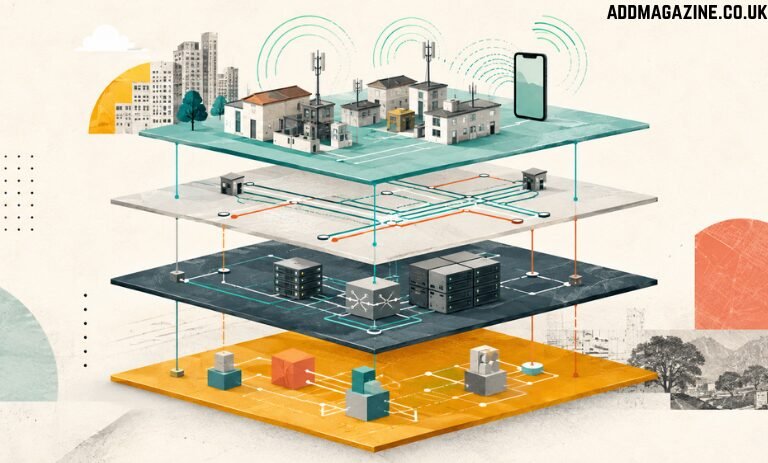
Even when a mobile network is built and supported by the local community, it still depends on physical radio equipment, a reliable power source, internet or core-network connectivity, and software that authenticates users and directs communications to the correct destination. Decentralisation redistributes responsibility for supplying, owning, and managing certain components across a wider set of participants It does not remove the physical network or make every layer collectively controlled. The clearest way to understand these systems is to separate four questions: who supplies the local radio equipment, who connects it to the wider internet, who operates the mobile service, and how each contribution is recorded or rewarded.
The physical arrangement can affect access, even when no blockchain is involved. A 2025 study of 107 tower-sharing transactions across 28 lower-income countries the study reviewed transactions finalized over the period from 2008 through 2020. The study found that large infrastructure deals covering over 1,000 telecom towers were linked with meaningful changes in connectivity costs and availability. Average mobile data charges declined from about $3.41 per gigabyte by roughly $1, while internet adoption among rural households increased by approximately 4.7 percentage points. These results suggest that changes in tower ownership and infrastructure-sharing arrangements can directly affect both the affordability and reach of digital services for end users.
Where Decentralisation Enters the Network
Decentralisation in telecoms is not an all-or-nothing condition. It can describe who installs equipment, who owns it, who supplies connectivity, or who records and coordinates each contribution. Those responsibilities may be distributed differently within the same network, which is why the label reveals little until the individual layers are separated. A locally hosted radio may widen participation at the edge, for example, while power, backhaul, and core-network operations remain under established providers. The point at which decentralisation enters the system therefore determines what has genuinely changed and what still depends on conventional infrastructure.
Every mobile connection begins with physical work. A nearby radio communicates with a handset, power keeps the site operating, and backhaul carries traffic towards the wider network. Distributed infrastructure frameworks may involve external participants in operating network resources, yet their involvement does not by itself show how specific engineering duties are reassigned across the system. A July 2026 podcast published by industry outlet AlphaWire with World Mobile co-founder Andrew Soper considered how telecoms, energy, and blockchain can operate within one infrastructure model.
A clear way to separate the roles is to view blockchain as the layer that manages shared records and verifies agreed contributions, whereas connectivity hardware, electricity supply, and data transmission continue to depend on physical infrastructure and service providers. It may help document that a participant registered eligible hardware, supplied a recognised resource, or completed a task under the network’s rules. It cannot by itself show that an antenna is well positioned, that backhaul has enough capacity, or that service is reliable in a particular place. “Community-powered” therefore describes who can participate and how participation is coordinated more accurately than it describes every part of the mobile network.
That boundary also prevents a common misunderstanding about ownership. A household, business, or local organisation might host access equipment without controlling spectrum, subscriber accounts, or the core systems that connect calls and data sessions. The remaining layers may still rely on established telecom providers, shared tower companies, satellite links, or regional fibre networks.
The 4 Layers to Check
The first layer is local access hardware. This includes the radio equipment that reaches nearby devices and the site that holds it. The main operational considerations involve how the system is deployed, serviced, scaled, and made accessible across the required area. Expanding the number of locally operated radio units does not automatically improve coverage; performance is shaped by strategic placement and each unit’s capacity to support listeners.
The second layer combines power and backhaul. A radio site must remain powered and must send traffic somewhere beyond its local coverage area. Backhaul may use fibre, microwave links, or satellite connections. A community may operate the local connection itself but rely on an external provider to carry traffic along the wider network route. Poor backhaul can become the bottleneck, even when the radio signal itself is strong.
The third layer contains operator and core-network functions. These systems authenticate subscribers, manage sessions, apply service policies, and connect traffic to other networks. They determine whether a local access point forms part of a working mobile service, rather than operating as isolated hardware. Distributed ownership at the edge does not automatically decentralise these operational responsibilities.
This is where blockchain-based records may be used to register participants, check evidence, and apply shared rules. The exact design varies, so an on-chain record should not be treated as proof that the off-chain service was useful. A location claim, device registration, or activity report still needs a method that connects the digital record to conditions in the physical world.
What Verification Can and Cannot Establish
A 2026 Frontiers review of decentralised physical infrastructure networks Blockchain-based systems can function as organized digital ecosystems where verified practical input is recognized, resource availability is connected with user demand, and exchanges are managed through predefined rules. It also found that the available literature remains relatively young and methodologically mixed. Of the 46 sources included in the review, only 5 were peer-reviewed journal articles, while 22 were grey-literature sources, such as reports, white papers, and industry material.
This lack of supporting evidence becomes especially important when evaluating the effectiveness of a mobile network built and maintained through community participation. A protocol may verify that a device submitted the required record, yet that does not settle whether coverage improved, customers used the service, or the connection remained dependable over time. Those outcomes require network measurements and sustained observation rather than ledger activity alone.
A useful assessment therefore moves from the ground upwards. Begin by mapping the nearby communication hardware, including its energy supply and network link. Next, determine the organization responsible for the central infrastructure and review the specific information stored on the blockchain. Decentralised coordination may widen participation and create a common accounting layer. The quality of the connection still depends on the physical and operational systems beneath it.