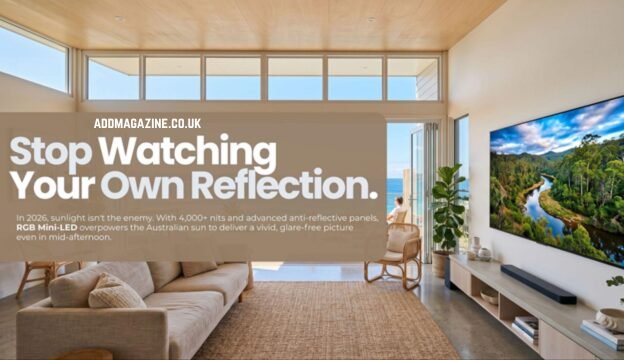
For years, the gold standard for home entertainment has been OLED. Its ability to turn off pixels individually to create perfect blacks is legendary. But as we move into 2026, many Australian homeowners are realizing that “perfect blacks” do not matter if all you can see on the screen is the reflection of your own sliding glass doors. In the context of a typical sun-drenched Queenslander, a coastal home with massive windows, or an open-plan living area in the suburbs, the battle against ambient light is the primary challenge. This has led to a massive technological pivot: the debut of RGB Mini-LED.
While OLED continues to dominate in dark dedicated cinema rooms, RGB Mini-LED has emerged as the breakthrough solution for the “daytime” viewer. Whether you are a sports fan watching a Saturday afternoon footy match or a family catching up on shows in a bright living room, the choice of panel technology has never been more critical. By 2026, the industry has moved beyond the standard blue-LED backlight, introducing a more sophisticated diode structure that changes the game for color volume and glare reduction.
The technical leap from Blue LED to RGB Mini LED
To understand why this is a breakthrough, we have to look at how traditional Mini-LEDs worked. Previously, TVs used thousands of tiny blue LEDs coated with a yellow phosphorus layer to create white light. This white light then passed through a color filter to create the images you see. While efficient, this process often resulted in “light bleed” and colors that could look slightly washed out when the brightness was pushed to the extreme.
The 2026 RGB Mini-LED technology does away with the blue-light shortcut. Instead, each microscopic backlight unit consists of dedicated red, green, and blue diodes. This allows the TV to produce a much purer white light and a significantly wider color gamut. Because the light source itself is already split into the primary colors, the “color volume” remains vivid even at incredibly high brightness levels. In an Australian home where the afternoon sun is pouring into the room, this extra “punch” in color volume is what keeps the image from looking faded or grey.
Beating the glare: OLED vs RGB Mini LED
For many, the first instinct is to look at the latest Glare-Free OLED models. Samsung and LG have made impressive strides in 2026 with matte finishes and specialized anti-reflective coatings that diffuse light rather than reflecting it like a mirror. For moderately lit rooms, these OLEDs are fantastic. They maintain their contrast while softening the “window reflection” that used to plague glossy screens.
However, there is a fundamental limit to OLED: peak brightness. Because OLED pixels are organic and self-emissive, they can only get so bright before they risk overheating or premature aging. RGB Mini-LED, being an inorganic technology, can reach “nit” levels (a measure of brightness) that OLED simply cannot touch. When you shop TVs online and compare the latest flagship models, you will notice that the RGB Mini-LED units often double or triple the peak brightness of their OLED counterparts. Choosing to shop TVs online at Bi-Rite gives you the advantage of comparing these technical specifications side-by-side to see which units are specifically built to combat high-ambient light.
Navigating the specs: Nits and Glare-Free ratings
When you are looking at the specs for a new television in 2026, two numbers matter more than any others for bright rooms: the peak nit rating and the reflection handle percentage. In a dark room, 600 to 800 nits is plenty. In a sun-drenched Australian living room, you really want a panel that can sustain at least 2,000 nits, with peaks hitting 4,000 or higher in RGB Mini-LED models.
This high brightness essentially “overpowers” the sun. Think of it like trying to use your phone outside on a clear day; you have to crank the brightness to 100 percent just to see your messages. A TV works the same way. The brighter the screen can get, the less the reflections on the glass will bother you. Bi-Rite’s online spec sheets now highlight these “Daylight Performance” ratings, making it easier for homeowners to identify which screens are designed for high-glare environments and which are better suited for a darkened media room.
Color volume: The hidden hero of daytime viewing
“Color volume” is a term that many people overlook, but it is vital for sports fans. It refers to the TV’s ability to maintain accurate, saturated colors at various brightness levels. On a standard TV, as you turn the brightness up to combat glare, the colors often start to look “thin.” The green of the grass on the pitch might start to look like a pale lime, or the red of a team jersey might look pinkish.
Because RGB Mini-LED uses dedicated color diodes for its backlight, it maintains a massive color volume. This means that even when the TV is at its maximum brightness to fight off the Queensland sun, the colors stay rich and true. For those watching the cricket or the AFL during the day, this results in a much more immersive and realistic experience. You aren’t just seeing a bright image; you are seeing an accurate one.
The spatial benefits of Mini LED for larger rooms
Australian homes often feature large, open-plan areas where the TV needs to be visible from the kitchen, the dining table, and the lounge. This often requires a larger screen size, such as 75, 85, or even 98 inches. In these larger formats, RGB Mini-LED often provides better value and more consistent brightness across the entire panel compared to OLED.
Manufacturing large-scale OLED panels is still an expensive and delicate process. Conversely, the modular nature of Mini-LED allows for massive screens that maintain incredible uniformity. When you have a 98-inch screen acting as the centerpiece of a bright room, the consistent brightness of the RGB Mini-LED ensures that someone sitting at the kitchen island gets the same vibrant view as someone sitting directly in front of the screen.
Longevity and peace of mind
Another factor for the Australian homeowner is the harsh climate. High heat and high brightness can be a tough combination for sensitive electronics. The inorganic nature of RGB Mini-LED makes it incredibly resilient. It is not susceptible to “burn-in” in the way that older OLED technology could be, which is a major plus for those who leave news channels or sports tickers running for hours on end.
In 2026, premium RGB Mini-LED sets are built with advanced heat sinks that allow them to maintain high brightness for long periods without degrading the panel. For a homeowner making a significant investment in a new entertainment system, this durability is a key part of the value proposition. You want a TV that will look just as good in year five as it did on day one, regardless of how many Saturday afternoons it spends fighting the sun.
Why Bi-Rite is the choice for the modern homeowner
Selecting the right panel technology is not just about reading a blog; it is about seeing the specs that matter for your specific living situation. Bi-Rite has tailored its 2026 digital experience to help Australians make these distinctions. Their focus on providing detailed “glare-free” ratings and “peak nit” data means you aren’t just buying a brand; you are buying a solution to a problem.
Their experts understand that a coastal home in New South Wales has very different lighting needs than a basement cinema in Melbourne. By providing a curated selection of the latest RGB Mini-LED and Glare-Free OLED models, Bi-Rite ensures that homeowners can find the perfect match for their lifestyle. In 2026, the “best” TV is the one that actually works in your room, and for the bright Australian home, that usually means embracing the power of RGB Mini-LED.
Final thoughts on the 2026 TV landscape
The choice between OLED and RGB Mini-LED has finally become clear-cut. OLED remains the king of the “batcave”—the dark, controlled cinema environment where its infinite contrast can truly shine. But for the rest of us—those who live in homes filled with light, who host midday barbecues, and who want to see every detail of the game without closing the curtains—RGB Mini-LED is the clear winner.
It represents a move toward a more practical kind of high-end tech. It is technology that respects the way we actually live in our homes. By prioritizing brightness, color volume, and glare reduction, RGB Mini-LED ensures that your living room remains the heart of the home, no matter how bright the sun shines outside. As you look to upgrade your home entertainment this year, keep your eyes on the nit counts and the backlight tech; it is the difference between watching your favorite content and just watching a reflection of your windows.