| THE SHORT ANSWERChanging an ebike battery looks simple until two packs with the same connector behave completely differently. A replacement can slide onto the rail, power the display and still be wrong — because voltage compatibility is decided by the whole system, not the plug. Replacing like-for-like (same nominal voltage) is the lowest-risk path. Moving 36V→48V or 48V→52V is a system change: the controller, charger, display and BMS all have to agree.The principle: match the system, not the voltage — and the number that actually decides it is 58.8V (full charge), not 52V (nominal). |
A more practical comparison goes beyond simply asking whether 52V outperforms 48V It is: “Does this battery match the electrical limits, current demand and physical space of the specific system it will run?” This guide breaks down the calculations and essential checks you should complete before spending money or connecting any components.
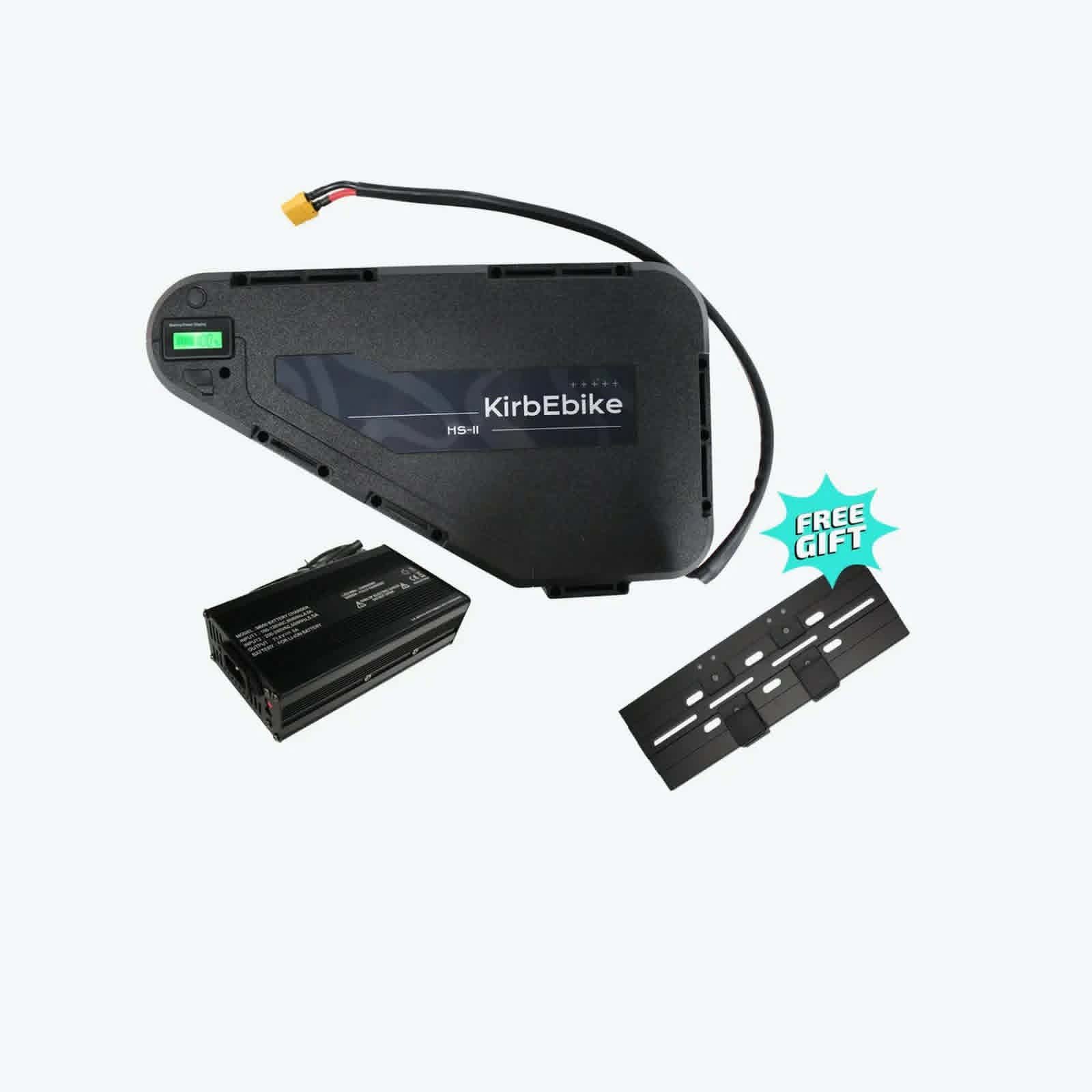
A battery is never a standalone part — it ships as a system that must agree: pack, charger, display and controller. Change the voltage and every one of these has to accept it. [alt: KirbEbike HS-II ebike battery system with charger, controller, display and mounting rail]
36V, 48V and 52V at a Glance
Voltage is often treated as a performance ladder — 36V basic, 48V stronger, 52V best. That shortcut is incomplete. The detail most buyers miss is the gap between NOMINAL voltage (the label) and FULL-CHARGE voltage (what the controller actually sees the moment you unplug the charger). Lithium-ion ebike packs are built from cells in series — and it is the full-charge figure that stresses the electronics:
| Pack | Cells in series | Full-charge voltage | Charger output | Typical Wh at 20Ah | Best suited to |
| 36V | 10S | ≈ 42.0V | 42V | ≈ 720 Wh | Existing 36V bikes; low-risk like-for-like |
| 48V | 13S | ≈ 54.6V | 54.6V | ≈ 960 Wh | Balanced commuter & conversion systems |
| 52V | 14S | ≈ 58.8V | 58.8V | ≈ 1,040 Wh | Systems designed end-to-end for 14S |
These are common configurations, not a universal promise for every chemistry. The key is to match the controller with the battery’s maximum voltage when it is fully charged. A 52V pack is a “58.8V problem” for the controller, not a “52V problem”.
What Actually Changes When Voltage Increases?
Motor speed potential
With the same motor winding and compatible electronics, higher voltage can raise the motor’s unloaded rotational speed. On the road, though, top speed is limited by law and by the controller — voltage does not simply translate into a legal speed increase.
Current and electrical load
Power ≈ Voltage × Current, so a fixed power demand draws LESS current at higher voltage. For the same nominal 1,000W:
| Voltage | Current for ~1,000W (before losses) | What it means |
| 36V | ≈ 27.8 A | Higher current — more heat, thicker wiring, more BMS stress |
| 48V | ≈ 20.8 A | Middle ground |
| 52V | ≈ 19.2 A | Lower current for the same power — cooler running, if the system is rated for 58.8V |
This is why higher voltage can be efficient — but only when the controller, wiring and BMS are all rated for the higher full-charge voltage in the first place.
Range and usable energy
Range comparisons should start with watt-hours (nominal voltage × amp-hours), never amp-hours alone — because the same amp-hours hold different energy at different voltages:
| Pack | Watt-hours | Note |
| 36V 20Ah | 720 Wh | Baseline |
| 48V 20Ah | 960 Wh | Same 20Ah, +33% energy vs 36V |
| 52V 20Ah | 1,040 Wh | Same 20Ah, +8% vs 48V |
| 48V 30Ah | 1,440 Wh | More energy than a 52V 25Ah pack |
| 52V 25Ah | 1,300 Wh | Higher voltage, LESS energy than the 48V 30Ah |
The last two rows carry the lesson. For a rider who mainly wants more range, watt-hours are the better first comparison than voltage: the 48V 30Ah example (1,440 Wh) holds more energy than the 52V 25Ah (1,300 Wh). The 52V version may still be the right choice for other reasons — but not automatically for range.
| OUR VIEW: the plug proves one thing — that it plugs in.A matching connector is not evidence that the voltage, polarity, discharge current or controller protection are compatible. Two mistakes cause most failed upgrades: reading 52V (nominal) when the controller actually meets 58.8V (full charge), and comparing amp-hours when the honest range comparison is watt-hours. Fix those two, evaluate the controller against full-charge voltage, and most “why won’t it work?” problems disappear before purchase. When in doubt, a same-voltage replacement or a complete matched system is not a performance compromise — it is the reliable answer. |
The Direction of Change Decides the Risk
Upgrades fail in different ways depending on which way the voltage moves:
| Change | Main risk | What to verify first |
| Same voltage (like-for-like) | Lowest risk — usually just physical fit & BMS current | Case size, mounting rail, connector, BMS discharge rating |
| Down-voltage (e.g. 48V→36V) | Cutoff logic may read the pack as empty and refuse to run; can also over-discharge | Controller low-voltage cutoff configuration |
| Up-voltage (e.g. 48V→52V) | Full-charge voltage (58.8V) can exceed capacitor / component ratings; display miscalibration | Controller max input voltage & display voltage settings |
A common online claim is that a 52V pack “will usually work” on a 48V controller. Some multi-voltage controllers do accept both, but that does not make it a safe general rule: unless the controller is documented to accept 58.8V input and its cutoff and display can be configured, the claim is a gamble.
The Eight-Point Compatibility Check
- Confirm the original nominal voltage. Read the label on the existing battery and controller — do not infer voltage from case shape, motor wattage or the charger’s plug.
- Read the controller’s supported voltage range. “36V/48V” marked is useful evidence; a controller marked only 36V should not be assumed to accept 48V or 52V.
- Check maximum input at full charge. The stress point is not 52V nominal — it is 58.8V straight off the charger. Confirm the controller’s capacitors and switching components are rated for it.
- Check the low-voltage cutoff. A 36V pack on a 48V controller can read as empty and refuse to run; a cutoff set too low for the pack can over-discharge it.
- Confirm display and gauge settings. Displays often infer state of charge from voltage; an incompatible display can show full when the pack is part-drained, or vice versa.
- Match the charger to the battery. 36V→42V, 48V→54.6V, 52V→58.8V output. Connector shape is not enough — the output voltage and current must match.
- Match BMS discharge current to controller demand. The continuous discharge rating should meet or exceed the controller’s maximum battery current, with margin. Peak ≠ continuous.
- Verify connector, polarity and physical fit. Measure the case and rail, check cable-exit space, suspension movement and bottle-boss position, and verify polarity before power is applied.
How to Compare KirbEbike Battery Options
For a replacement or conversion build, filter in this order: supported system voltage → continuous discharge requirement → watt-hours → physical fit. Riders can compare KirbEbike battery options across 36V, 48V, 52V and higher-voltage systems on that basis. For high-power setups, voltage and capacity are only part of the equation; discharge capability, battery management, cell quality, and charging speed become equally important.
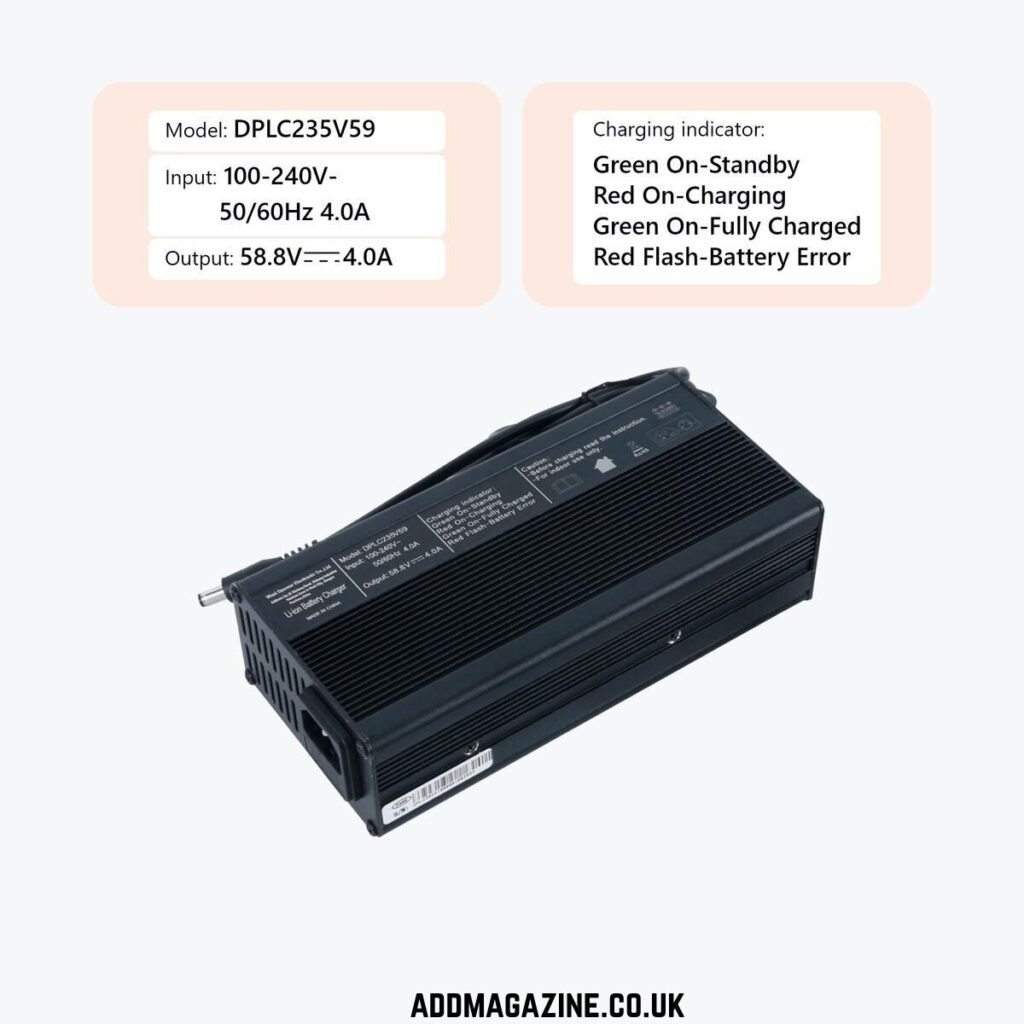
Match the charger to the pack’s full-charge voltage, not its plug: this label reads 58.8V — the correct output for a 52V (14S) battery. [alt: KirbEbike ebike battery charger label showing 58.8V 4.0A output for a 52V battery]
On range specifically, the 48V 30Ah option is the more interesting comparison: its ~1,440 Wh exceeds the 1,300 Wh of a 52V 25Ah pack. The 52V version can still be right when the whole system is built for 14S — but if range is the only goal, the watt-hours point the other way.
Which Voltage Should You Choose?
Choose 36V when reliability and low-risk replacement come first
Sensible when the bike, controller and charger are already 36V and the current performance is fine. If the only problem is range, a higher-capacity 36V pack is usually the cleanest fix.
Choose 48V for a balanced conversion system
A properly matched 48V system suits commuters, utility riders and conversion-kit owners who want stronger performance without moving into specialised high-voltage hardware — often the best balance of energy, current and component availability.
Choose 52V when the ENTIRE system is designed for it
A 52V pack makes sense when the controller accepts 58.8V at full charge, the display can show the correct state of charge, and the charger is a 14S (58.8V) unit. Chosen for a matched system, it runs cooler at a given power; retro-fitted to 48V-only electronics, it is a risk.
Choose more Wh, not more voltage, when range is the only goal
If the system already works and you simply want a longer ride, comparing higher-capacity packs at the SAME voltage removes most compatibility variables at once. More watt-hours, same electronics.
A Note for UK and US Riders
Battery voltage alone does not determine road legality. In Great Britain, an EAPC is assessed principally on usable pedals, a motor of no more than 250W maximum continuous rated power and assistance cutting off at 15.5mph — a higher-voltage battery does not change those requirements. In the United States, rules vary by state and often turn on class, motor power, assisted speed and throttle operation. Review the riding regulations that apply specifically to the area where you plan to use the bike.
Common Battery Upgrade Mistakes
- Assuming higher voltage automatically means longer range.
- Matching only the motor’s wattage while ignoring controller voltage and current.
- Comparing amp-hours without converting to watt-hours.
- Ignoring the difference between BMS peak current and continuous current.
- Changing a connector without checking polarity.
- Ordering before measuring the complete battery case and mounting rail.
- Assuming every pack can accept a 4A or 5A fast charger.
A Five-Step Upgrade Decision
- Photograph the original battery, controller and charger labels so specifications compare side by side.
- Confirm the controller’s nominal voltage, maximum input voltage, battery current limit and low-voltage cutoff.
- Calculate the energy needed in Wh and confirm the battery’s continuous discharge rating meets controller demand.
- Verify charger output, connector type, polarity, display setting and battery mount.
- Measure available frame space and get the supplier to confirm compatibility in writing before ordering.
If any detail cannot be confirmed, the conservative choice is a same-voltage replacement or a complete matched system. Guessing is not a performance strategy.
Frequently Asked Questions
Is a 48V Battery Compatible With a 36V E-Bike?
Not unless the controller, display and other electronics are explicitly rated for 48V. A fully charged 48V battery can climb to roughly 54.6V, considerably exceeding a 36V system’s expected 42V limit and potentially overloading incompatible electrical parts.
Can a 48V controller use a 52V battery?
Only when the controller is documented to accept 52V (or at least 58.8V input) and its cutoff and display can be configured. A controller marked only 48V should not be assumed to handle 58.8V at full charge.
Can a 52V battery extend your riding distance compared with a 48V battery?
Not necessarily — compare watt-hours. A 52V 20Ah pack is about 1,040 Wh, while a 48V 30Ah pack is about 1,440 Wh. Riding conditions and efficiency also affect the real result.
Can I use my old charger after upgrading?
Only if its output voltage, approved current, connector and polarity match the new battery. A 48V charger (54.6V) will not correctly charge a 52V pack (58.8V), and vice versa.
Can I use a higher Ah battery with the same voltage?
Often yes — usually the simplest way to add range. Still confirm the BMS discharge rating, case dimensions, mounting rail, connector and polarity.
Does a higher-voltage battery damage the motor?
It depends on the complete system. Higher voltage can raise available motor speed; controller settings determine current and power. Damage risk comes from running components beyond their rated voltage or current, not from the label alone.
What is the difference between nominal and full-charge voltage?
Nominal is the label (36V/48V/52V); full charge is what the pack actually reaches off the charger (about 42V / 54.6V / 58.8V). The controller must be rated for the full-charge figure, not the nominal one.
Match the System, Not Just the Voltage
The best ebike battery is not the pack with the largest number on the case. It is the one whose full-charge voltage, BMS output, charger, connector and dimensions all match the specific system it will run. For a genuine voltage upgrade, treat the controller, display, charger and BMS as one decision — and remember the number that really has to line up is 58.8V, not 52V. Get the system to agree, and the upgrade does what you hoped: more usable energy, delivered safely, for the riding you actually do.