Most advice about leg circulation assumes you have the freedom to change your schedule. Get up every 30 minutes. Walk at lunch. Use a standing desk. For people who sit six to eight hours a day as a professional requirement, this advice is well-meaning but structurally incomplete. The sitting continues. And so does the damage.
If your legs feel heavy, swollen, or numb by the end of a workday, that is not a minor inconvenience — it is your circulatory system signaling that something in your setup is actively working against your body. The most effective fix is not a new habit or a rigid movement schedule. It is choosing the best chair for leg circulation: one that keeps blood moving in your legs while you work, continuously, without requiring you to stop.
Here is why standard solutions fall short — and what actually works.
What Sitting Does to Your Legs
The body manages blood circulation against gravity through a system that depends entirely on movement. The calf muscle — specifically the soleus — acts as a secondary pump, contracting with every step to push blood from the lower legs back toward the heart. Exercise physiologists call this the peripheral heart. When you sit still, this pump stops working entirely.
Within the first hour of static sitting, blood begins to pool in the lower limbs. Venous pressure in the legs rises. The lymphatic system, which has no dedicated pump and relies entirely on muscle movement to drain fluid from tissue, stalls as well. This is why legs swell — not just from blood, but from lymphatic fluid accumulating in tissue when the movement that normally clears it disappears.
At the same time, the front edge of a seat pan creates direct mechanical compression on the back of the thighs and the popliteal vein at the back of the knee. Over hours, that sustained compression restricts venous return and contributes to the aching, heaviness, and end-of-day swelling that are the hallmarks of poor leg circulation at a desk.
The best chair for leg circulation must address this directly — not by optimizing a static position, but by keeping the muscles that drive venous return active throughout the day.
Why the Usual Recommendations Fall Short
Scheduled movement breaks
Taking a short walk every 30 minutes genuinely helps. The problem is that the moment you sit back down in a static chair, the calf pump switches off and the process restarts from zero. Breaks interrupt the damage — they do not prevent it. For anyone spending large portions of the day in meetings, on calls, or in deep focus work, a break every 30 minutes is also simply not realistic.
Standing desks
Standing desks have become the default recommendation for desk workers with circulation concerns. But standing still creates nearly the same problem as sitting still — the calf muscle pump is off in both positions. Sustained standing also increases venous pressure in the legs, which over time contributes to varicose vein development. The benefit of a standing desk comes from the transition between positions, not from standing itself. It is a partial solution at best.
Compression socks
Compression socks manage the symptoms of poor venous return without addressing the cause. They squeeze the vein walls from outside to compensate for the absence of the muscle pump. Useful for diagnosed venous insufficiency or long-haul flights — but relying on them at a desk every day is a workaround, not a fix. The root cause remains unchanged.
Standard ergonomic chairs
Standard ergonomic chairs are engineered to optimize a static seated position — better seat angle, reduced edge pressure, contoured foam. These adjustments reduce some discomfort, but an ergonomic chair that keeps you stationary still keeps the calf pump off. It makes stillness more comfortable. It does not make stillness less harmful. No ergonomic chair, however well designed, qualifies as the best chair for leg circulation if it does not generate movement.
The gap in every one of these approaches is identical: none of them provide continuous movement throughout the seated period. That is the only thing that keeps leg circulation functioning while a person is at their desk.
What the Best Chair for Leg Circulation Actually Does
The best chair for leg circulation is not defined by its cushioning, its recline angle, or its lumbar geometry. It is defined by whether it keeps the body in motion while seated. When the seat itself allows continuous micro-movement — subtle shifts, tilts, and weight redistributions — the calf muscles, hip stabilizers, and lower leg muscles stay partially activated throughout the day. The venous return pump keeps running at a low but consistent level. Lymphatic drainage does not stall. Blood does not pool.
The best chair for leg circulation achieves this passively. The user does not have to schedule movement or remember to shift position. The chair creates the mechanical condition for continuous motion automatically — which means the circulatory benefit persists through hours of focused work, long calls, and back-to-back meetings when no one is thinking about their legs.
Why CoreChair Is the Best Chair for Leg Circulation
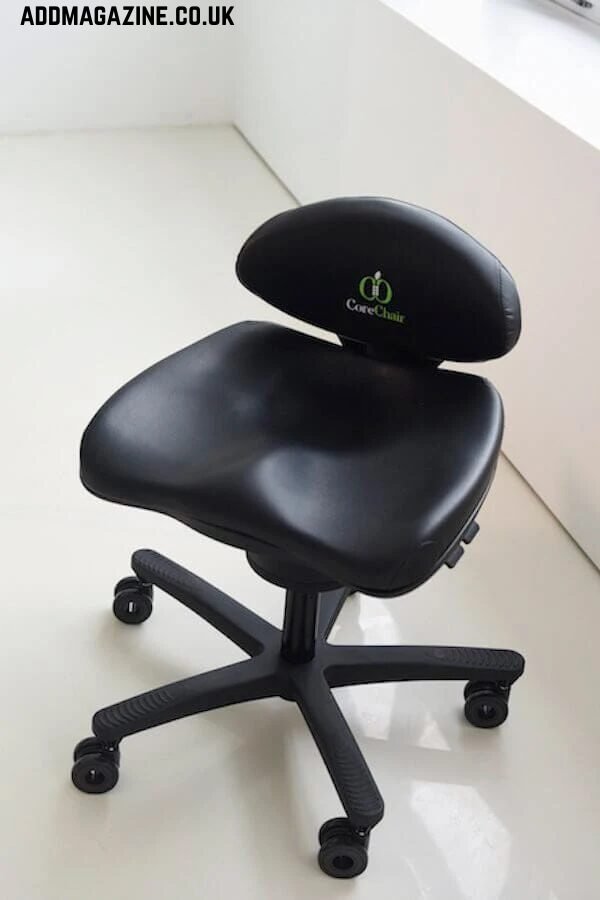
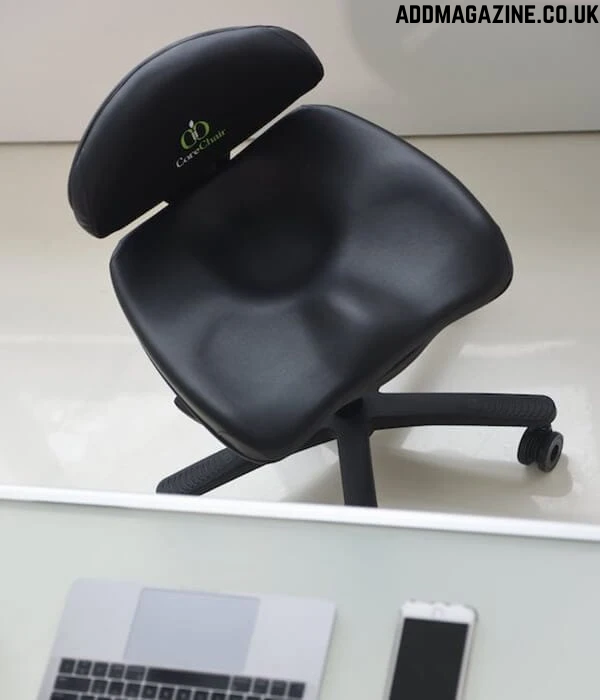
CoreChair is built on a dynamic pivot base that allows continuous micro-movement in all directions — tilting, rocking, and shifting in response to the body’s natural weight distribution. This is not a rocking mechanism that cycles between two fixed positions. It is a free-range pivot that keeps the pelvis, hips, and lower body in constant subtle motion, maintaining the low-level muscle activation that venous return depends on. Throughout an eight-hour day, the calf pump never fully shuts down.
What separates CoreChair further from every other candidate for the best chair for leg circulation is what it intentionally leaves out.
There is no backrest. This is a deliberate design decision with direct circulatory consequences. A backrest gives the body something to collapse into, switching off postural muscles and allowing the spine to slump. That slumped posture compresses the abdomen, restricts diaphragmatic breathing, collapses the hip angle, and increases mechanical pressure on the femoral vessels running through the upper thigh. Without a backrest, the body must self-support. The deep stabilizing muscles stay engaged. The spine stays upright. The hip angle stays open. Blood flows more freely through the entire lower body.
There are no armrests either. Armrests allow the upper body to offload tension downward, collapsing posture from above and reducing the core engagement that keeps the torso tall and the hip angle neutral. Without them, the shoulder girdle, thoracic spine, and core work as an integrated support system — the way the body is built to function. The open posture this creates is not just better for the spine. It is better for circulation throughout the entire lower body.
The pivot base handles continuous lower-body activation. The absence of passive support structures keeps posture upright and hip geometry open. Together, they make CoreChair the best chair for leg circulation not as a category claim but as a mechanical outcome: it is the only seating option where the design actively prevents the conditions that cause leg circulation to deteriorate over a long workday.
What Changes Over a Full Workday
The difference the best chair for leg circulation makes is cumulative and most visible at the end of the day — precisely when the usual cascade of swelling, heaviness, and numbness would normally set in. People who switch from static ergonomic seating to CoreChair consistently report less ankle swelling and end-of-day leg heaviness, fewer episodes of tingling and numbness during long seated sessions, and noticeably better afternoon energy — a direct result of sustained circulation and oxygen delivery to both the legs and the brain.
The body also adapts over time. The core and postural muscles that CoreChair keeps in continuous use gradually strengthen, improving overall seated posture and reducing the fatigue that comes from unconsciously fighting a slumped position all day.
Making the Transition
Transitioning to the best chair for leg circulation after years in traditional seating requires a short adaptation period. The postural muscles that a backrest normally replaces need time to rebuild endurance.
Start with two to three hours of use per day in the first week, then extend gradually over the following weeks. Keep the desk at a height that allows the elbows to rest at approximately 90 degrees without the shoulders rising. Pair CoreChair with short ankle rotations and calf raises at natural breaks between tasks — not because the chair needs the help, but because the combination accelerates circulation recovery after years of static seating habits.
Most users adapt fully within two to three weeks. After that, the micro-movement and postural activation become automatic — and the legs stop reminding you at 5pm that you were sitting all day.
The Bottom Line
If your job keeps you seated for most of the day and your legs are suffering for it, the chair is the most powerful variable in your setup. Most seating options — however ergonomically refined — are still built around static positions. They make stillness more comfortable. They do not make it less harmful.
The best chair for leg circulation is one designed around the principle that the body must keep moving to stay healthy — and that the chair should create that movement, not rely on the person to remember it. CoreChair’s backless, armrest-free design and dynamic pivot base deliver exactly that: a seated experience that works with your circulatory system all day, so your legs can handle the hours your job demands.