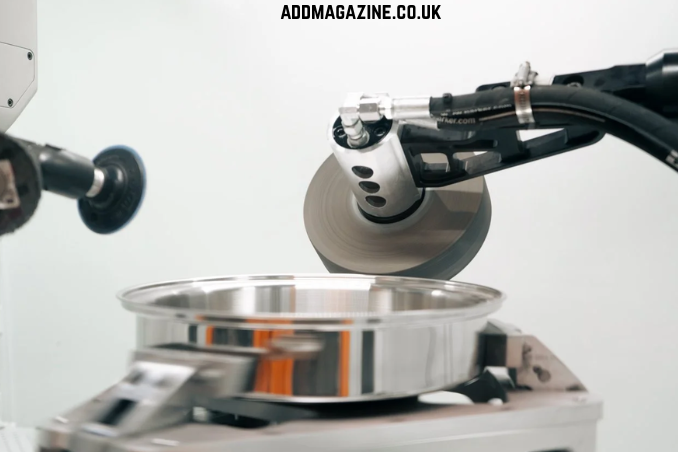
Manual deburring can become a bottleneck when operators are finishing parts one at a time with grinders, brushes, files, or other hand tools. Deburring automation uses industrial robots, force-controlled tooling, vision systems, fixtures, and controls to remove burrs and sharp edges with greater consistency.
For manufacturers, the goal is not simply to replace a manual finishing task. A well-designed robotic deburring system must remove the correct amount of material, follow complex part geometry, accommodate normal variation, and maintain the required cycle time without damaging the component.
What Is Deburring Automation?
Deburring automation uses robotic or automated equipment to remove unwanted material left behind after machining, casting, stamping, welding, or other manufacturing operations.
Depending on the application, a deburring cell may use:
- Rotary cutting tools
- Abrasive brushes
- Grinding wheels
- Belt sanders
- Compliant spindles
- Force-controlled end effectors
- Machine vision
- Custom fixtures
GLOBAL Automation Technologies designs robotic deburring cells around the part geometry, burr location, material, tooling requirements, floor space, and production rate.
How Does Robotic Deburring Work?
A robotic deburring system usually combines several steps into one controlled process.
A typical cycle may include:
- A part enters the cell.
- A fixture or vision system identifies its position.
- The robot moves the selected tool to the required edge.
- Force or compliance control maintains contact.
- The robot follows a programmed toolpath.
- Burrs, flash, or sharp edges are removed.
- The finished part moves to inspection or the next production step.
The system repeats the same process for every component, helping reduce the variation that can occur with manual finishing.
Why Force Control Matters in Deburring Automation
Deburring is different from simple pick-and-place automation because the robot must physically interact with the part.
If the tool applies too much force, it can gouge the surface or remove too much material. Too little force may leave the burr partially intact.
Force-controlled tooling or compliant end effectors help the system maintain more consistent contact while accommodating small differences between parts.
GLOBAL identifies force control as particularly important for castings and forgings, where surfaces may not be perfectly identical from part to part.
What Types of Parts Can Be Automatically Deburred?
Robotic deburring is suitable for many components with repeatable features and defined areas requiring material removal.
Typical applications include:
- Machined metal parts
- Castings
- Forgings
- Stamped components
- Welded assemblies
- Gear components
- Automotive parts
- Heavy-equipment components
The feasibility depends on part size, material, burr type, required finish, volume, and whether the robot can reliably access the relevant features.
GLOBAL serves automotive OEMs, Tier 1 suppliers, heavy industry, and general manufacturing applications where repeatable finishing is required.
Deburring Automation for CNC Machined Parts
CNC machining frequently leaves small burrs around drilled holes, milled edges, slots, and other features.
These may require additional finishing before the part can move into assembly, inspection, coating, or shipment.
Robotic deburring can be integrated directly after CNC machining.
For example:
- A robot unloads the CNC machine.
- The part is positioned for deburring.
- The robot processes specified edges.
- The part moves to inspection or another operation.
Combining machine tending and deburring can reduce separate handling steps and create a more continuous workflow.
How Machine Vision Supports Robotic Deburring
Not every part arrives in exactly the same position.
Machine vision can identify part location and orientation before processing begins.
Vision-guided deburring may help with:
- Variable part presentation
- Randomly positioned components
- Reduced dedicated fixturing
- Part identification
- Toolpath alignment
- Processing-area verification
GLOBAL integrates vision guidance with robotic finishing systems when applications require the robot to adapt to how a component is presented.
Choosing the Right Deburring Tool
Tool selection depends heavily on the burr and material.
Rotary Tools
Rotary burrs and cutting tools can remove defined material around edges, holes, and machined features.
Abrasive Brushes
Brushes can work well for lighter burrs and edge conditioning where aggressive stock removal is unnecessary.
Grinding Tools
Grinding equipment can handle heavier material removal or larger irregularities.
Abrasive Belts
Belt systems are useful for broader finishing operations and larger surfaces.
A robotic system may also use tool changers when different areas of a component require different finishing methods.
GLOBAL engineers tooling around the specific material-removal requirement rather than selecting the robot independently of the process.
What Are the Benefits of Deburring Automation?
More Consistent Edge Quality
A programmed robot follows the same path and process parameters on every cycle.
This reduces differences caused by operator technique or fatigue.
Higher Throughput
Manual finishing can become a production bottleneck when parts arrive faster than operators can deburr them.
Automating the process can help keep finishing aligned with upstream machining rates.
Reduced Repetitive Manual Work
Grinding, sanding, and deburring can involve repetitive motions, vibration, dust, noise, and physically demanding handling.
Robotic systems can reduce direct operator exposure to these tasks.
Better Process Repeatability
Automation creates defined toolpaths, force settings, speeds, and process sequences that can be reused across production runs.
GLOBAL positions robotic deburring around improved edge consistency, throughput, quality control, and operator safety.
How Simulation Helps Deburring Automation
Robotic paths can become complex when a component contains multiple edges, curves, bores, or recessed areas.
Offline simulation allows engineers to evaluate robot reach, tool orientation, collision risks, and cycle time before the equipment reaches the plant floor.
GLOBAL uses AI-assisted simulation to model and optimize robot programs before deployment. Its current deburring guidance notes that simulation can help identify path problems earlier and shorten programming effort.
Can Deburring Automation Handle Multiple Part Variants?
Yes, when the system is designed for flexible production.
Different robot programs, fixtures, vision recipes, or tools can be used for multiple components.
However, flexibility should be considered during the initial engineering process.
Important factors include:
- Part geometry
- Fixture requirements
- Tool changes
- Vision requirements
- Cycle time
- Production mix
A highly flexible cell may require more engineering than a system dedicated to one high-volume component.
When Does Deburring Automation Make Sense?
Automation is worth evaluating when a process has:
- High or repeatable part volume
- Significant manual deburring labor
- Inconsistent edge quality
- Difficult-to-fill finishing positions
- Ergonomic concerns
- Production bottlenecks
- Repeatable burr locations
- Expensive rework or scrap
The business case should compare the current labor, quality, throughput, and rework costs with the expected performance of an automated system.
What Should a Deburring Automation Integrator Provide?
A robotic deburring project requires more than purchasing a robot arm.
A capable integration partner should support:
- Feasibility analysis
- Process testing
- Simulation
- Robot selection
- Tooling
- Fixture design
- Vision integration
- Force-control setup
- PLC and HMI programming
- Safety systems
- Factory acceptance testing
- Installation
- Commissioning
- Training
GLOBAL provides turnkey delivery from concept and simulation through installation, training, and ongoing production support.
Build Deburring Automation Around Your Parts
Successful robotic deburring depends on matching the robot, tooling, force control, vision, fixtures, and programming to the actual part and finish requirement.
GLOBAL Automation Technologies designs deburring automation for machined parts, castings, forgings, welded assemblies, and other industrial components. Their team can evaluate your burr locations, materials, cycle time, current manual process, and production requirements to determine a practical path toward automated finishing.