
Today, more than 5 billion people use social media globally. This represents over 60% of the world’s population maintaining at least one active profile on different platforms. Social networks have become a central part of communication, business, and identity.
Because of this massive digital presence, searching for social media accounts has become valuable in many professional fields. Recruiters, investigators, compliance teams, legal professionals, and journalists often rely on social data to gather insights. Financial organizations, especially lenders, also use these signals to support identity checks, fraud detection, and risk evaluation.
Since most social platforms require an email address for registration, email has become one of the most important identifiers in digital investigations. It often acts as a gateway to discovering a person’s online footprint.
Manual vs Automated Social Media Search Methods
Finding social media profiles linked to an email or phone number can be done in two main ways: manual searching or using automated tools. The choice depends on the scale, accuracy requirements, and available resources.
Manual Social Media Account Search
Manual searching involves checking each platform individually to locate a user’s profile. This method is simple but often time-consuming and limited in accuracy.
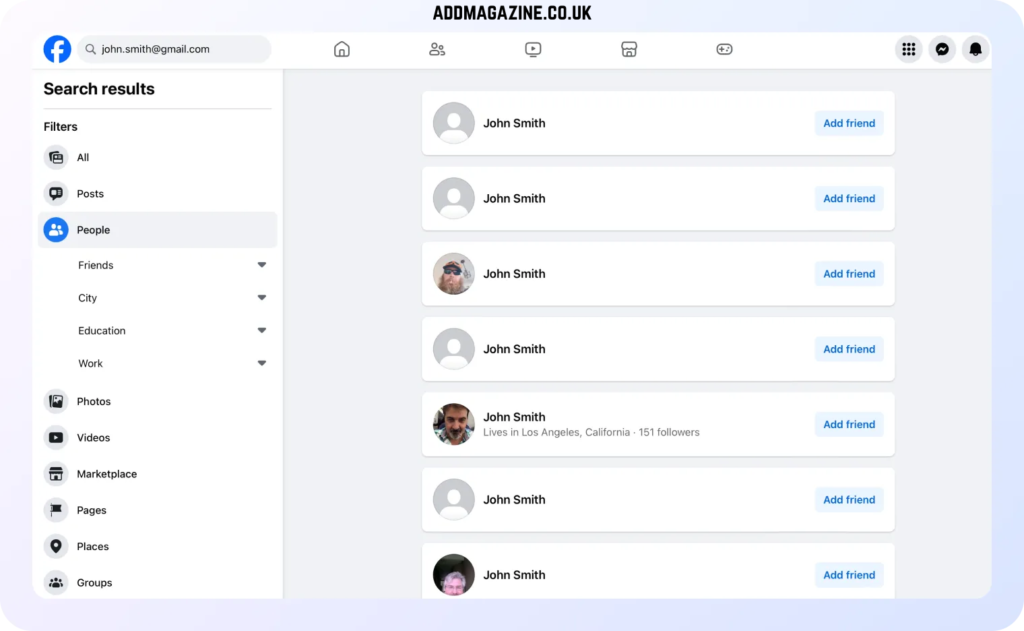
Facebook Search by Email
Facebook allows users to search for profiles using the search bar. However, results are usually broad and may include unrelated profiles. Even when an email is used, matching accuracy is not always reliable.
Searching with a phone number sometimes produces better results, especially when privacy settings allow discoverability. In some cases, advanced filters can help narrow down potential matches if additional user information is available.
LinkedIn Profile Search
LinkedIn follows a similar search structure. Users can enter an email or name to locate profiles, but irrelevant matches are common. Sometimes an email may appear in a profile’s “About” section without actually belonging to the account owner, which can create confusion during manual checks.

Instagram Search Limitations
Instagram does not provide a straightforward method to find accounts using email addresses. As a result, manual discovery on this platform is usually ineffective unless the account is already connected through contacts or mutual connections.

X (Twitter) Account Discovery
Finding users on X using an email address is even more restricted. The platform primarily relies on username-based search. In some cases, syncing phone contacts or using “people you may know” suggestions can help, but email-based search is not directly supported.
Automated systems enable organizations to quickly trace social media profiles that may be associated with an email address or phone number, offering a far more efficient approach than doing it manually.
These tools streamline the entire process by removing the need to search each platform one by one. As a result, they are widely used in areas such as identity verification, fraud detection, hiring processes, background investigations, and customer due diligence, depending on the specific requirements.
A range of dedicated platforms support this functionality, including services like SignalHire and Social Catfish, along with sector-focused solutions. In financial services, for instance, companies such as RiskSeal are used to analyze digital footprints alongside social account discovery to improve verification accuracy and assess potential risk.
For those interested in the practical mechanics behind email-based profile discovery, detailed resources are available that social account search by email address works and how it contributes to uncovering online identities for verification purposes.
Overall, automated solutions outperform manual methods by delivering greater speed, improved scalability, and more reliable consistency, especially when dealing with large datasets or high-volume user analysis.
Challenges of Manual Search Methods
Manual investigation is usually only suitable for small-scale use. While it does not require paid tools, it comes with several drawbacks:
- Time-intensive process
- Limited accuracy of results
- Need to access multiple platforms separately
- Poor scalability for large datasets
Because of these limitations, manual search is often not practical for business or enterprise use.
Rise of Automated Social Media Search Tools
Automated tools have significantly improved the way social media profiles are discovered. These systems can quickly identify accounts linked to an email address or phone number by scanning multiple data sources simultaneously.
They are widely used in industries such as finance, recruitment, cybersecurity, and compliance. Instead of checking each platform individually, automated systems consolidate results into a single report.
Some well-known tools in this category include platforms like SignalHire, Social Catfish, and other identity intelligence solutions. Certain enterprise-level systems, such as RiskSeal, go further by combining social discovery with broader digital footprint analysis for fraud prevention and identity verification.
Categories of Social Account Search Tools
Social media search solutions generally fall into two main categories:
1. Basic Search Tools
These include both free and paid services such as Spokeo, Pipl, PeekYou, BeenVerified, and Social Searcher. They are mainly used for individual lookups, basic background checks, and simple identity searches.
2. Enterprise-Level Intelligence Platforms
These are advanced systems designed for organizations that require large-scale data processing. They integrate social media discovery into broader risk analysis workflows, helping institutions assess identity credibility and detect fraud patterns.
For example, platforms like RiskSeal support lenders and financial institutions by combining digital footprint signals with identity verification systems.
Key Differences Between Free and Paid Tools
Free Tools Usually Offer:
- Limited search capacity
- Basic profile information
- Restricted daily usage
- Minimal reporting features
Paid or Premium Tools Provide:
- High or unlimited search volume
- Advanced filtering options
- Detailed and enriched reports
- Integration with business systems
- Scalable data processing
How to Choose the Right Tool
Selecting the right social account search solution depends on several important factors:
Data Accuracy
Reliable platforms ensure updated and verified information.
Coverage of Platforms
Some tools include regional or niche social networks that mainstream platforms may miss.
Pricing Structure
Different organizations require flexible pricing based on usage volume.
Scalability
Enterprise users need systems that can handle bulk searches efficiently.
Advanced Features
Integration options, analytics dashboards, and enrichment capabilities add significant value.
Importance of Digital Footprint Analysis
In today’s digital-first environment, online activity plays an important role in identity verification. Social media presence, email traces, and other online signals help create a more complete picture of an individual.
Industries such as banking and lending increasingly rely on this type of data. Instead of replacing traditional credit scoring systems, digital footprint analysis acts as an additional layer of verification.
It helps organizations:
- Strengthen identity checks
- Reduce fraud risks
- Improve decision-making
- Gain deeper customer insights
Applications in Financial Services
One of the fastest-growing uses of social account search is in the financial sector. Lenders and fintech companies use it to improve application assessments.
Fraud Detection
Applications with no visible digital footprint may require further verification, helping identify suspicious activity early.
Risk Evaluation
Additional online signals provide context beyond credit reports, improving lending decisions.
Identity Verification
Matching online profiles with application data helps confirm whether an identity is genuine or potentially synthetic.
Real-World Use Case
In some lending systems, email-based analysis is combined with social search tools to detect newly created or inactive email addresses. If an email shows little or no online presence, the application may be flagged for additional review.
This approach allows organizations to identify a large portion of suspicious applications early, while still ensuring legitimate users experience a smooth onboarding process.
Conclusion
Social account search has become an essential part of modern digital identity analysis. From recruitment and investigations to fraud prevention and financial risk assessment, it plays a growing role across multiple industries.
While manual search methods still exist, automated tools offer faster, more reliable, and scalable solutions. As digital interactions continue to expand, the importance of understanding online footprints will only increase further.