Specifying or purchasing tile for exterior use in the United States is not the same decision it is in more temperate regions. The continental US spans an unusually wide range of climate conditions — from hard-freezing winters in the Upper Midwest and New England, to sustained desert heat in the Southwest, to the persistent humidity and salt air along the Gulf and Atlantic coasts. Each of these environments places a different set of demands on the same category of material. What performs reliably in one context can fail structurally or cosmetically within a few seasons in another.
This creates a real challenge for project managers, architects, facility operators, and property developers who are responsible for specifying surfaces that will hold up over time without requiring frequent replacement or repair. The decision is not simply about appearance. It involves material science, installation conditions, substrate behavior, and regional climate patterns that interact in ways that are not always obvious at the point of purchase.
This guide addresses those variables in practical terms, organized by the climate conditions that most commonly affect exterior tile performance across the United States.
Understanding What Exterior Porcelain Tile Is and Why It Differs From Interior Grades
Porcelain tile made for exterior use is manufactured to a different standard than the same-looking product intended for indoor floors or walls. The core difference lies in density and water absorption. Exterior porcelain tile is fired at higher temperatures and pressed under greater force, which produces a body that absorbs very little moisture. This low absorption rate is the foundation of its durability in outdoor conditions. When water cannot penetrate the tile, it cannot freeze and expand inside the material, cannot carry dissolved salts that crystallize and damage the surface, and cannot soften the bond between tile and substrate over time.
For buyers who are beginning to research product categories, a structured Exterior Porcelain Tile overview can clarify how different product lines are rated, what finish types are available for outdoor applications, and how collections differ in thickness and surface texture — all of which affect performance before installation even begins.
Interior porcelain, by contrast, may meet visual standards but lack the structural density required for outdoor exposure. Using it externally does not always produce immediate failure, but it shortens product lifespan significantly and often voids any applicable warranty. The classification system used to rate porcelain for exterior use is not arbitrary. It reflects measurable material properties that correspond to real-world performance under thermal stress, moisture cycling, and physical load.
The Role of Tile Thickness in Outdoor Applications
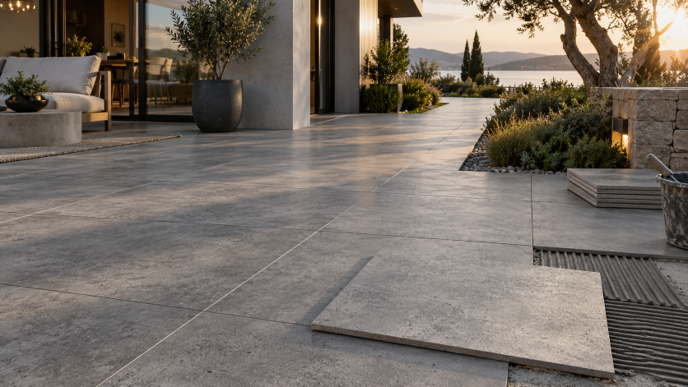
Exterior installations generally require thicker tile formats than interior work, and this is especially true for ground-level applications such as patios, pool decks, walkways, and commercial plazas. Thicker tile resists flexion under foot traffic and uneven substrate movement. When a substrate shifts — due to seasonal ground movement, thermal expansion of a concrete slab, or settling over time — a thinner tile is more likely to crack or debond than a thicker one that distributes stress across a larger cross-section.
Large-format exterior tile, which has become more common in both residential and commercial projects, amplifies this concern. Larger panels have more surface area in contact with the substrate, and any variation in flatness beneath them becomes a point of stress. This is why proper substrate preparation and appropriate mortar bed thickness are not optional considerations for exterior tile work — they directly influence how long the installation holds up regardless of the tile quality itself.
Freeze-Thaw Performance in Cold Climates
In regions where temperatures drop below freezing regularly during winter months, freeze-thaw cycling is the primary cause of exterior tile failure. The mechanism is straightforward: water that has been absorbed into tile or into the grout joints and substrate expands when it freezes. Over repeated cycles through a single winter, this expansion and contraction works to fracture materials, lift tiles from their beds, and open grout lines to further moisture infiltration.
The American Society for Testing and Materials maintains testing standards that porcelain tile must meet to be classified as frost-resistant, and buyers in cold-climate states should confirm that any exterior product they consider meets those thresholds. States in the Midwest, Mountain West, New England, and the Great Plains see the highest number of freeze-thaw cycles annually, and in those regions, product selection based solely on appearance is a common and costly mistake.
Grout and Joint Selection in Freeze-Prone Environments
The tile itself is only part of the freeze-thaw story. Grout joints and the adhesive mortar beneath the tile are equally vulnerable. Standard cement-based grout is porous, and in cold climates, an unsealed or poorly maintained grout joint becomes a consistent entry point for water. Once water reaches the mortar bed through grout, it can undermine adhesion from below rather than attacking the tile surface directly, which means the problem is well advanced before it becomes visible.
Epoxy grout is more resistant to water infiltration and is worth considering in climates with consistent freeze-thaw exposure. Movement joints — intentional gaps in the tile field that allow for thermal expansion — are also essential in large exterior installations in cold climates. Their omission is one of the more common technical errors in exterior tile work, and it typically results in cracking or debonding within the first few winters after installation.
Heat and UV Exposure in Arid and Southern Climates
The challenge in hot and arid climates is almost the inverse of the cold-climate problem. Rather than moisture and freezing, the primary concern is thermal expansion and intense ultraviolet radiation. In regions like the American Southwest, exterior surfaces can reach temperatures well above ambient air temperature when exposed to direct sun for extended periods. This heating and cooling cycle — which can occur dramatically within a single day — causes tile, substrate, and setting materials to expand and contract at rates that depend on their individual material properties.
When those materials expand and contract at different rates, stress accumulates at the bond line between them. Over time, this stress causes debonding, lippage, or cracking. Specifying setting materials that are rated for exterior and high-temperature use is essential in these regions, as is accounting for color and finish when selecting tile. Darker colors absorb more heat, which increases thermal expansion. Light-colored or reflective finishes behave differently and may be more appropriate in direct-sun applications in hot climates.
Surface Texture and Slip Resistance in High-Heat Settings
Exterior surfaces in hot climates are often adjacent to pools, spas, or other water features where wet conditions are routine. In these environments, surface texture becomes a safety consideration, not just an aesthetic one. Tile intended for pool surrounds, outdoor showers, or commercial wet areas must meet slip resistance standards that are distinct from those applied to dry interior floors.
Polished or highly smooth porcelain finishes, which perform well indoors, can become hazardous when wet outdoors. Textured or matte finishes, as well as tile formats that include surface relief or grip patterns, are more appropriate for these applications. The relevant slip resistance ratings are established and published by industry bodies, and they should be part of any specification checklist for outdoor wet areas regardless of climate zone.
Humidity, Salt Air, and Coastal Conditions
Coastal climates along the Gulf Coast, Atlantic Seaboard, and Pacific Coast present a different set of material stresses. High ambient humidity affects how adhesives cure and how grout performs over time. Salt air, particularly within a few miles of the ocean, accelerates the degradation of metal anchors, fasteners, and susceptible setting materials. It can also affect surface finishes on tile that are not fully vitrified or that have been marketed as exterior-rated without meeting the density thresholds appropriate for coastal exposure.
According to the National Weather Service, coastal areas in the southeastern United States regularly experience conditions that combine heat, humidity, and salt-laden air over extended seasons, creating a cumulative stress environment that is more demanding than any single factor alone. In these settings, the specification process should include not just the tile itself but every component of the installation — from the waterproofing membrane and mortar to the grout type and any metal elements used in the surrounding structure.
Managing Moisture Vapor in Humid Climates
In high-humidity regions, moisture vapor transmission through concrete slabs and other substrates can create pressure beneath tile that weakens adhesion over time. This is a less obvious risk than surface water infiltration, but it is a real one, particularly in ground-level installations over concrete in warm, humid climates. Moisture vapor barriers and appropriate membrane systems are standard practice in commercial flooring for exactly this reason, and the same principle applies to exterior tile over concrete substrates in coastal and subtropical environments.
Installation Standards That Affect Long-Term Performance
The quality of the tile selected for a project sets a ceiling on performance, but installation determines whether that ceiling is reached. Across all US climate zones, the most common failures in exterior porcelain tile installations trace back to installation errors rather than product defects. These include insufficient mortar coverage, incorrect trowel selection, failure to allow adequate curing time before exposing the installation to traffic or weather, and the absence of movement joints in large tile fields.
The Tile Council of North America publishes installation guidelines that address each of these variables in detail, and referencing those guidelines during the specification and bidding process is a practical step toward reducing installation-related risk. Contractors who are familiar with those standards and who have experience with exterior work in the relevant climate zone are better positioned to deliver installations that hold up over time without requiring premature remediation.
Closing Considerations for Buyers and Specifiers
Choosing exterior porcelain tile for a US project requires more than selecting a product that looks appropriate for the space. The material must be matched to the climate zone it will occupy, the substrate it will be installed over, the volume and type of traffic it will bear, and the maintenance program that will realistically be followed after installation is complete.
Buyers who take the time to verify freeze-thaw ratings in cold climates, thermal expansion behavior in hot climates, and moisture resistance in humid or coastal environments are making decisions that protect not just the initial investment but the operational continuity of whatever space the tile serves. A terrace, walkway, pool deck, or commercial plaza that fails within a few years creates disruption, cost, and reputational risk that extends well beyond the cost of replacement tile.
The most reliable exterior tile projects share a common approach: the product is specified based on measurable performance criteria, the installation follows established standards for the climate and substrate conditions present, and the components of the installation — tile, mortar, grout, membrane, and movement joints — are treated as an integrated system rather than independent choices. That approach, applied consistently, is what separates installations that perform for decades from those that require attention within a few seasons of completion.