
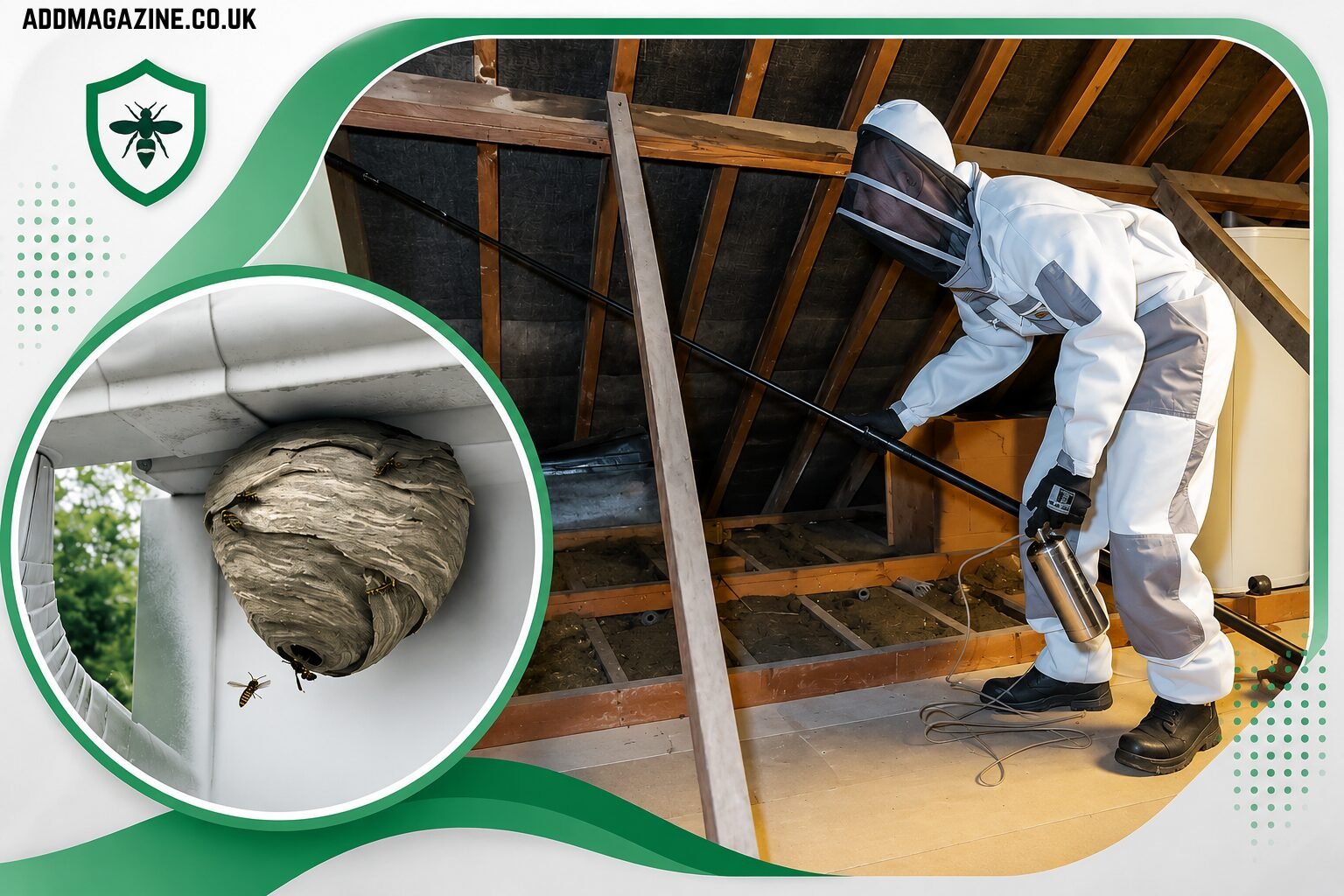
It starts innocently enough. By July, that modest structure could contain several thousand highly territorial insects — and if you’ve decided to deal with it yourself, you may be about to make an expensive, and potentially dangerous, mistake. Unlike a blocked drain or a dripping tap, the consequences of getting it wrong aren’t just inconvenient — they can send you to A&E.
How Quickly a Wasp Nest Grows
She builds the initial cells alone, lays the first eggs, and rears the first generation of workers herself. By May, those workers take over construction and the nest expands rapidly.
The nest itself is constructed from chewed wood pulp and saliva, forming a remarkably strong, water-resistant paper shell. Its size can grow to that of a football or larger.
This matters for one practical reason: a nest that looks manageable in May is a very different proposition in August.
Where Nests Get Built — And Why That Complicates Things
Wasps are drawn to sheltered, dry spaces that offer some protection from wind and rain. In residential properties, the most common locations include roof spaces and loft voids, wall cavities entered through gaps in brickwork or rendering, under roof eaves and fascia boards, garden sheds They may also establish nests inside sheds or exterior structures, underneath wooden decks, or directly in soil areas with soft or dry ground conditions.
A nest inside a wall cavity or loft space can’t simply be approached from outside.
Hidden nests also create an additional hazard: the entry point isn’t always obvious until you’re already too close for comfort.
The Real Risks of DIY Wasp Nest Treatment
Stings — and lots of them. They also release a pheromone when threatened that signals other workers to join the attack. Disturbing a large, established nest without protective equipment can result in dozens or even hundreds of stings in a very short period.
Allergic reactions. Around one in a hundred people in the UK experience a significant allergic reaction to wasp venom, and roughly ten people die each year from wasp or bee stings. The problem is that severe allergy can develop even in people who have been stung before without issue. You may not know you’re in that category until the reaction starts.
Working at height during nest removal can quickly become dangerous. Wasp nests are often hidden beneath roof edges, inside attic areas, or mounted high along exterior walls and fencing. Attempting treatment from a ladder while disturbed wasps swarm around the area increases the chance of losing balance or falling. Accidents linked to ladder use during nest removal are a common reason for injury-related emergency callouts.
Ineffective treatment. Off-the-shelf insecticide sprays are formulated differently to professional-grade products. They often kill wasps at the entry point without penetrating the nest structure, which means the queen and core colony survives. Partially treated nests tend to become more defensive, not less. The colony can also re-establish through alternative entry points.
These mistakes can quickly turn a manageable wasp problem into a serious household hazard. Sealing the entrance too early may trap the colony and push angry wasps to find new routes through walls, ceilings, or rooms. In both cases, the risk increases sharply instead of being solved.
What Professional Treatment Actually Involves
A proper treatment begins with inspection — identifying the species, locating all active entry points, and assessing the nest’s position and size. This shapes the choice of product and the method of application.
Applied directly into the nest entrance using specialist equipment, the dust adheres to wasps as they move in and out, carrying it through the interior of the nest. The queen and brood cells are reached in a way that surface sprays simply cannot achieve. Activity increases briefly after treatment — this is normal, and it indicates the product is working — before dropping significantly within 24 to 48 hours.
Critically, professionals understand when not to remove the physical nest structure. Typically, the nest is not removed after treatment because wasps do not return to abandoned nests, and the material gradually breaks down on its own over time. Attempting to remove it too early, before the colony is fully eliminated, risks exactly the kind of disturbance that causes injuries.
Recognising the Signs of an Active Nest
The clearest sign is sustained wasp traffic: a consistent stream of wasps entering and leaving a specific point. An entry point that sees wasps moving in and out at regular intervals, particularly during warm weather, almost always indicates an established nest nearby.
Other signs include an audible buzzing sound from within a wall or ceiling void, wasps appearing inside rooms without an obvious explanation, and in late summer, slow-moving or apparently sluggish wasps, which are often workers from a maturing colony.
If you notice any of these, the right response is to observe from a safe distance, identify the entry point if possible, and call a professional rather than attempting to investigate further.
When to Act
The earlier in the season a nest is treated, the simpler and less costly the process. A nest found in May or June, still in its early stages, requires far less work than one discovered in August at full size. Early treatment also reduces the risk of wasps establishing a return preference for the same location in subsequent years.
Waiting to see whether the problem resolves itself is rarely a good strategy. Wasps don’t simply move on once they’ve established a colony in a suitable site. The nest will grow through the summer, peak in late summer, and only die back naturally as temperatures drop in autumn. The queen and a cohort of new queens will have already dispersed by then, ready to establish fresh colonies the following spring — potentially in the same area.
For homeowners dealing with a nest for the second year running in the same location, this cycle is frustratingly familiar. Professional treatment, combined with advice on preventative measures like sealing entry points after the colony has been eliminated, is the only reliable way to break it.
Choosing a Qualified Pest Controller
Not all pest control services operate to the same standard. When choosing a professional, it’s worth confirming that they hold relevant industry certification — the British Pest Control Association (BPCA) is the main professional body in the UK — and that they carry adequate public liability insurance. A reputable contractor will offer a clear written quote before any work begins and should be willing to explain the treatment process and aftercare requirements.
Response time matters in summer, when demand for wasp nest treatment is at its highest. Choosing a provider that responds quickly, correctly identifies the pest, and resolves the issue during the first appointment can save both time and repeat problems.
Services like Clear Zone Pest Control operate on this basis — offering same-day or next-day callouts, transparent pricing, and treatment focused on thorough elimination rather than a quick visit that leaves the underlying problem unresolved. For wasp nest removal specifically, a no-obligation quote and clear communication about the process should be the minimum expectation from any qualified contractor.
A Note on Wasps Generally
It’s worth acknowledging that wasps are not simply pests. They play a genuine role in garden ecology — preying on aphids, caterpillars, and other insects, and acting as secondary pollinators. The goal of professional treatment is not to eliminate wasps from a garden but to remove a colony that has established itself in a location that poses risk to people.
An experienced pest controller will confirm whether what you’re seeing is genuinely an active wasp nest, or whether it’s residual activity from a colony that has already died back. Not every call-out results in a treatment, and that honesty is itself a sign of a professional worth trusting.
Clear Zone Pest Control provides professional residential wasp nest treatment with same-day availability. Contact them to discuss your situation before the problem grows.