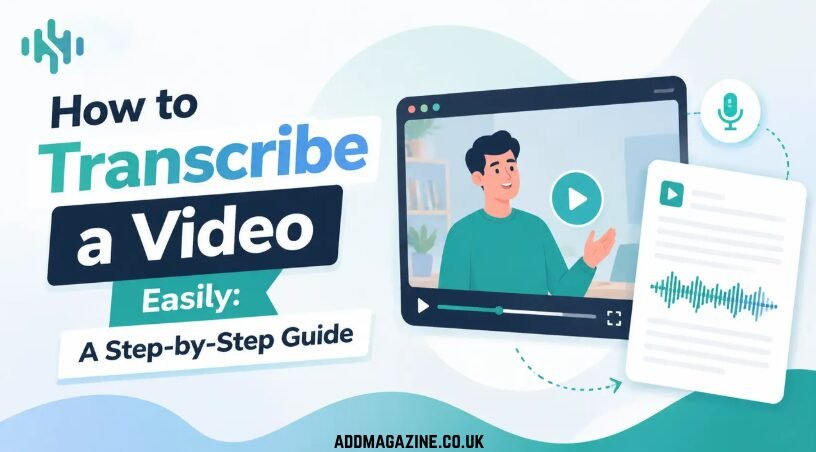
The text on a clip is what you want, but every time the player pauses, you have to press your eyes to the keyboard and start making some entries and it takes too long to get some of that text now. Fortunately, this way of working – which takes a lot of time – is no longer necessary. From a creator to a student to a marketer, this guide demonstrates how to easily transcribe a video.
The next part of the article focuses on the high powered Artificial Intelligence tools, the free hidden features and the exact manual strategies to convert any media to text. This information helps to save energy and the workflow as a whole, too.
3 Things to Consider Before Transcribing
Just a few moments of examining some key factors can save a lot of time, and get you on the right track to finding the most effective solution to convert video to text.
- Budget and Timeline Constraints: Manual transcription ok if time is no constraint, budget is. However, if it is time then an automatic software that would provide results in a few minutes would be better suited.
- Accuracy Requirements: Human Editors are extremely important in highly sensitive settings, like legal activities and problems or high essential meetings, where accuracy is crucial. However, if you’re publishing a work on social media or just rough draft podcasts, this usually only requires the basic accuracy that the automated engines provide.
- Source Video Conditions: They have limitations and will not process a source video if there is too much background noise, cross talking, or captions not working.
This knowledge of these basic conditions can create a seamless transition between the set-up basics and the operational parameters for each possibility.
Method 1: How to Transcribe Video Manually
In a typical case, someone would hear the video and manually type out everything he hears. However, it will take a longer time and more effort, but grant you complete control over the text that will be generated. Legacy accuracy is still prevalent in legal practices/cords, medical records, academic work and many other professions where precision is all-important.
While it’s an admirable project to try and do a manual transcription, having a structured workflow can help you become more efficient and accurate.
Step 1. You watch the video once for a first impression of the video content and/or unfamiliar word usage.
Step 2. The second pass is the same, but you take sips of the video and pause every 15-30 seconds to type everything that is being said.
Step 3. As you type, you add punctuation, capitalization and speaker labels to maintain clarity and organization in the transcript.
Tip: If writing by hand, use a foot pedal so you don’t have to make a lot of distractions during working or choose to use a software that supports using keyboard shortcuts, be it on a global scale or not.
Method 2: Convert Videos into Text Instantly with AI Technology
All attempts that surround real-time video to text conversion tools powered by AI. However, if you need a long recording or transcripts of a considerable amount of information, it is better to use an AI transcriber. In such systems it is possible to achieve a very high level of accuracy even where the linguistic setting of the test sheets or the background noise are different, so that no time is needed for dictation transcription.
Basic ones can be a testing ground for complex scenarios with combined languages or several players. A particular platform, such as Hoocs, supplies an overall answer that handles these specific functions difficulties:
- Speaker Diarization and Language Support: It’s easy to analyze multilingual conversations, tag each speaker in interviews with the platform and utilizes over 130 languages.
- Timestamping and Subtitle Generation: System’s generates accurate text association with audio. Professional SRT files can be exported directly by video makers − no manual alignment required.
- Flexible Input and Export Options: Links to YouTube content or Google Drive can be pasted directly from YouTube or Google Drive without downloading the files first. The software will conveniently accommodate standard media formats such as MP4, MOV and MP3, output forms include Word, PDF, TXT and SRT.
Also, it automatically produces instant summaries and key action points. Automated solutions such as Hoocs complete the entire workflow in a short period of time so that professionals can concentrate on the main activities. For now, the bandwidth for testing is provided for free for 300 minutes.
Step 2: Sign up or log in to your Hoocs account, you will have access to the transcription features.
Step 3: Translate Text and speech recognition (this option to translate text and enable speaker recognition can optionally be included depending on the type of video you want to transcribe).
Step 4: Once the process is completed, and after the summaries and mind maps have been produced, revise or translate the text; optionally switch on/off the timestables by means of the buttons.
Step 5: Export finished text as PDF, DOCX or SRT as per requirement.
Method 3: How to Extract Text From a YouTube Video for Free
If the video you want to extract text from is already available at YouTube, there is a totally no-cost feature built right into YouTube that can enable you to obtain the text. The platform uses an automatic speech recognition service for creating transcripts of content as long as the user designing the content has provided captioning.
- Formatting Issues: The output text is unpunctuated, and it breaks lines randomly depending on how fast people speak, which means it must be massively rewritten from it in word processors.
- No Speaker Separation: Companda synopsizes all the spoken audio and it becomes hard to tell who said what and when in a conversation.
- Audio Dependency: If the background noise is loud, the accent is difficult to hear or if it is very recent content, then the system may not be able to create captions.
How to get a transcript of YouTube videos on desktop
With a few easy steps you can help you get the transcript of any video that you view on YouTube directly on your desktop browser.
Step 1: Go to YouTube via your browser and enter the video’s name.
Step 2: Click on the link and a description will appear under the video player, and will expand when you click on More.
Step 3: Click on the “Show Transcript” link and the transcript will display on the right side of the screen.
Step 4: Make a toggle between turning on and off the timeline or turn them on and off as needed before copying to a document.
Getting the text of YouTube content on your cell phone
Knowing how to record your desktop video, watch the next information about how you can record a YouTube video from your cell phone.
Step 1: Go to the YouTube app on your mobile, and type in the name of the video you want.
Step 2: Play the video and then click on the ‘Expand description’ link under the video name.
Step 3: Scroll down and select the checkbox to show/hide the Timestamps.
Step 4: If it’s easy to copy or download the full text, use a mobile browser to request the desktop version of the text, otherwise look at the text on the screen.
Manual vs. AI vs. YouTube: Which Transcription Method Is Best?
| Comparison Factors | Manual Transcription | AI Transcriber(e.g. Hoocs) | YouTube Built-in Tool |
| Financial Cost | High if outsourcing; Free if done personally | Low subscription fees; Free trial available | Completely free |
| Delivery Speed | Slow; Often takes hours or days | Extremely fast; processes files in minutes | Instantaneous once processed by the platform |
| Accuracy Rate | High; Reaches up to 99% with human editing | High; Consistently achieves 90% or more | Moderate; Dependent on audio clarity |
| Technical Jargon | Excellent; Human research specialized terms | Strong; Advanced vocabulary recognition | Weak; Often misinterprets industry terminology |
| Language Support | Limited by the individual transcriber | Extensive; Often covers over 130 languages | Moderate; Supports major global languages |
| Post Editing Effort | Minimal; Text is fully formatted and polished | Low to moderate; Requires quick formatting checks | High; Lacks punctuation and proper line breaks |
| Best Scenario | Legal, medical, and high-stakes corporate files | Interviews, podcasts, and fast content creation | Casual viewing and basic online learning clips |
Conclusion
The best option of transcribing a video is subjective based on your complete situation and accuracy needs. A manual transcriber makes sure to get it right and YouTube has free access but if speed and quality are on par, it’s an AI transcriber. If you don’t know which path will best suit your needs for your project, try out Hoocs; there is currently 300 minutes of free transcription time to help you get started quickly.