The “Bro Split” is a widely recognized workout routine used by bodybuilders and fitness enthusiasts worldwide. But, can anyone do a bro split? This is a common question asked by beginners, intermediate lifters, and even some advanced athletes. In this article, we will explore the effectiveness, pros, cons, and considerations of the bro split routine to determine if it’s suitable for everyone.
What is a Bro Split?
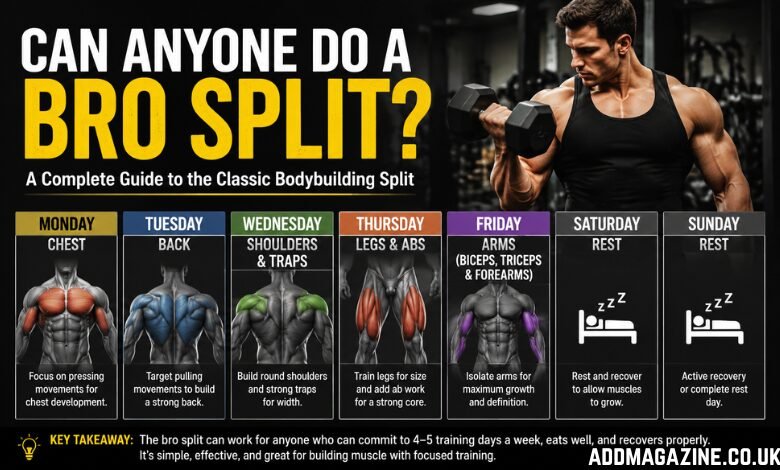
A bro split is a type of bodybuilding workout where each day of the week is dedicated to training a specific muscle group. The idea is simple: by focusing on one muscle group per workout, individuals can dedicate their full attention and energy to maximizing growth for that muscle. For example, a traditional bro split may look like this:
- Monday: Chest
- Tuesday: Back
- Wednesday: Shoulders and Traps
- Thursday: Legs and Abs
- Friday: Arms (Biceps, Triceps, and Forearms)
- Saturday: Rest
- Sunday: Rest or Active Recovery (Cardio/Core Work)
This type of training splits the body into separate days, allowing for focused and targeted muscle development. But how effective is it? Can it be used by everyone, including beginners?
The Pros of a Bro Split
The bro split is known for its simplicity and effectiveness for building muscle mass. Some of the key advantages of the bro split include:
- Focus on One Muscle Group at a Time: This routine allows you to give complete focus to one muscle group. This is ideal for advanced lifters who require more volume and intensity for specific muscles.
- Easy to Follow: The bro split is easy to follow, especially for beginners, as it provides a clear, structured approach to training. With rest days strategically placed, it ensures adequate recovery for the muscles worked earlier in the week.
- Good for Muscle Growth: When done correctly, with appropriate volume and intensity, the bro split can result in significant muscle hypertrophy (muscle growth). It works well for people aiming for size rather than strength.
The Cons of a Bro Split
Despite its popularity, the bro split has faced its fair share of criticism. Some of the main drawbacks include:
- Low Training Frequency: One of the most frequent criticisms of the bro split is that it only targets each muscle group once per week. Research suggests that hitting a muscle group 2-3 times per week may be more effective for muscle growth, as muscle protein synthesis peaks within 36 hours after training. By training each muscle group once, you may be limiting potential growth. A study published in the Journal of Strength and Conditioning Research concluded that high-frequency training did not necessarily provide greater hypertrophy or strength than lower-frequency routines, as long as volume and intensity were matched. However, some athletes find that training each muscle group more frequently enhances their results.
- Lack of Balance for Strength Gains: While the bro split works well for muscle growth, it might not be the best approach for strength-focused goals. Strength training often requires more frequent practice of compound lifts, which are generally done in full-body routines or with other splits that hit each muscle group more often.
- Not Ideal for Beginners: For those new to weightlifting, the bro split might not be the best choice. Beginners typically benefit more from full-body workouts, which offer more frequency and consistency in muscle activation. A full-body routine helps beginners build a foundation of strength and muscle endurance across the entire body, which is crucial for proper form and overall fitness.
Can Anyone Do a Bro Split?
Now that we’ve looked at the pros and cons, let’s address the big question: Can anyone do a bro split? The answer depends on a variety of factors, such as your training experience, fitness goals, and personal preferences.
- Beginners: For beginners, a bro split might not be the ideal approach. New lifters typically see faster progress with full-body workouts or push-pull-legs (PPL) splits, which allow them to train each muscle group multiple times a week. These types of routines help improve overall strength, endurance, and movement patterns, which are necessary for a solid foundation before moving to more advanced training splits like the bro split. The bro split can be too intense for beginners, as it requires a higher level of focus, recovery, and volume than they might be able to handle.
- Intermediate Lifters: If you’re an intermediate lifter, the bro split can be an excellent choice. At this stage, your body has already adapted to basic exercises, and you’re likely looking for ways to build muscle mass. With the right balance of intensity, volume, and recovery, the bro split can help you achieve your muscle-building goals effectively. It provides a focused approach that lets you dedicate an entire workout to a single muscle group.
- Advanced Lifters: Advanced bodybuilders and athletes who are looking to specialize or improve muscle size may find the bro split beneficial. Since these individuals are already quite muscular, their muscles require more recovery time. The bro split allows them to dedicate enough time to each muscle group while still providing sufficient rest. However, advanced athletes may also combine the bro split with other training techniques, such as high-frequency training, to optimize their results.
The Science Behind a Bro Split
There are several theories as to why a bro split works well for muscle growth:
- Muscle Protein Synthesis: Muscle protein synthesis is a critical process for muscle repair and growth. When you perform resistance training, the muscle fibers are damaged, and protein synthesis is activated to repair and grow the muscle. The bro split allows muscle groups to recover completely before they are worked again, theoretically optimizing muscle protein synthesis for each muscle group.
- Volume and Intensity: The bro split routine allows for higher training volumes on each muscle group. For example, during a chest day, you might perform 4-5 different chest exercises, which increases the overall volume for that muscle. Research suggests that high-volume training, when combined with proper recovery, can contribute to muscle hypertrophy.
- Recovery: The bro split ensures adequate recovery for each muscle group, which is essential for long-term muscle growth. By targeting each muscle group once a week, you’re allowing your body enough time to recover before training that muscle again. For many advanced lifters, this recovery period is necessary to continue making gains.
Is Bro Split Better than Other Training Routines?
The effectiveness of the bro split can vary depending on your specific goals. Let’s compare it to other popular training splits:
- Push-Pull-Legs (PPL): The PPL split is one of the most popular alternatives to the bro split. Unlike the bro split, which focuses on one muscle group per day, the PPL routine alternates between pushing movements (chest, shoulders, triceps), pulling movements (back, biceps), and legs. This routine allows you to hit each muscle group twice a week, providing more frequency and better overall balance. For individuals seeking strength and hypertrophy, PPL is often seen as a more balanced option.
- Full-Body Split: In full-body training, all major muscle groups are targeted in each workout. This routine is typically performed 3 times a week, with rest days in between. Full-body routines are great for beginners and those looking for general fitness and strength. They can also help optimize muscle growth by increasing frequency and targeting muscles more often. However, full-body workouts may not provide enough focus on individual muscles for advanced bodybuilders.
- Upper-Lower Split: The upper-lower split is similar to the PPL split but focuses on training the upper body on one day and the lower body on another. This split allows you to train each muscle group twice a week, which is beneficial for muscle growth and strength development. For those who want to train more frequently but don’t have time for a full-body workout, this split is a good option.
Adjusting the Bro Split to Fit Your Needs
While the bro split is effective for muscle growth and bodybuilding, it’s essential to tailor it to suit your needs, preferences, and schedule. Here are some ways you can modify the bro split to maximize its benefits:
1. Adjusting for Training Experience
If you’re a beginner, you might find it difficult to maintain intensity throughout the week with the bro split, especially if you’re not accustomed to high training volumes. In this case, it’s recommended to use a modified version of the bro split. You can start by reducing the overall volume (number of sets) or choosing compound exercises that engage multiple muscle groups simultaneously.
Intermediate and advanced lifters can benefit from the full bro split with high volume. They have already built a solid foundation and are capable of handling more frequent training of specific muscle groups, and can thus maximize hypertrophy by performing higher-intensity workouts.
2. Incorporating Active Recovery
While traditional bro splits usually reserve rest days on Saturdays and Sundays, you can modify the schedule by incorporating active recovery or cardio on your rest days. Active recovery can be a low-intensity exercise such as walking, swimming, or stretching, which keeps blood flowing to your muscles and aids recovery without taxing the body.
Some athletes also use this time to focus on mobility exercises or work on weak points. Incorporating yoga or foam rolling into your rest days can improve flexibility, reduce muscle tightness, and speed up recovery.
3. Volume and Intensity Adjustments
As your fitness level progresses, you may find that the initial bro split routine doesn’t provide the same intensity or volume you need. To address this, you can increase the number of sets and reps for specific exercises, or incorporate advanced training techniques such as drop sets, supersets, and pyramid sets.
For example, on Chest Day, you might start with a flat barbell bench press, followed by an incline dumbbell press, and finish with some plyometric push-ups or cable flyes for a higher volume workout. By alternating between heavy, compound exercises and lighter, isolation exercises, you can vary the intensity to better stimulate muscle growth.
4. Tailoring the Bro Split for Weak Points
One of the main benefits of the bro split is the ability to dedicate an entire session to a specific muscle group. This allows you to tailor your training to your weakest points. For example, if your arms are a weak point, you could spend extra time on Biceps and Triceps Day, incorporating additional exercises to give them more attention.
Another option is to “bring up” lagging body parts by adding a second day for that muscle group. For example, if your chest is lagging, you might add another chest-focused exercise to your routine on another day or even use part of your back day to focus on compound lifts that also target the chest.
5. Considering Alternative Splits
While the bro split is effective for many, it’s important to note that it’s not the only split available. As mentioned previously, alternatives like the Push-Pull-Legs (PPL) split, full-body split, and upper-lower split can provide more frequency and flexibility for individuals seeking balanced muscle development.
If your primary goal is strength and functional fitness rather than just muscle growth, you may want to consider a PPL split or full-body training routine. These routines offer a better balance of frequency, volume, and recovery. Additionally, these alternatives often provide more variety, keeping your workouts engaging and less prone to plateauing.
6. Keeping Progress in Mind
As with any workout routine, the bro split should be treated as a dynamic system that you tweak and adjust over time. If you’re not progressing or if you’ve hit a plateau, it’s essential to reassess your training program. This could mean varying your exercises, changing the rep ranges, adjusting the weight, or even considering an entirely new approach such as incorporating more compound movements.
Rest is also a key element of the bro split. If you find yourself not recovering properly, it could be a sign that you’re overtraining or need to take a deload week. Always listen to your body and ensure you are giving your muscles time to recover and rebuild.
Is the Bro Split Worth It for You?
Ultimately, whether the bro split is the best option for you depends on a few factors:
- Your Goals: If your goal is to build muscle size and you enjoy training one muscle group per day with focused intensity, then the bro split could work well for you. It’s an excellent option for bodybuilders or those with an interest in hypertrophy training.
- Your Experience Level: Beginners may benefit more from full-body or push-pull-legs splits to build foundational strength and muscle endurance. Advanced lifters can handle the intensity and recovery demands of a bro split and might find it more beneficial in terms of hypertrophy.
- Time Commitment: The bro split requires a significant time commitment, generally requiring 4-5 training days per week. If you can commit to that frequency and the volume of work, the bro split can be a good fit. However, if you can only train 2-3 times per week, other routines such as full-body workouts may suit you better.
- Recovery Ability: Muscle growth requires adequate recovery, and the bro split allows for dedicated rest days for each muscle group. However, if you’re not recovering properly between workouts or feel fatigued, you may need to adjust the volume or take more rest days.
Conclusion
So, can anyone do a bro split? The answer is yes, but it depends on the individual’s goals, fitness level, and available training time. For beginners, the bro split might not be the best starting point; however, for intermediate and advanced lifters who are focused on muscle hypertrophy and recovery, the bro split can be an effective and manageable approach. It’s important to listen to your body, experiment with different training splits, and find what works best for your personal fitness goals.
In the end, the bro split is a tried-and-true method for building muscle and strength, but it’s not a one-size-fits-all approach. Make sure you assess your personal needs and adjust your workout plan accordingly to achieve the best results.